
How to Crochet Easter Eggs
Crochet Easter eggs with a surprise pocket inside: the smooth egg shaping, colour changes for stripes and speckles, and filling them for the hunt.

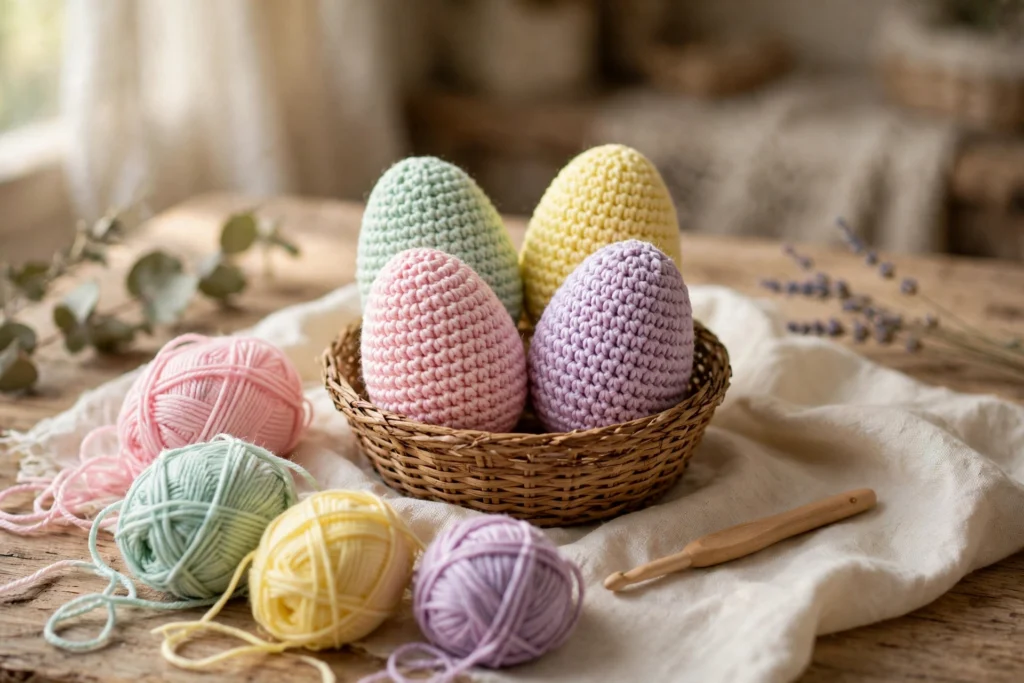
There are two kinds of crochet Easter egg. The first kind sits in a bowl looking pretty. The second kind — this kind — opens up and hides something: a chocolate egg, a folded note, a tiny chick if you make this batch’s companion project. Little Crochet Farm’s surprise egg is the pattern I reach for every spring, because the shaping is genuinely smooth, the pocket version needs no sewing beyond closing part of the seam, and a bowlful of them in pastels is the whole of Easter decorating done.
Jump to section
What follows is the method with my notes on stripes, speckles and sizing — including how to scale the egg up for a proper chocolate egg and down for egg-cosies and garlands.

Why the egg shape works
An egg is just a sphere that kept growing at one end, and the pattern exploits that: a magic-ring start, even increases to the widest round, a few plain rounds that drift the width gently upward, then decreases that taper faster at the top than they did at the bottom. Get the order right — wide end down, point end up — and the thing stands on a table without wobbling, which matters when it is holding chocolate. If your spheres have ever come out as lemons, the fault is usually decreasing too evenly; eggs want a lazy bottom and a decisive top.
how to crochet a magic ring is the start every amigurumi egg needs — a ring that pulls fully closed leaves no hole for stuffing or sweets to escape through.
What you need
- DK or worsted cotton or acrylic yarn in pastels: pink, mint, lemon, lilac, sky
- A hook one size smaller than the yarn suggests, for dense fabric
- Toy stuffing for the solid version; nothing but a chocolate egg for the pocket version
- Stitch marker — egg shaping is counted, and counting is not optional
- Yarn needle and scissors
- Optional: a second colour for stripes, and brown or cream for speckles
The shaping, round by round
Work in a continuous spiral and mark the first stitch of every round; eggs punish drifted counts more visibly than most amigurumi because the silhouette is the entire point. Increase evenly to the pattern’s widest round — spread the increases so they do not stack into seams — then work plain rounds to build the height. The taper at the top uses invisible decreases, which sit flatter than standard ones and keep the point smooth. Stuff the solid version firmly but not heroically: an overstuffed egg bulges at the wide end and rocks. The pocket version is worked as two pieces — a bottom cup and a top cap — so the egg opens; leave both unstuffed and let the chocolate do the filling.
Stripes, speckles and colour stories
Change colour on the last yarn-over of the stitch before the new round and stripes stay jogless. Two rounds of colour, two of cream is the painted-egg classic; a single band at the widest point looks like ribbon. Speckles are embroidered afterwards — short straight stitches in chocolate brown, scattered unevenly on purpose — and they turn a plain pastel egg into a mini egg, which is the bowl I put on my own table. Pastels are the tradition, but a set in cream and terracotta with brown speckle looks like speckled farm eggs and stays out on display long after Easter. For more small-motif colour play, the easy crochet heart uses the same scrap-friendly logic.
Sizing: cosies, hunt eggs and the big one
The written size fits a chocolate egg or a handful of mini eggs. To scale, hold the yarn double and go up two hook sizes for a display egg the size of a goose egg, or drop to 4-ply and a 2.5mm hook for egg cosies that sit on boiled eggs at the Easter breakfast table — the cosies want the pocket construction with a wider opening. A string of the smallest size, joined with a chain between each, makes a garland for the mantel; crochet snowflake ornaments taught a lot of readers the hanging-loop finish that works here too: chain ten at the point before fastening off.
Filling and hiding: making the hunt fair
Chocolate eggs are the obvious filling, but the pocket also takes a folded scavenger clue, a tiny crochet heart, a coin, or — for the adults’ hunt my family now insists on — a miniature bottle’s worth of dignity and a promise of washing-up exemption. Close pocket eggs with two or three loose stitches of matching yarn or a small ribbon bow so little hands can open them without a fight. Number the eggs with embroidered stitches if your hunt has rules about one-per-person; in my house it does not, and the bowl empties accordingly.
Storing them for next year
Crochet eggs keep beautifully: shake them out, store them dry in a box with the other Easter things, and they will come out next spring needing nothing but a palm-roll to restore the shape. Keep the pocket eggs unstuffed and flat-packed if storage is tight — they re-inflate around their chocolate in seconds.
Frequently asked questions
Why does my egg lean or wobble?
Usually the increases have stacked in a spiral seam, pushing one side out, or the stuffing settled unevenly. Rotate your increase positions each round — start the round’s increases a few stitches later every time — and roll the finished egg firmly between your palms to settle the stuffing before judging it.
Can beginners make the surprise pocket version?
Yes — it is two simple shaped pieces and no new stitches. The one skill to practise first is the invisible decrease, because the cap’s taper shows every irregularity. Make one solid egg first to learn the shaping with stuffing to hide behind, then make the pocket pair.
What yarn gives the smoothest eggs?
A smooth cotton or cotton-blend in DK, worked a hook size down, gives the crispest silhouette and takes embroidered speckle beautifully. Fluffy or haloed yarn hides the shape and the stripes; save it for the chick in this batch, who is supposed to look soft.




