
Crochet Easter Chick in a Surprise Egg
A crochet Easter chick that pops out of its own surprise egg: one tiny amigurumi, two makes in one, and the face placement that makes it irresistible.

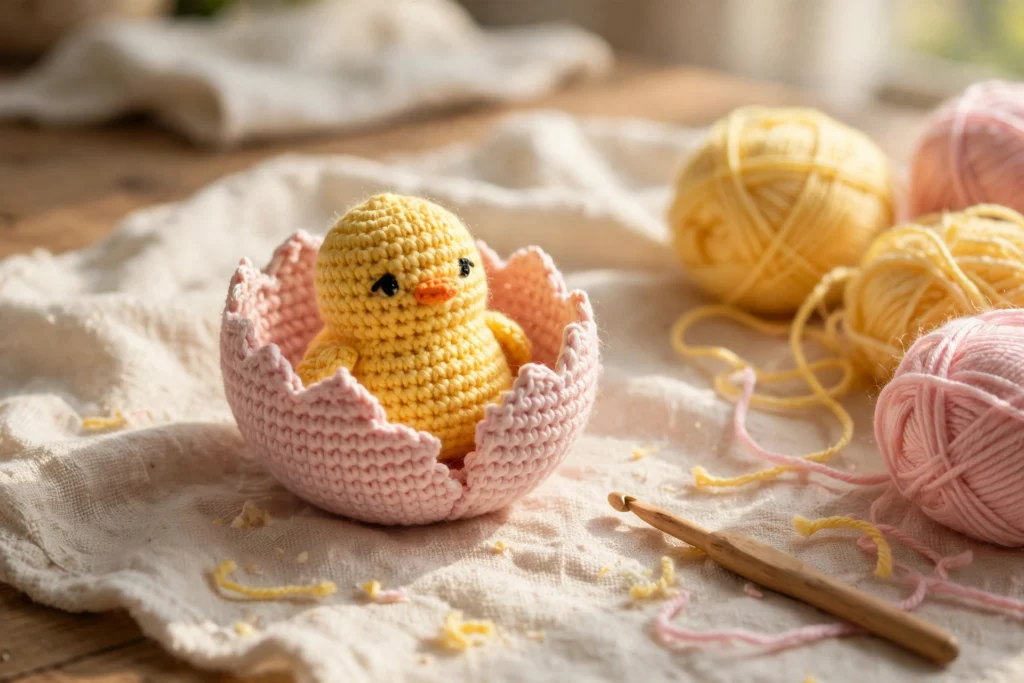
Every Easter table needs a moment that makes people say “oh, stop it” out loud, and this year it is a tiny yellow chick sitting inside the bottom half of its own crocheted eggshell, looking pleased with itself. Little Crochet Farm designed the chick and the surprise egg as a pair — the same egg family as this batch’s crochet Easter eggs, scaled so the chick fits inside — and together they are two makes that behave like one very good joke.
Jump to section
The chick itself is a gentle amigurumi: a round body, a smaller head worked in the same piece, a beak you can embroider or crochet, and a tuft. What follows is the method, the face-placement rules that decide whether your chick looks adorable or alarmed, and how to size the shell so the chick actually sits in it.

One chick, two makes
Make the chick alone and it is a sweet palm-sized toy. Make the egg alone and it is this batch’s surprise egg. Make both and the chick lives inside the egg: cap on, it is an egg in the bowl; cap off, it is hatching. Children understand the mechanism instantly and adults pretend not to care and then ask you to do it again. The pair also gift beautifully — the chick travels inside its egg, so nothing gets squashed in a card envelope’s journey through the post.
our crochet mini ghost amigurumi is the closest relative in the back catalogue: same one-piece body logic, same face rules, different season entirely.
What you need
- Yellow DK yarn for the chick — a soft acrylic or cotton blend
- A small amount of orange for the beak, pastel for the shell
- A hook one size down from the yarn band, for dense amigurumi fabric
- Toy stuffing, a small amount
- Black yarn or embroidery thread for eyes (the baby-safe choice), or 4mm safety eyes
- Stitch marker, yarn needle, scissors
The body: shaping a chick
The chick is worked from the bottom up in one piece: a sphere that narrows at the neck round — a single round of decreases — then swells again for the head before closing. That neck pinch is the entire secret of the silhouette; skip it and you have a lemon with a beak. Stuff the body firmly, the head a little less, and stuff before the closing rounds get small. The tuft is three chain loops worked into the final round or stitched on after: two loops looks surprised, three looks cheerful. Wings, if you want them, are two small flattened circles stitched at the sides at a slight angle — angled down for sleepy, up for startled. Choose sleepy; Easter is tiring.
The face: placement is everything
Amigurumi faces are won or lost on two decisions. Eyes sit lower and wider than instinct suggests — around the middle of the head, spaced roughly a third of the head’s width apart — because high, close eyes read as worried. The beak goes directly between and just below the eye line: a small orange triangle, either a tiny crocheted cone flattened and stitched, or three embroidery stitches in a diamond. Add the faintest pink cheek dots if your chick is for a child, and pin everything before you stitch anything. the magic ring start matters here too — the chick’s bottom is its sitting base, and a holey start makes a chick that leaks stuffing and dignity.
The shell: sizing so the chick fits
The shell is the bottom portion of the surprise egg pattern, stopped early and finished with a zigzag round — alternating taller and shorter stitches — so the rim looks cracked. The one measurement that matters: the shell’s widest round must be a few stitches wider than the chick’s widest round, or the chick wedges instead of nestling. Make the chick first, measure it honestly, and work the shell to fit the bird you actually made rather than the one in the photograph. A cap in the same pastel, made from the egg’s top section, completes the hiding trick for the egg hunt.
Gifting, hunting and photographing
For the hunt, hide the closed egg among the plain ones and let the finder discover the passenger — it becomes the prize egg without any extra spending. For gifting, the chick-in-egg is the rare handmade present that fits in a coat pocket and survives being sat on. For photographs, sit the chick in the shell on a saucer with a little shredded tissue as a nest; natural light, no flash, and the tuft does the rest. If chicks multiply — they do — a row of them in different pastel shells covers an Easter table completely, and easy crochet gift ideas has the wrapping treatments I use for small makes like these.
Making a whole clutch
One chick is a gift; five chicks are a centrepiece. Vary the shell colours, tilt a couple of heads by stitching them at a slight angle, and let one chick sit outside its shell altogether as if it hatched first and is showing off. The whole clutch takes a weekend and most of a ball of yellow.
Frequently asked questions
Is this chick suitable for a baby?
With embroidered eyes and securely stitched features, yes — that is exactly why the pattern offers the embroidered version. Skip safety eyes, sew the beak and tuft with extra passes, and use a yarn you can wash, because the chick will be chewed. Check seams before gifting, as with any handmade toy.
My chick’s head flops. How do I fix it?
The neck round needs stuffing discipline: pack the body well, add a small extra pinch of stuffing right at the neck before the head rounds, and make sure the decrease round at the neck is worked firmly. A floppy head on an existing chick can be firmed by ladder-stitching a discreet ring around the neck to cinch it slightly.
How long does the chick and egg take?
The chick is an evening’s make — about two hours at a comfortable pace with the television on. The shell adds forty minutes. A whole row for the table is a weekend project, and most of that time is the pleasant kind, not the counting kind.




