
How to Crochet a Daffodil
Crochet a daffodil for spring: the six-petal star, the trumpet cup with its frilled edge, wired stems, and turning one flower into a March vase.

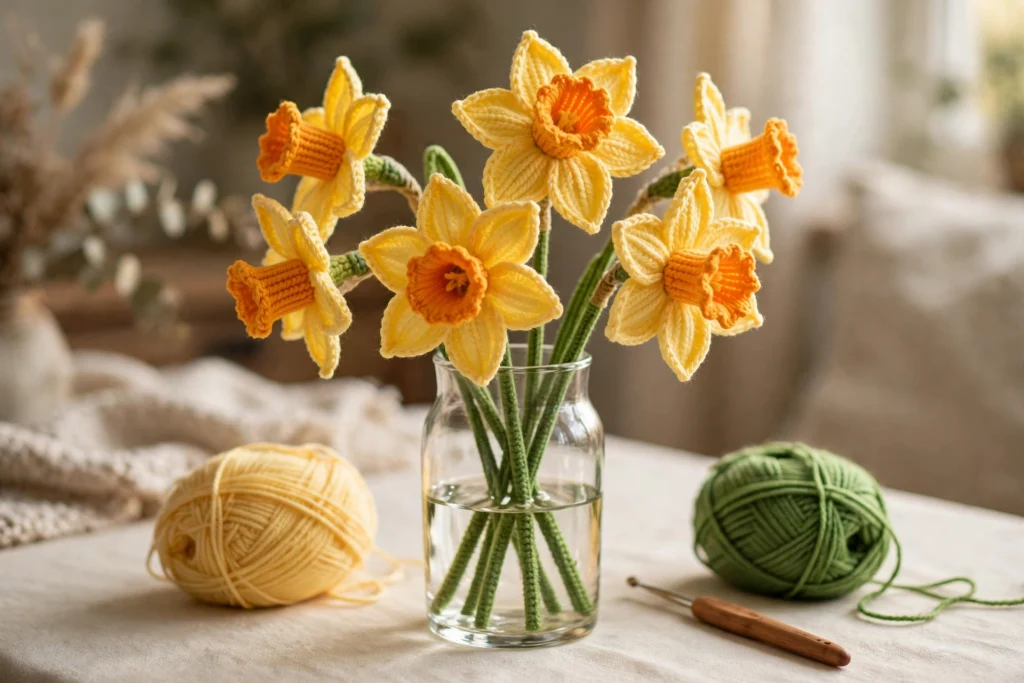
The daffodil is March in flower form: it comes up through cold ground, it does not care that winter is not finished, and a vase of them on the table is a promise. LilyRosy’s crochet version — part of her birth-month flower series, the daffodil being March’s — gets the anatomy right in a way most crochet daffodils don’t: a proper six-point petal star lying nearly flat, and that frilled trumpet standing proud in the centre. It is the flower I would teach after this series’ tulip, and the two of them in one vase is spring arriving in yarn.
Jump to section
What follows is the construction with my notes on the trumpet join, stems that actually hold a flower head up, and turning one bloom into a vaseful — plus the colour notes for the white and orange narcissi that grow alongside the classic yellow.

Anatomy of a yarn daffodil
A real daffodil is two structures wearing one name. Behind: six flat petals — botanically a perianth — arranged in a star. In front: the corona, the trumpet, a tube with a flared, frilled mouth. Crochet versions fail when the two are blurred into a generic flower with a bump. This pattern keeps them separate and joins them late, which is why it reads as daffodil from across the room. Work the petal star first in your main yellow, the trumpet second in the same yellow or a deeper gold-orange, and assemble with the stem so the flower faces slightly downward, the way real daffodils nod.
how to crochet a flower is the flat five-petal foundation this builds on — if petals are new to you, one evening there first will make the daffodil’s star feel easy.
What you need
- DK cotton yarn in daffodil yellow, a deeper gold or orange for the trumpet, and green for stem and leaf
- A 3mm or 3.5mm hook
- Florist wire or a thin skewer for the stem core
- A small amount of stuffing or yarn scraps for the trumpet join
- Yarn needle, scissors, and pliers if you are bending wire ends
The petal star
Six pointed petals worked around a small centre ring, each petal shaped with a chain up, stitches down the other side, and a picot or a slip-stitch point at the tip. The two things that keep the star crisp: work the petals in a yarn with no halo — cotton shows every point — and block the finished star for ten minutes under a damp cloth with the points pulled gently outward. Daffodil petals sweep slightly backward on a real flower; a light press with the points angled back sells the likeness more than any extra round would. If your points curl, the hook is a touch small for your tension; go up half a size rather than fighting it.
The trumpet, and that frilled edge
The corona is a short tube: a ring of stitches worked in rounds, plain for its length, then a final round worked two or three stitches into each stitch so the mouth flares and frills at once. That flare round is the whole performance — too few increases and the trumpet looks like a thimble; too many and it frills into a tutu. Follow the pattern’s count exactly the first time. Join trumpet to star by stitching through the star’s centre into the tube’s base, a few firm stitches, and hide the join with the stem assembly. The tutorial’s order — petals, trumpet, join, then stem — keeps every seam at the back where the leaf will cover it.
Stems and the one long leaf
A daffodil stem has to hold a head that is heavier at the front, so give it a core: florist wire or a skewer wrapped tightly in green yarn, stitches or a spiral of yarn glued at intervals only if your wrapping slips. Bend the top centimetre of the stem forward so the flower nods. The leaf is one long strap of green worked in rows, shaped to a point, and attached low on the stem — daffodil leaves are strappy and grey-green, so a sage or grey-leaning green reads truer than grass green. how to crochet a leaf covers the strap-leaf shaping if you want to vary the length.
From one flower to a March vase
Three daffodils is a posy, five is a vase, seven is a statement. Vary the stem lengths by two or three centimetres so the heads sit at different heights, and mix one white narcissus — white petals, orange trumpet — into a yellow bunch if your yarn stash allows; real March borders do exactly that. As a Mother’s Day alternative to the rose bouquet in this batch, a wrapped bunch of daffodils with a paper cone and twine is the cheerfuller gift, and the crochet daisy bookmark slips into the card as the small extra. Birth-month note for the card: daffodils are March’s flower, so for a March birthday this is not just a spring gift, it is the correct one.
Off the stem: appliqué and garlands
The flower head alone, made without wire or stem, is a motif worth having: stitched to cards and gift wrap, sewn along a spring garland with the eggs from this batch, or pinned as a brooch for a March birthday. Worked in white with an orange trumpet it becomes a narcissus, and a mixed strand of the two is prettier than either alone.
Frequently asked questions
Why does my trumpet collapse instead of standing?
The tube needs denser fabric than the petals: work it a hook size down, or add a discreet ring of stitches inside the base before joining. A tiny pinch of stuffing or a knot of scrap yarn pushed into the tube before assembly also holds the shape — the join to the petal star then keeps it there.
Can I make daffodils without wire?
For a flat use — appliqué on a card, a garland, a spring wreath — yes, skip the stem entirely and the flower is complete as a motif. For a vase, the wire is what makes the nod possible; a yarn-only stem will hold the flower upright for a photograph and give up by dinner.
Which cotton gives the crispest petals?
A mercerised DK cotton with a smooth, slightly shiny finish. It holds the picot points, resists the fuzz that blurs the star’s outline, and the colours — especially the yellows — stay clean rather than dusty. Save brushed and matte yarns for the leaves, where softness helps.




