
Crochet Rose Bouquet for Mother’s Day
A crochet rose bouquet for Mother's Day: beginner roses, leaves and stems, wrapping maths for five, seven or nine stems, and flowers that never wilt.

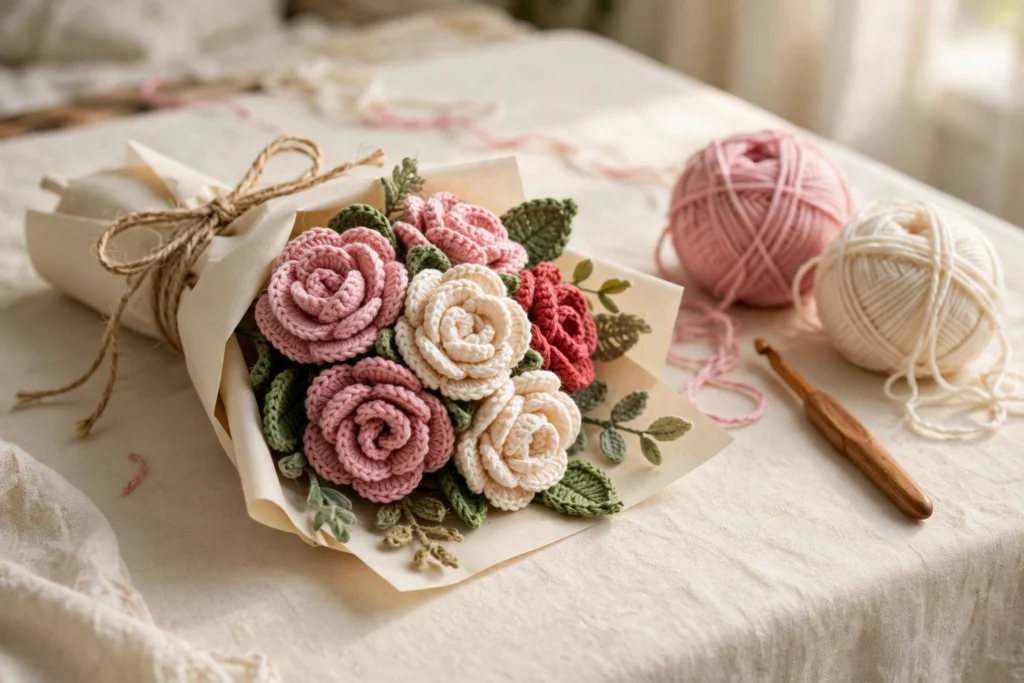
Flowers are the correct Mother’s Day present and also a small logistical tragedy: bought on Saturday, glorious on Sunday, compost by Thursday. A crochet rose bouquet skips the tragedy. Naztazia’s beginner rose — a strip of crochet rolled into a bloom — is the friendliest flower in this whole series, and a wrapped bunch of them, with proper leaves and stems, has fooled more than one visitor at my door into leaning in for a sniff.
Jump to section
What follows is the rose method, the leaf and stem construction that turns single flowers into a bouquet, the colour stories I would wrap for three different mothers, and the wrapping itself — because the paper and twine are half of why a bouquet reads as a bouquet.

The rolled rose: a strip that becomes a flower
This rose is not crocheted petal by petal. You work a strip — a foundation row with a wavy, scalloped top edge — and then roll it, tacking stitches as you go, and the scallops settle into rings of petals around a tight centre bud. The magic is in the roll: roll loosely and the rose opens flat like a garden rose; roll tightly and it stays a bud. Make one strip longer for the big central roses of the bouquet and shorter ones for the buds at the edge, and the arrangement grades itself. Practise the first rose with scrap yarn and unroll it twice — the third roll is the one your hands will remember.
how to crochet a flower is the flat-petal alternative in the back catalogue; the rolled rose is its fuller, more three-dimensional cousin.
What you need
- DK or worsted yarn in your rose colours — blush, cream and soft red is the classic trio
- Green yarn for leaves and stems
- A hook matched to the yarn for flowers; one size down for leaves
- Florist wire or skewers for stems, one per rose
- Kraft or cream paper and twine for wrapping
- Yarn needle and scissors
Leaves and stems: the supporting cast
A rose without leaves reads as a lollipop, so do not skip this section. Each stem wants one or two leaves: a pointed oval worked in rows, pinched at the base, either stitched to the stem or worked directly onto it as the tutorial shows. Stems are wire or skewers wrapped in green yarn from just under the bloom downward, with the leaf attached a third of the way down. Add a small green calyx — a star of five pointed stitches — under each bloom where it meets the stem; it hides the join, stops the head wobbling, and is the detail florists’ fakes always forget. how to crochet a leaf has the shaping variations if you want serrated or rounder leaves.
Colour stories for three mothers
Blush, cream and one soft red is the bouquet that suits the mother who grows roses herself. All cream with sage leaves is the calm, scandi version for the minimalist — wrap it in white paper and it could come from a Copenhagen florist. And dusty mauve with deep plum buds is the dramatic one, for the mother who wears black and red lipstick and would find pastels an insult. The rule underneath all three: no more than three flower colours, and let one of them be a near-neutral — cream, blush, or the palest pink — so the eye has somewhere to rest.
Assembling and wrapping the bouquet
Odd numbers, always: five stems is a posy, seven is a bouquet, nine is a declaration. Arrange with the largest rose at the centre front, buds toward the edges, stems crossed in a spiral in your hand — a spiral bunch fans the heads naturally and stands in a vase later without rearrangement. Bind the stems with twine at two points, then the paper: a square of kraft or cream, bouquet laid diagonally, corners folded in like a envelope, never taped tight. Finish with the twine bow at the binding point, tails left long. The wrapping should look like a florist did it in ninety seconds, because a florist did — the charm is in the economy.
Beyond Mother’s Day
The same bunch, recoloured, covers the year: deep reds for Valentine’s and anniversaries, whites for weddings — a crochet bridal bouquet is a keepsake no fresh arrangement can match — and a single stem as the year’s most reliable last-minute gift, because one rose still reads as a gesture. Left unstemmed, the blooms become brooches, hair clips and the centres of wreaths. And if your gift list runs longer than your evenings, easy crochet gift ideas is the list I plan my own December from.
Keeping yarn flowers looking fresh
Crochet roses do not wilt, but they do gather dust: a cool hairdryer blast or a gentle shake outdoors twice a year keeps them clean. Store a bouquet upright in its vase rather than flat — rolled petals relax over months in a drawer, and ten minutes of re-rolling by hand is the only refresh they will ever need.
Frequently asked questions
How many roses do I need for a bunch that looks generous?
Seven is the sweet spot for a hand-tied bouquet — enough to fan, few enough to finish in a weekend. Five works if the roses are large and the leaves generous; three is a posy and should be wrapped like one, in a smaller cone. Add leaves freely: foliage is what makes seven roses read as abundance.
My rolled roses keep unravelling at the base. Help?
Stitch as you roll, not after: two or three firm stitches through all layers at the base after every full turn. Then add the calyx star over the base and stitch through it once more — it locks the roll mechanically as well as hiding it. A dab of fabric glue inside the final wrap is the belt-and-braces option for gift bouquets.
Is this bouquet suitable for a complete beginner?
The rose itself, yes — it is chains and one repeated stitch pattern, and Naztazia’s tutorial is paced for beginners. The honest beginner plan: roses this week, leaves and stems next, wrapping the night before. Your first rose will be imperfect and your seventh will not be, and a bouquet is precisely seven chances to improve.




