
Crochet Butterfly: Easy Wings for Spring Makes
A crochet butterfly in ten minutes: one ring of petals, one fold, and a wrapped centre — plus the dozen places a flight of them likes to land.

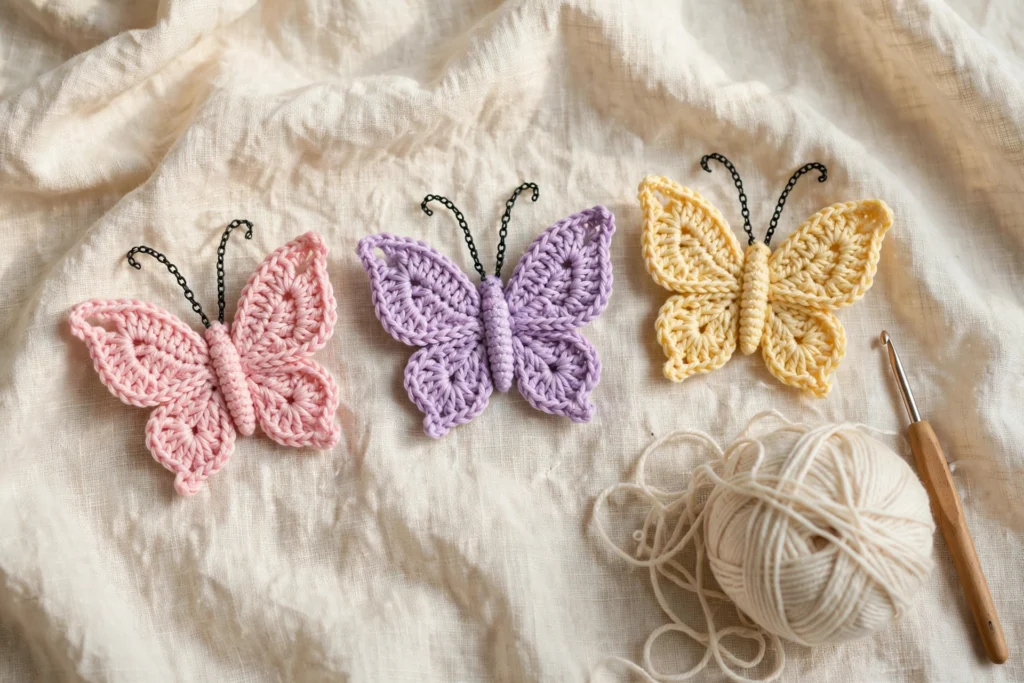
The fastest spring make in this house is also the one that travels furthest. A crochet butterfly takes two rounds, a fold and ten minutes, and then it refuses to stay in one place: it lands on hair clips, cards, garlands, gift wrap, the rim of a plant pot, the corner of a plain cushion that needed a note of spring. Make one and you will make twenty; this is your warning as much as your tutorial.
Jump to section
The version I work from is TunzaleCrochets’ beginner butterfly tutorial, which builds the whole insect from a single ring of stitches — no separate wings to sew, no body to assemble. What follows is that construction with my notes on yarn weight, colour and the dozen honest uses for a flight of them.

What you need
Scraps. That is the whole list: a few metres of yarn or crochet cotton, a hook that suits it, and a needle for the ends. Cotton thread at a 2mm hook gives you a butterfly of about five centimetres with lace manners; DK cotton at 3.5mm gives a bolder eight-centimetre insect for garlands and bags; chunky scraps give you a cushion appliqué in four minutes. However small the scrap bag, there is a butterfly in it — the project is the scrap bag’s revenge on every other project in this batch.
The construction: one ring, eight petals, one fold
The butterfly is crocheted flat, as a ring of eight petal groups — sets of tall stitches worked into a magic ring or chain circle, separated by chains. Worked in one colour it reads as a flower, which is exactly the point: the insect is a flower in disguise. Fold the ring in half, matching petal to petal, and the flower becomes four wings — two large above, two small below. A length of chain wrapped around the centre fold becomes the body and, extended and knotted at the ends, the antennae. Nothing is sewn; the fold and the wrap do all the engineering. If the fold is new to you, our how to crochet a flower tutorial teaches the petal ring it grows from — make one flower first and the butterfly is a five-minute sequel.
Colour: how a butterfly chooses
Real butterflies are either camouflaged or shameless, and the crocheted kind should pick a side. For the garden palette, work the ring in one spring colour and the centre wrap in a dark contrast — lilac with a charcoal body, butter yellow with brown, blush with plum. For the shameless version, change colour halfway around the ring so the folded wings come out two-toned, or work each petal group in the next pastel from the ball bag. Variegated yarn does the colour work for you and is the scrap bag’s gift to this pattern. One discipline: whatever the wings do, the body stays dark and plain, because the body is the line the eye reads the insect by.
Finishing: wings that hold
A butterfly straight off the hook is a relaxed creature; whether that suits you depends on its posting. For clips, cards and appliqué, leave it soft — it will be sewn or glued flat anyway. For garlands and mobiles, where the wings must hold their own in the air, block it: pin the folded butterfly out on a board, wings spread to the angle you want, mist with water or the lightest starch, and let it dry in position. The antennae are finished with a knot at each tip — an unknotted antenna unravels its dignity within a week — and a dab of clear glue on the knot is permitted, quietly, by everyone who has ever made two.
Where they land
Glue or stitch one to a plain hair clip and it is a spring hairpiece; sew a row along the edge of the basket in this batch and the Easter table is done. Thread a dozen through their centres onto a chain for a garland that weighs nothing and stores in an envelope; pin them along a curtain hem; stitch one to the corner of the bookmark from our crochet daisy bookmark and a plain gift becomes a wrapped intention. My own favourite is the plant pot: one butterfly on a florist’s wire among the leaves of a houseplant, in the company of the stems from our crochet snowdrops, is a whole spring garden at windowsill scale — and the only kind that has never once needed watering.
Sizing the flight
The pattern is one-size in method and every size in practice, because the yarn does the scaling. A 1.5mm hook and crochet thread give a three-centimetre butterfly for earring drops and card corners. A 3.5mm hook and DK cotton give the eight-centimetre garland standard. A 6mm hook and chunky yarn give a twenty-centimetre cushion appliqué that reads across a room. Nothing in the construction changes at any size — the petal groups simply grow — which makes the butterfly the rare pattern you can honestly cast on at any weight without a swatch, a gauge or a prayer.
Frequently asked questions
How long does one butterfly take?
About ten minutes at DK weight once the construction clicks — the first one takes twenty and teaches you everything. A flight of a dozen for a garland is a single evening with tea.
Why does my folded ring not look like a butterfly?
Usually the petal count: eight groups fold into four wings, six fold into a triangle that convinces nobody. Count the groups before the fold, and wrap the centre tightly — a loose wrap lets the wings splay back into a flower.
What is the best yarn for beginners?
DK cotton in a pale, solid colour. It shows every stitch clearly, holds the fold without blocking, and forgives the unpicking that the first butterfly always involves.




