
Crochet Lavender Sprigs: Purple Stems for the Spring Table
Crochet lavender sprigs for the spring table: dense purple bud heads, wired stems and narrow leaves — and why a bunch, not a sprig, is the unit.

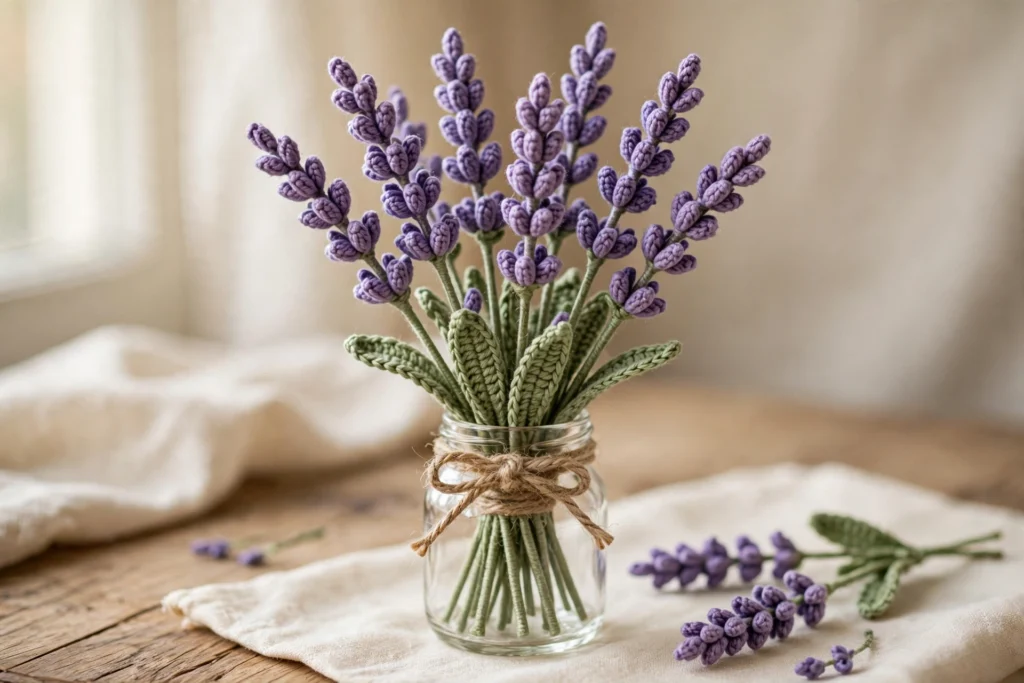
Every spring table deserves one stem that never wilts, and lavender is the stem I choose: a slim green column crowded with small purple buds, recognisable across a room, at home in a jam jar, a drawer, a posy or a wrapped parcel. Crochet lavender is also the flower tutorial that teaches the most per gram — bud construction, wired stems, leaves, assembly — in a project that fits in an envelope.
Jump to section
The tutorial I follow is ElyseCrochets’ beginner lavender, which builds the bud head stitch by stitch at a pace a first-timer can hold. What follows is that method with my notes on the bud density, the stem wire and the bunching, because a single sprig is a sample and a bunch is the point.

What you need
A small amount of purple yarn — lavender, lilac or the dusty mauve between them — green yarn for stem and leaves, florist’s wire or a thin garden cane per stem, florist’s tape or green thread for wrapping, and a 3mm or 3.5mm hook. Cotton gives the buds their crisp definition; acrylic works and is softer in the hand. The wire is not optional decoration: a lavender stem is tall and top-heavy by design, and it is the wire that lets it stand in a jar like it means it.
The bud head: density is realism
The head is a slim column of small clustered stitches — chains and slip-stitched or single-crocheted buds worked in spiralling rows around a short foundation, so the buds crowd over one another like the real flower’s. The realism of the whole sprig is decided here, in the density: buds packed tightly, with no green showing through the purple, read as lavender from across the room, while a sparse column reads as beads on a stick. Work the head over six to eight centimetres for a natural proportion, tapering the bud size slightly towards the tip, where the real flower’s youngest buds sit smaller and paler. A second, paler purple held for the last rounds gives that gradient for free.
The stem and the leaves
The stem is the wire, dressed: either wrapped in florist’s tape over a core of green yarn, or crocheted around directly with a round of single crochet over the wire itself — slower, and the better finish, because the covering can never unwind. Lavender leaves are long, narrow and few: work a foundation chain, single crochet back along it with a point at the tip, and attach two or three low on the stem, angled upward. Real lavender keeps its leaves modest and its flowers loud, so resist adding foliage with every round; a crowded stem looks like a herb, and the herb was not invited.
Assembly and the bunch
Join head to stem with the yarn tail and a few firm stitches, then wrap the join with tape or thread until it disappears into the stem’s green. One sprig is a bookmark with ambitions; the unit of lavender is the bunch. Five sprigs make a posy for a place setting, nine fill a jam jar honestly, and a dozen tied with twine is a gift that outlasts the occasion. Vary the head lengths by a centimetre or two inside the bunch — real stems never march in step — and fan the heads slightly rather than binding them into a lollipop. Keep any short stems that fail the jar’s height test; they are exactly the drawer and parcel stock the sprig does so well elsewhere. Our crochet rose bouquet teaches the wrapping and ribbon maths for a formal arrangement; lavender is its country cousin, tied not wrapped.
Lavender among its family
This site’s stemmed flowers now form a small dynasty, and lavender is its tallest member. The cup-shaped head of our crochet tulip tutorial taught the wired stem; the trumpet of our crochet daffodil tutorial taught the statement flower; lavender teaches the spray — many small units composed into one silhouette. Learn all three and you can build a spring vase that never needs water, arranging by height exactly as a florist does: daffodils for the face, tulips for the middle, lavender standing at the back giving everything else something to be photographed against. Add a drop of lavender oil to the jar’s rim, out of sight, and the illusion completes itself in the one sense yarn cannot reach.
Lavender beyond the vase
The sprig’s second career begins when the jar is full. Two sprigs tied with ribbon make the drawer and wardrobe version — the traditional linen-closet lavender, which wants a drop of oil at the bud bases once a season and then perfumes the sheets honestly. Three sprigs laid along a wrapped parcel replace the bow entirely. A single sprig sewn to a cushion corner carries the whole stemmed-flower idea into soft furnishings. None of these need the wire: work the lying-flat stems described in the questions below, on doubled yarn, and let them drape where they are put.
Frequently asked questions
How many sprigs make a convincing bunch?
Nine is the honest jarful; five tied as a posy reads deliberate rather than sparse. Odd numbers arrange better than even ones — the eye prefers them, and so do florists.
Can I make lavender without wire?
For lying-flat uses — drawer sprigs, card toppers, wreaths — yes: work the stem over a doubled strand of yarn and let it drape. For anything standing in a jar, wire is the difference between lavender and a purple lollipop.
What purple should I choose?
The dusty middle of the family flatters the flower most. Very pale lilac washes out at distance, and the darkest purples lose the bud detail; hold three shades together and take the one that still reads as a flower in the shade.




