
Crochet Cowl Tutorial: An Easy Neck Warmer for Deep Winter
A crochet cowl fills the coat gap a scarf keeps missing. Sizing for snug or slouchy, the anti-twist join, and stitches that actually block wind.

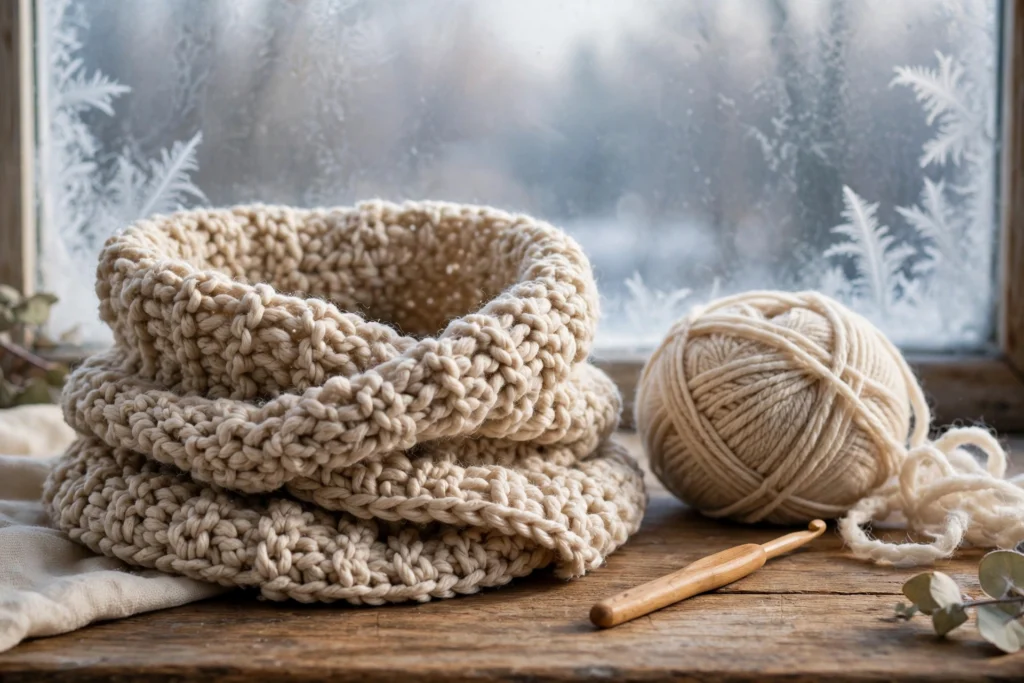
A cowl is the scarf for people who have lost one too many scarf ends to coat zips, bicycle wheels and the gap beside the car seat. It sits where you put it, it cannot unravel itself in your bag, and it fills the exact gap a winter coat leaves open at the neck. In January, when the wind finds every gap on purpose, a cowl is less an accessory than a repair.
Jump to section
It is also one of the friendliest first wearables in crochet: a tube, worked in the round or seamed, with no shaping to speak of. If you made my easy crochet scarf for beginners in the autumn, the cowl is its relaxed winter sibling — same stitches, half the length, none of the dangling. One skein of chunky yarn and two evenings is the usual budget.
The tutorial below is from Lullaby Lodge, whose easy neckwarmer pattern is the one I recommend to anyone making their first cowl. Their video is below, with my notes on sizing, the dreaded twist, and stitch choices for different kinds of cold.

Sizing: snug, slouchy or double-wrap
Cowls come in three families. A close neck warmer, around 55 to 60 centimetres around and 20 centimetres deep, sits inside a coat collar and does the pure wind-blocking job. A slouchy single-loop cowl, 65 to 75 centimetres around, drapes a little and looks like clothing rather than equipment. A long double-wrap, 120 centimetres or more, loops twice and can pull up over your ears in a gale. Measure your favourite existing scarf arrangement against your neck and choose honestly: most beginners should start with the slouchy single loop, which is forgiving to make and to wear.
The twist, and how to avoid it
Every cowl worked in the round begins with one dangerous moment: joining the foundation chain into a ring. If the chain twists before you join, you crochet a Möbius strip — beautiful in mathematics, annoying in knitwear. Lay the chain flat on the table, run your fingers along it to untwist every link, then join while it stays flat. Check again after the first round. If you would rather skip the jeopardy entirely, work the cowl flat as a rectangle and seam the ends: the seam is one honest line at the back of your neck, and nobody in the history of winter has ever inspected it.
What you need
- One to two skeins of chunky or aran yarn, 100 to 200 g
- A 6 mm hook for chunky, or as your yarn suggests
- A stitch marker if working in the round
- Scissors and a yarn needle
- A tape measure — cowls are a fit project
Stitches for warmth and texture
Warmth lives in density. Half treble crochet builds a cowl quickly with a fabric thick enough for real weather. Moss stitch gives a woven look and lies beautifully flat. Ribbing — worked with front and back post stitches, or in rows of back-loop-only stitches seamed into a tube — is the warmest and stretchiest of all, and it looks knitted, which will confuse your knitting friends in the nicest way. Save open stitches for spring cowls in cotton; a January wind goes through a lacy cowl like it is not there, because mostly, it is not.
Yarn choices for something worn at the throat
This project lives against the most sensitive skin you own, so shop with your neck, not your eyes. Hold the skein against your throat for ten seconds in the shop; if it prickles there, it will prickle at hour three of a cold walk. Soft acrylics and acrylic-wool blends are the January workhorses — warm, washable, kind. Pure wool is warmer still and the traditional choice; merino is the soft end of it. The matching-hat principle applies too: a cowl in the same yarn as my easy crochet beanie for beginners makes a set that looks bought, in the good way.
Finishing and wearing
Weave ends in thoroughly — a cowl gets pulled over heads daily, and a lazy end will work loose by February. Block lightly if the edges curl; ribbed cowls usually settle by themselves. Wear the seam at the back, fold a deep cowl down once for a collar effect, or pull a long one up as a snood when the weather turns serious. And make the second one soon after the first: cowls are the most borrowed item in any household, and the borrower never brings them back in the same season.
Make one for the dog-walk, one for best
My own cowl collection settled into a system I now recommend: one dark, hard-wearing cowl that lives by the front door for dog walks, school runs and bin duty, and one soft, good-coloured cowl that stays clean for actually seeing people. Add the matching crochet fingerless gloves and the door set is complete. The pattern is the same; only the yarn changes. Worked in an evening each, they solve the whole neck end of winter between them, and the door cowl doubles as an emergency gift when a visitor leaves underdressed for the weather — which is how the system perpetually needs restocking.
Frequently asked questions
How long should a crochet cowl be?
For a single loop, 55 to 75 centimetres around covers most necks — closer for a wind-blocking warmer, looser for a slouchy look. Depth of 20 to 30 centimetres lets it fold or bunch attractively.
Is a cowl easier than a scarf?
Yes, for most beginners. It uses less yarn, there are no long rows to count, and there is no second end to keep even. The only new skill is joining in the round — or seaming, if you work it flat.
What yarn is warmest for a cowl?
Wool and wool blends trap the most warmth; chunky acrylic is close behind and easier to wash. Whatever you choose, pick a dense stitch — the fabric’s thickness matters as much as the fibre.




