
Crochet Leg Warmers: Ribbed, Cosy and Made to Stay Up
Crochet leg warmers are back — and these stay up. Calf measuring, ribbing that grips, and three ways to wear them over leggings and boots.

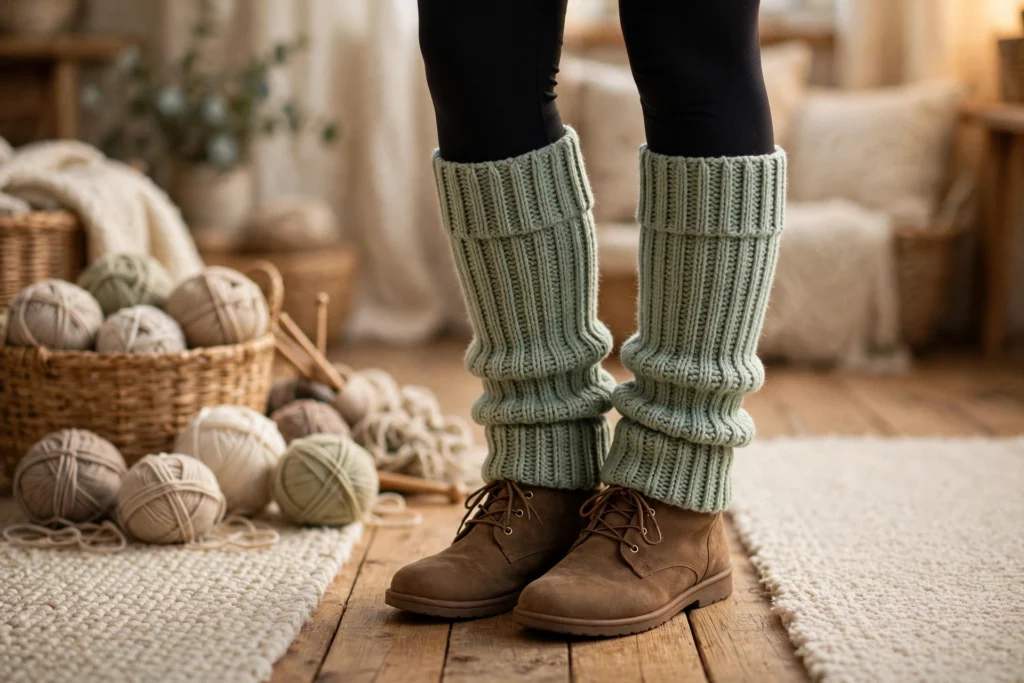
Leg warmers have quietly come back — over leggings at the school gate, under boots on dog walks, and pulled down over the ankle gap that every pair of cropped trousers leaves exposed to January. They are also, secretly, one of the best beginner projects in crochet: two straight tubes, no shaping unless you want it, and a finished pair in a weekend.
Jump to section
The trick that makes leg warmers stay up is ribbing and a good fit at the calf — the warmers in cheap shops slide down because they are tubes of nothing in particular. Yours will be measured to your leg, elastic in behaviour if not in content, and as long or short as your wardrobe needs. If you enjoyed the quick-wearable satisfaction of my crochet fingerless gloves, leg warmers are the same pleasure at a larger gauge.
The tutorial below is from omazingpaige, whose easy leg warmer walkthrough shows the whole make without fuss. Her video is below; I have added sizing notes, the ribbing choices, and how to wear them three different ways.

Measuring your legs, honestly
Leg warmers fail in the fitting, not the crocheting. Measure around your calf at its widest, around your ankle, and the length you want from just below the knee to the ankle — or shorter, if you want the scrunched look over boots. The finished warmer should measure one to two centimetres less than your calf around: crochet stretches, and that negative ease is what keeps them up. Jot the numbers down and check your work against the tape after the first few centimetres, not at the triumphant end.
Ribbing: the stay-up secret
Work the top ten centimetres in a ribbed stitch and the warmers grip the calf exactly where they should. Back-loop-only trebles or half trebles, worked in rows and seamed, give a deep knitted-look rib. Front and back post stitches make a richer rib in the round. Below the rib, change to a plainer stitch for speed — the body of the warmer can be simple half trebles, moss stitch, or the same rib continued if you like the uniform look. A second, shorter rib at the ankle end is optional but helps the warmer sit neatly over a boot top.
What you need
- 150 to 250 g of DK or aran yarn
- A 4.5 to 5.5 mm hook, to suit your yarn
- A tape measure
- A stitch marker, scissors and a yarn needle
- Optional: a short length of elastic thread if your calves are very slim
Working the pair
Crochet the first warmer completely before starting the second, and write down your stitch counts, row counts and any adjustments as you go — second-sock syndrome applies to legs in every craft, and the cure is a written recipe plus starting warmer two the same day. Try the first one on over the trousers or leggings you plan to wear it with; ease that works over bare legs can vanish over denim. If the top rib still slips on you, thread a round of elastic thread through its last row and knot it discreetly at the seam — an invisible fix that has saved many a pair.
Three ways to wear them
Over leggings, pulled up: the classic — full length, rib at the calf, for walks, yoga and cold floors. Scrunched at the ankle: push them down into soft folds over boots; the extra bulk at the ankle is the entire point and it keeps the boot gap warm. Over the boot: wear the lower rib over the top of ankle boots like a cuff, which seals the draught and looks deliberate. The same pair does all three, which is more than can be said for most of my wardrobe.
Yarn and colour thinking
Leg warmers are a visible accessory, so colour earns its keep here. Match them to your coat and they read as part of the outfit; contrast them and they become the outfit. Wool blends are warmest and hold ribbing’s spring best; acrylic is the wash-and-wear choice for the school-run pair. Stripes at the rib use up oddments beautifully. And if you are building a whole cosy set, the yarn that matches my easy crochet scarf for beginners or the household’s easy chunky crochet blanket makes January feel remarkably coordinated for a month spent mostly in the dark.
Sizing for children and very tall humans
The same pattern scales without drama: measure the actual leg in front of you, keep the two-centimetre negative ease, and adjust the length. Children’s warmers are a single evening’s work and a genuine hit for cold playgrounds and dance classes. For very long legs, buy the extra ball — knee-to-ankle coverage in aran can surprise you with its appetite, and a warmer that ends mid-shin because the yarn gave up is a sad object. Work both warmers from the same dye lot, and if you are striping from stash, mirror the stripe order exactly; mismatched stripes read as an accident, matched ones as a design.
Frequently asked questions
How do I stop leg warmers sliding down?
Fit and ribbing. Make the top measurement one to two centimetres smaller than your calf, work a proper rib for the top section, and if needed thread elastic through the final row. Most sliding is a too-big warmer, not a bad one.
How much yarn do leg warmers take?
Around 150 to 250 grams for an adult pair in DK or aran, depending on length. Knee-length in chunky yarn sits at the top of that range; short ankle warmers can take under 100 grams.
Are leg warmers a good first project?
An excellent one — they are rectangles or tubes with one fitting rule. Choose a light-coloured yarn so you can see your stitches, and keep a note of counts so the second warmer matches the first.




