
Crochet Bobble Cushion Cover: A Weekend Sofa Refresh
A bobble cushion cover is the fastest sofa refresh there is: plump texture, one calm plain back, and closures that survive the washing machine.

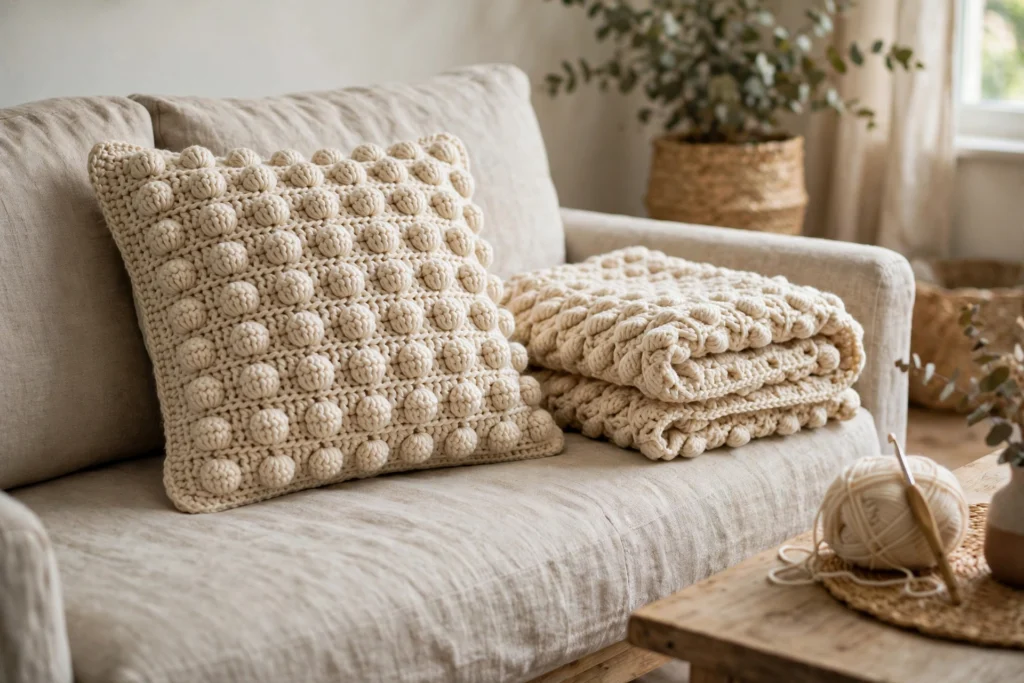
January is when the sofa becomes the centre of the house, and the fastest way to make a sofa feel new — without buying a sofa — is a cushion cover with real texture. The bobble cushion is the one people touch first: rows of plump, three-dimensional bobbles that look like they took weeks and take, in truth, a focused weekend.
Jump to section
A cover is also the most forgiving large project in crochet. It is flat, it is square, nobody has to fit inside it, and if your tension wanders slightly the cushion pad absorbs the evidence. My crochet pillow ideas roundup covers the whole family of designs; this article is the deep dive on the bobble version, the one that earns the compliments.
The tutorial below is from The Crochet Crowd, whose easy bobble pillow walkthrough lays the stitch out stitch by stitch. Their video is below; my notes cover yarn appetite, the plain back decision, and closures that survive the washing machine.

The bobble stitch, demystified
A bobble is a cluster of unfinished trebles worked into the same stitch and closed together, so the yarn puffs out towards you in a soft bead. Five trebles is the classic; four makes a daintier bobble, six a statement. Bobbles are usually worked on the wrong side so they pop out on the right side — which means the row that feels backwards is doing exactly what it should. Practise on a swatch first: ten minutes of swatching teaches your hands the rhythm, and the swatch doubles as your tension check for sizing the cover.
Bobbles eat yarn: plan for it
Each bobble uses roughly five times the yarn of the stitch it replaces, so a fully-bobbled cushion front can take two to three times the yarn of a plain one. Buy generously — an extra ball is cheaper than the dye-lot heartbreak of running out at row thirty. Sensible compromises: bobble every other row, space the bobbles in a diamond grid with plain stitches between, or bobble the front panel only and work the back plain. That last option is what most of us do, and it has a bonus: the cushion is comfier to lean on with one calm side.
What you need
- 300 to 500 g of aran or chunky yarn for a 45 cm cover
- A hook to suit your yarn — 5.5 to 6 mm for chunky
- A cushion pad the same size as your finished cover
- Buttons, a zip, or nothing at all for an envelope back
- Scissors, a yarn needle and a tape measure
Sizing and construction
Make the cover the same size as the pad or a centimetre smaller — crochet stretches, and a snug cover looks plump rather than tired. The simplest construction is two squares sewn or crocheted together on three sides. Or work the front in bobbles and the back as two overlapping plain rectangles for an envelope opening: no fastenings, washes beautifully, and the pad pops in and out in seconds. Buttons across the back are prettier and worth it if the cushion lives somewhere formal; choose flat buttons that will not announce themselves through the fabric when leaned on.
Colour and texture combinations
Bobbles are a texture, and texture shows best in one colour — cream, oatmeal and soft grey are the classic cushion shades because the shadows do the decorating. That said, a grid of bobbles in a second colour on a plain ground is gorgeous and easier, since most of the front is plain stitch. The texture family in my textured crochet patterns guide pairs well: try a bobble front with a lemon-peel or waffle back for a cover that is interesting from both sides. Whatever you choose, hold the yarn against your sofa in daylight before committing — cushion colours live in the room’s light, not the shop’s.
Care and the January refresh
Choose washable yarn, because cushions in real houses meet tea, dogs and small sticky hands. An envelope-back cover goes in the wash in one piece; buttoned covers, turn inside out first. While the covers are off, beat the pads, air them, and consider that you have now done a full sofa refresh for the price of two balls of yarn — considerably less than the January sales were hoping you would spend. It is the same household alchemy as my how to crochet a granny square projects: small squares of effort, arranged into comfort.
One pattern, a whole sofa scheme
Once the first cover exists, the rest of the sofa is a production line: a second cover with the bobble rows spaced wider, a third in the same yarn worked entirely plain with a bobble border, and suddenly you have a coordinated set that looks designed rather than accumulated. Keep the yarn and the pad size constant and vary only the texture — that is the whole secret of the expensive-looking cushion displays. It also makes washing day simpler, since every cover takes the same cycle. January is the month to do it: the light is poor, the evenings are long, and the sofa is where you will be sitting to admire the results.
Frequently asked questions
How big should a crochet cushion cover be?
Match the pad: for a standard 45 cm pad, crochet panels of 44 to 45 cm square. A fraction smaller than the pad is better than bigger — the cover should look filled, not fitted loosely.
Why do my bobbles not pop out?
They are worked on the wrong side so they emerge on the right side; if yours look flat, you are probably viewing the back. Give each bobble a gentle push from behind once the row is done, and check your stitch count per bobble.
Can I crochet a cushion cover as a beginner?
Yes — the cover itself is two squares. The bobble is one new stitch, best practised on a swatch first. If bobbles feel like a lot, work the front in any textured stitch and add a single row of bobbles as a border.




