Lemon Nails for Summer: Slices, Whole Fruit and Leaves
Lemon nails for summer: the slice method step by step, whole fruit with leaves, the Amalfi blue pairing, and how to stop yellow staining.

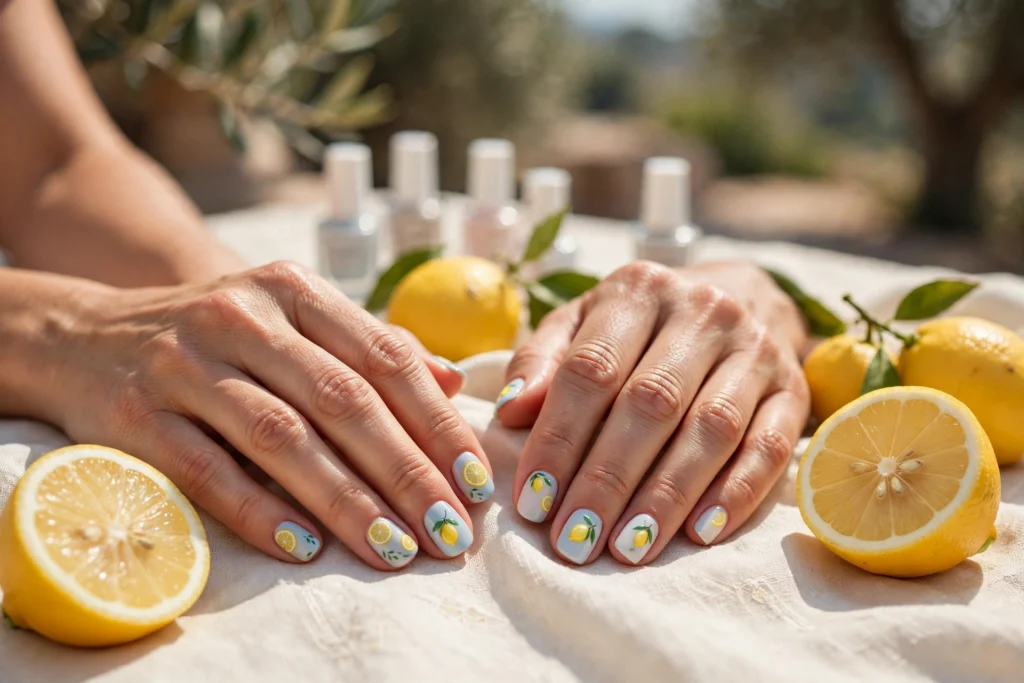
Some nail art is a whole personality, and lemon nails are summer’s: sunshine yellow, a white pith line, segments you can practically taste. They are the manicure equivalent of a cold glass of lemonade — cheerful, a little bit nostalgic, and guaranteed to start conversations at the checkout.
Jump to section
The tutorial below paints the classic lemon slice step by step, and VIO NAILART’s lemon manicure is the cleanest version of the technique I have found. What follows is her slice method with my notes on whole-fruit variations, the blue-and-white Amalfi pairing, and keeping yellow polish from staining your natural nails.

Why lemons are summer’s friendliest motif
Fruit nails can tip into novelty fast, but lemons hold their elegance because the palette does the work: yellow, white and a leaf of green is practically a Mediterranean tablecloth distilled. A single slice on an accent nail over white is chic; a whole set of slices is joyful. Lemons also pair with the season’s other big stories — gingham, Amalfi blues, linen everything — without fighting any of them.
The closest cousin on this site is cherry girl nails, a full listicle of cherry sets; cherries are the flirty red option, lemons are the sunny yellow one, and the painting logic is much the same.
What you need
- A sunshine yellow polish — opaque in two coats, not neon
- White polish for pith and segment lines
- A leaf-green polish and a fine liner brush
- A white or pale blue base for the non-lemon nails
- Base coat (non-negotiable under yellow) and glossy top coat
Step one: the slice
Start with the accent nails bare-based in white. For a slice, paint a yellow half-disc or full disc with the polish brush, leaving a margin of white showing around it. While it dries, decide your composition: a full slice centred reads graphic and modern; a half slice cropped by the nail’s edge reads like the fruit was just cut, and it is the more forgiving of the two because the crop hides imperfection. Then the detail that makes it a lemon: with the liner and white, draw the segment lines radiating from the centre like spokes, and ring the disc with a slightly thicker white pith line inside the yellow edge.
Whole lemons and leaves
For whole fruit, paint a yellow oval with two pointed ends — an egg shape pinched at both poles — then add one small green leaf at the top and a tiny stem dot. Two lemons and a leaf cluster on one nail is a still life; keep the neighbouring nails plain white or pale sky blue so the fruit has somewhere to breathe. A scattered micro-lemon — three millimetres, no segments, just the oval and a leaf — is the short-nail version, and it is adorable over a milky base.
The Amalfi pairing and other bases
The combination all over the Italian coast this summer is lemons over cobalt or tile blue, sometimes with a white stripe. It is bold, and it works because blue and yellow sit opposite each other and make each other brighter. Softer options: lemons over the palest buttermilk yellow for a tone-on-tone set, or over a French base where the slice replaces the smile line entirely. However you base it, a glossy top coat is essential — lemons should look juicy, never matt. For more hot-weather colour stories, summer nail inspo rounds up the season’s palettes in one place.
The staining problem, solved honestly
Yellow pigment is the most staining in the polish drawer; wear it bare-based and you will be lemon-tinted for a fortnight after removal. Always use base coat — two coats under a full yellow set — and remove with an acetone-based remover held on the nail for ten seconds rather than scrubbed around the skin. If a tint lingers, a gentle buff and a week of sheer polish disguises it completely. A soft gradient version of this palette, if slices feel like a lot, is in ombre nails with a sponge — yellow melting into white is lemonade in gradient form.
Lemons and gingham: the picnic set
If the Amalfi blue pairing is the evening version, the daytime one is lemons over gingham — and this summer the two keep appearing together on everything from tablecloths to nail sets. Paint the check first in white and the palest blue-grey, using the crossed-stripe method, then set a single cropped lemon slice over the ring finger’s check. The fruit reads as though it is sitting on the picnic cloth, which is precisely the charm. Keep the gingham nails slightly matte if you can — a cloth should not shine — and gloss only the lemon nails, so the fruit looks freshly cut against the fabric. It takes ten extra minutes over a plain set and earns compliments from people who never normally notice nails at all.
Frequently asked questions
Do lemon nails suit short nails?
Beautifully. Use the cropped half-slice or the micro whole lemon, keep to one or two accent nails, and let the rest of the set be white or pale blue. The motif reads clearly at small scale because the yellow is so high-contrast.
Which yellow should I buy if I only buy one?
A true sunshine yellow with a cream finish — not neon, not mustard, not gold. It should look like the fruit’s skin in daylight. Cream formulas paint the most evenly; jellies streak over white bases.
How do I keep the white segment lines crisp?
Paint them last-but-one, with the liner barely loaded, and let each line set before adding the next so they do not merge. Top coat goes on floated in one direction only — scrubbing is what drags white into yellow.