Hibiscus Nails: Paint the Flower as Big as It Grows
Hibiscus nails paint the tropics at full size: five broad petals and one long stamen per bloom. Two accent nails carry the whole theme at home.

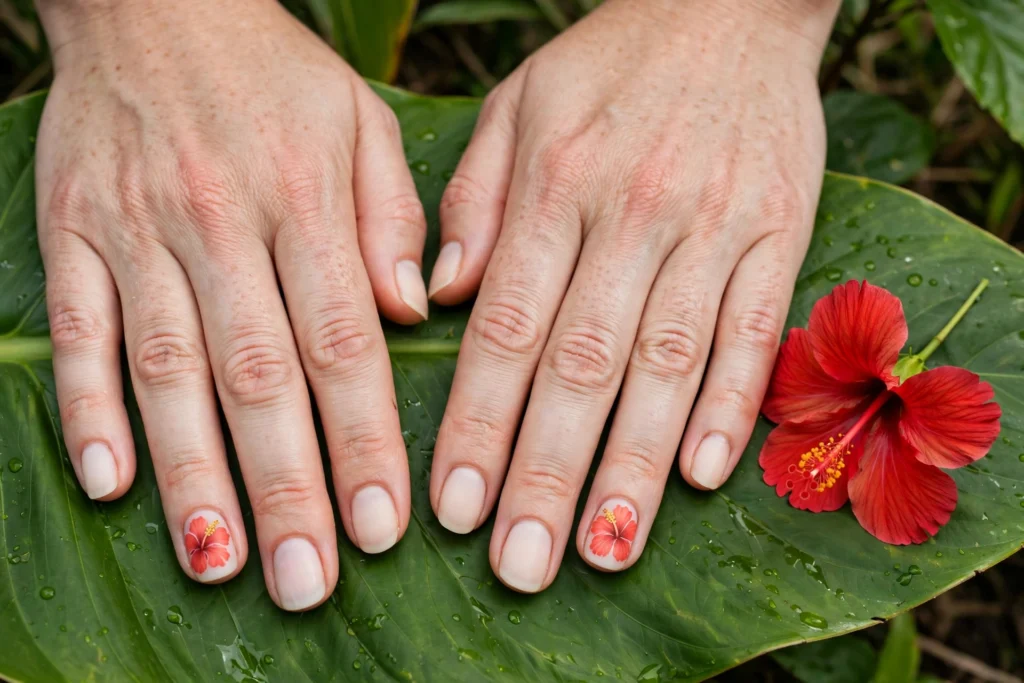
The hibiscus is the tropics in a single flower — five big petals, one long stamen, no interest in being subtle — and painted on nails it does what the flower does in a hedge: stops the eye from across the garden. Hibiscus nails are the design of beach holidays and summer parties, and their secret is scale: this is a flower you paint big, one bloom per nail, with a brush you already own.
Jump to section
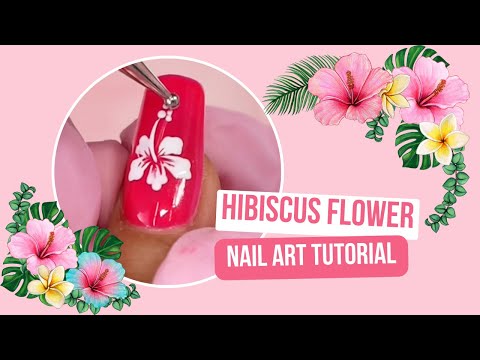
The reference is Makartt Official’s hibiscus flower nail tutorial — a professional nail house’s art build, per its title — and the method is the petal-by-petal construction: five broad petals laid in with a flat or angled brush, shaded at their bases, with the stamen drawn out long and dotted at its tip. What follows is that construction with my own notes on colour (hibiscus red is a specific red), the two-nail rule for real life, and the leaf question, where restraint wins again.
What you need
A flower colour — the reds, corals, pinks and sunset oranges of the real hedge — a deeper shade of the same for petal shading, white or pale yellow for highlights and the stamen’s pollen dots, a deep green for optional leaves, and a flat or one-stroke brush for the petals plus the finest liner you own for the stamen. A contrasting base: the hibiscus blooms over pale, nude and milky bases in the classic register, or over deep teal and navy in the evening one. Our spring floral nail art painted small and many; the hibiscus is the same family at the opposite scale — few and huge — and the two techniques cover the whole floral year between them.
The flower: five petals, laid not drawn
A hibiscus petal is a fan: wide at its outer edge, gathered at the centre, with a ruffled rim. The tutorial builds it by loading the brush with the petal colour and laying each petal in one or two strokes, the stroke’s natural fan doing the ruffle’s suggestion. Five petals radiate from an off-centre point — hibiscus are not symmetrical stars, and a bloom whose centre sits slightly towards one side reads as grown rather than stamped. Shading goes in while the petal is workable or as a second pass: a deeper tone at each petal’s base, dragged out a third of its length, gives the flower its trumpet depth. Perfection is not the standard — real petals crease, overlap and tear slightly, and a painted bloom with one imperfect petal is more convincing than five identical fans.
The stamen: the signature stroke
No hibiscus is finished without its stamen — the long column that leans out of the flower’s centre, ending in a cluster of pollen dots. It is the design’s signature and its most-missed detail: petals alone read as a generic tropical flower, but the stamen names the species. Draw it as one confident curved line from the centre, longer than instinct suggests — the real stamen reaches beyond the petals — and dot its tip with four or five pollen points in yellow or white. A shaky stamen beats a timid one; practise the stroke on paper twice and then commit. This is the same lesson our hand-painted rose nails teach about their swirl: the flower’s defining gesture, done once, at full confidence.
Colour: which hibiscus are you?
The classic is the red — a warm, orange-leaning scarlet that the flower made famous. The coral and salmon blooms are the summer’s soft fashion version, flattering on warm skin and kind at office distance. The sunset hibiscus — petals shaded from yellow at the base to pink at the rim — is the showpiece, and the tutorial’s shading method is exactly its recipe. White hibiscus with a pink heart is the bridal-tropical crossover, and the deep magenta is the evening one, best on the navy base. Match the flower to the skin the way the hedge matches the light: cool skin takes the pinks and magentas, warm skin the corals and scarlets, deep skin everything at full saturation — hibiscus is a generous genus.
The two-nail rule and the leaf question
A full ten-bloom set is a lei worn on the hands — magnificent on holiday, administratively heavy at a keyboard. Real life’s version: full blooms on the ring fingers and thumbs, the remaining nails in the flower’s colour as a plain set, or in the base with a single petal’s echo at the tip. The set still reads hibiscus from across the room, because the eye completes the theme from two honest blooms. Leaves: one deep-green leaf behind a bloom steadies it; a leaf per flower builds a thicket and the flowers drown in their own hedge. The tutorial’s restraint is the professional’s — foliage as punctuation. Pair the finished set with our butterfly nail art tutorial on alternate weeks and the whole tropical garden is yours by August.
Wear and keeping
Layered petal work is slightly raised, so seal it under two coats of top coat, the first floated to avoid dragging the shading. The stamen’s fine line is the most delicate element and the first to soften; it is also the fastest repair in nail art — one stroke, five dots. Re-gloss at day three. Photograph the set in shade outdoors if you can: full sun blows out the petal shading, and the flower’s depth — the thing you worked for — lives in that shading.
Frequently asked questions
Are hibiscus nails hard to paint?
The petals are laid with a flat brush in one or two strokes each — broader and more forgiving than fine line work. The stamen is one curved line. Beginners succeed by painting big: one bloom per accent nail, not five small ones.
What colours do hibiscus nails come in?
The real flower’s range: scarlet, coral, pink, sunset blends of yellow-to-pink, white with a coloured heart, and deep magenta. Choose by skin tone the way you would choose the flower for your hair.
How many nails should carry the flower?
Two full blooms (ring fingers, or thumbs and ring fingers) over a matching plain set is the wearable classic. Ten blooms is the holiday statement — glorious, and a commitment.