
Crochet Picnic Blanket in Gingham Checks
Crochet picnic blanket in gingham checks: three shades, carried yarn, block maths for any size, and the blanket every summer after this one.

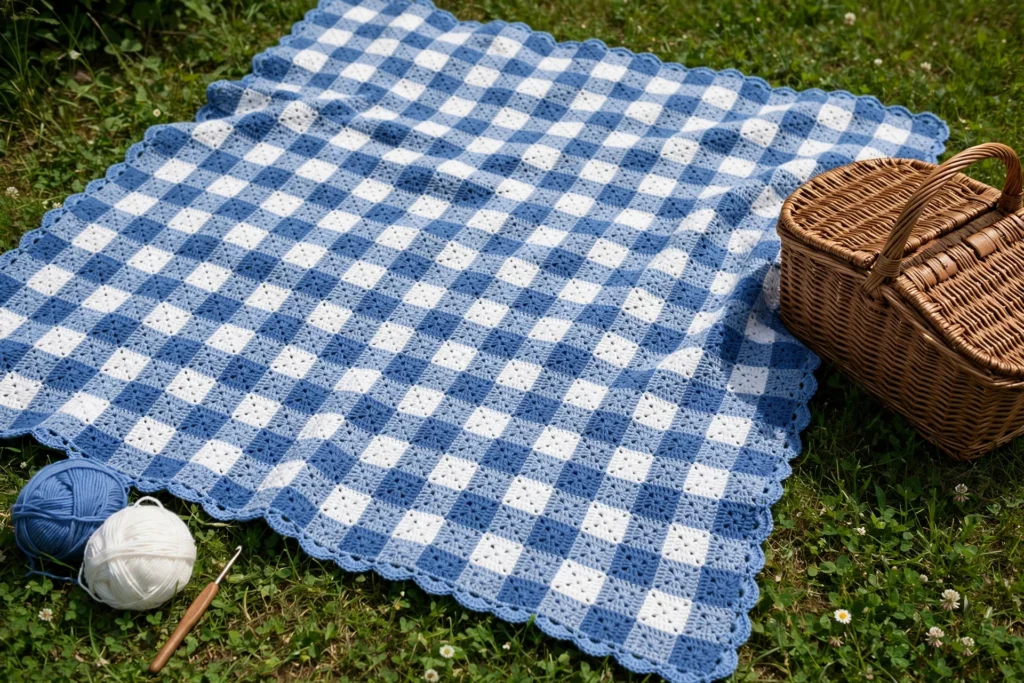
Gingham is the pattern of summer itself — picnic cloths, café awnings, the dress you wear to both — and in crochet it is a small magic trick: three shades of one colour, carried yarn, and checks that appear as if printed. The picnic blanket below is worked in one piece, no squares to join, and it folds into the basket like it was always meant to live there.
Jump to section
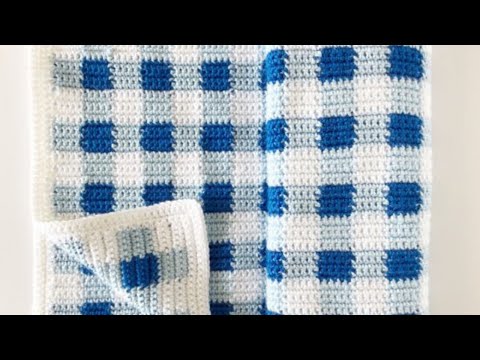
The tutorial below uses the carried-yarn method in single crochet blocks, and Daisy Farm Crafts’ picnic gingham blanket is the definitive version — their blue original has been made in every colour the yarn shop stocks. What follows is their construction with my notes on shade selection, carrying yarn without tangles, and sizing from lap blanket to full picnic spread.
How three shades become gingham
The trick is arithmetic, not illusion. Gingham cloth is white threads crossed with coloured threads; where they overlap you get the mid-tone. Crochet fakes it with three yarns: white, your colour in a soft shade, and your colour in a strong shade. Rows alternate white-and-soft blocks with soft-and-strong blocks, and the eye assembles the check. Choose shades that are genuinely one family — a blue, its pastel, and white — rather than three unrelated colours, or the finished blanket reads as patchwork instead of gingham. Red is the classic picnic choice; the blue of the tutorial is the seaside one; sage green is the garden one.
What you need
- Aran or worsted acrylic or cotton-blend yarn in three shades (white + two of one colour)
- A 5mm or 5.5mm hook
- Two yarn bobbins or small wound balls per colour — carrying gets tangled without them
- Scissors, a yarn needle, and patience measured in rows rather than skill
Step one: carrying the yarn
You never cut between blocks. The colour you are not using lies along the top of the previous row and you crochet over it, trapping it inside the stitches — carried yarn, hidden completely where the two colours are close in value, which in gingham they always are. Change colour in the last yarn-over of the final stitch of each block, so the new colour starts the next block cleanly. Blocks run five stitches wide and five rows tall in the standard scale; keep a small note of your block counts at the row ends, because the whole check depends on blocks aligning vertically — a block that drifts by one stitch announces itself forever.
The rhythm and the honest timescale
This is single crochet, five stitches at a time, and it settles into the most meditative rhythm in the craft — which is fortunate, because a picnic blanket is a commitment of weeks, not evenings. Take heart from the construction: there are no joins, no motifs, no second half that differs from the first. If a full blanket daunts, the same fabric at half scale makes the lap blanket version, and a quarter scale makes a doll-and-teddy picnic set that teaches the method in a weekend. The texture family sits comfortably beside textured crochet patterns — flat colourwork on one side, honest stitch texture on the other.
Sizing: your chain sets everything
Work in multiples of the block: for five-stitch blocks, your starting chain is a multiple of five plus one, and the number of blocks across should be odd so the blanket starts and ends with the same block. A lap blanket runs about 90cm; a true picnic blanket 130–150cm square so four people can sit at its corners with the food in the middle. Length is simply blocks repeated — weigh your yarn at the halfway row if you are using a precious shade, because gingham eats the mid-tone fastest of the three. A border of two plain rounds in the strong shade frames the checks and hides any edge waviness; the chunkier construction in easy chunky crochet blanket is the faster route if warmth matters more than pattern.
Using it: the blanket’s actual job
Acrylic gingham shakes grass off, washes without ceremony, and does not mind a jam incident — choose acrylic or a cotton blend over pure wool for a blanket that will live outdoors. It also works as a tablecloth for garden lunches, a car-seat cover for wet dogs, and the backdrop of every summer photograph. The motif itself starts life in how to crochet a granny square territory — blocks and colour changes — but the carried-yarn flat version here is the one that reads as cloth rather than crochet, which is precisely gingham’s charm.
Choose your colour family by where the blanket will live: red for the classic picnic field, blue for the coast, sage or mustard for the garden. All three photograph beautifully, and all three hide grass stains with equal tact — a genuine design consideration for a blanket whose whole purpose is to be sat on outdoors.
Frequently asked questions
Why do I need three shades? Can’t I use two?
Two colours give you checkerboard, not gingham. The mid-tone — where colour seems to cross white — is what the eye reads as woven gingham, and it has to be crocheted in as its own shade.
My carried yarn shows through — what am I doing wrong?
Usually tension: the carried strand is being pulled too tight, puckering the block, or too loose, peeking between stitches. Keep it lying flat and relaxed along the row, and work over it rather than around it. It shows least between the two closest shades, which is why block order matters.
How long does a picnic blanket take?
In aran at single crochet, expect roughly twenty to thirty relaxed hours for a full-size blanket — a spring of evenings for a summer of picnics. The lap size halves that. It is a slow project by design; the rhythm is the reward.




