
Crochet Sun Hat with a Wide Brim
Crochet sun hat with a wide brim: crown-down construction, raffia versus cotton, brim firmness tricks, and a fit that survives a sea breeze.

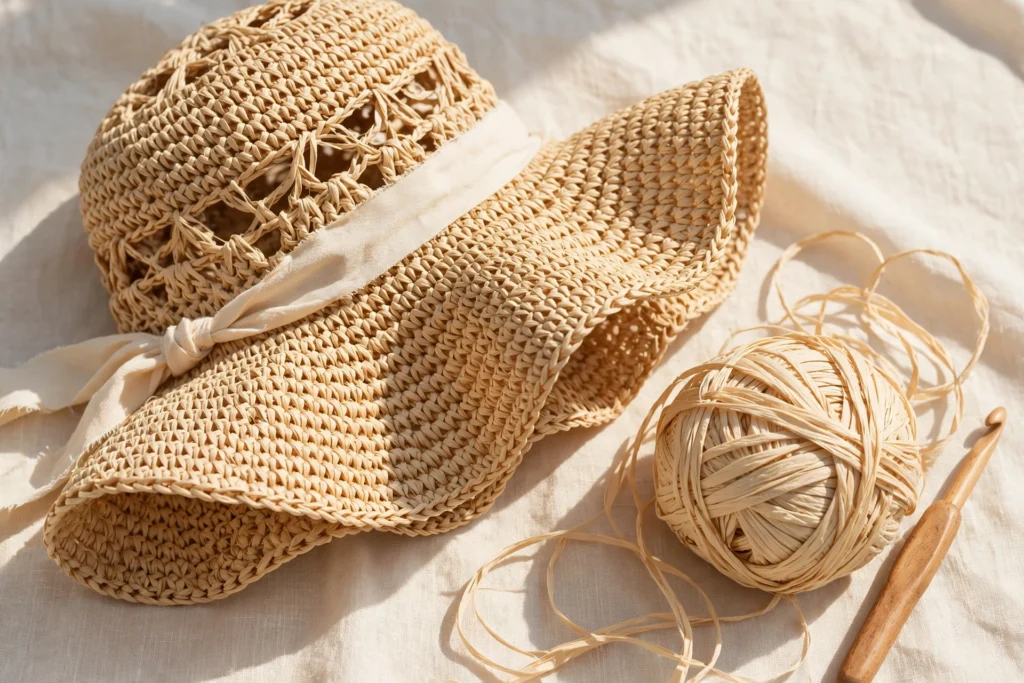
A proper sun hat is the hardest-working object of the summer: it shades your face, finishes an outfit, and folds into a beach bag without complaint. Crocheting your own means it fits your actual head — not the statistical head the high street designs for — and the wide-brim version below takes a weekend of easy rounds.
Jump to section
The tutorial below works the hat from the crown down with three brim options, and The Turtle Trunk’s Country Cottage sun hat is the pattern I recommend whenever someone asks where to start. What follows is her construction with my notes on raffia versus cotton, brim firmness, and getting a fit that survives a sea breeze.

Sun hat versus bucket hat: choosing your brim
The bucket hat is the sun hat’s casual cousin — a short, downward brim, close fit, packable to nothing. This site’s how to crochet a bucket hat covers that shape fully. The wide-brim sun hat is a different tool: a flat or gently flopped brim of three inches or more that actually shades shoulders as well as eyes, and an unmistakably dressier silhouette. Make the bucket for festivals and dog walks; make this one for gardens, holidays and every photograph you will be in until September.
What you need
- Raffia-style paper yarn or a firm cotton — 100–150g
- A 3.5mm or 4mm hook (smaller than the yarn suggests, for body)
- A stitch marker — this hat is worked in a spiral
- Optional: millinery wire or a strip of firm interfacing for a structured brim
- A ribbon or a crocheted band for the finishing trim
Step one: the crown is a flat circle, then a wall
Every top-down hat begins as the flat circle from a magic ring: increase evenly until the circle’s diameter matches the crown of your head — measure a hat that fits, or use the rule that the circle diameter in centimetres is roughly your head circumference divided by three. Then stop increasing and work straight: the rounds become the wall of the crown, and you simply keep going until the wall reaches from crown to just above your eyebrows when you try it on. Try it on constantly — heads vary more than any size chart admits, and the spiral means you can stop at your exact fit.
The brim: increases return, gently
At the brim, increases come back but slower than the crown’s — roughly one increase round in every two or three — so the brim flares rather than saucers. Too-fast increases make ripples; too-slow makes a lampshade. The floppy, romantic brim needs no help. The firm, flat brim that holds a line needs one of two tricks: raffia yarn, which has body of its own, or a final round worked over millinery wire. Steam is your finishing friend either way — a waft from the kettle and a minute pressed under a book persuades most brims into manners.
Fit: the sea-breeze test
A sun hat should sit snug, not tight: two fingers should not fit under the band, but it should not leave a mark after an hour. If your finished hat is a whisper loose, thread a ribbon through the brim junction and tie it at the back — prettier than elastic and adjustable at a windy cliff top. Too small is the one real failure, and it is a gauge problem, so do measure your circle at the crown stage rather than discovering it at the brim. The sizing habits here are the same ones behind easy crochet beanie for beginners — heads are heads in every season.
Trim and care
Finish with a band: a length of grosgrain ribbon, a contrasting round of double crochet, or a skinny scarf threaded through the brim base and tied in a bow that doubles as a chin strap on blustery ferries. Raffia hats wipe clean and should never be soaked; cotton hats wash gently and dry over an upturned bowl to hold their shape. Store them stuffed with tissue, brim flat, and they will come out of the cupboard each June looking intentional.
One hat, several summers of variations
Once the crown-down construction is in your hands, the variations multiply on their own. Work the crown in a spiral of two alternating shades for a striped holiday version; stop the brim an inch earlier and add a picot edge for a garden-party hat; thread a patterned scarf through the brim junction instead of a ribbon and the hat changes outfits with your wardrobe. A child’s version with the ruffled brim option from the same tutorial makes the matching-set photograph that grandparents frame. The pattern repays learning properly because it is really three hats wearing one set of instructions — and the fit knowledge, once earned on your own head, transfers to every hat you will ever crochet.
Budget an afternoon for the brim alone and do not rush it — the brim is the part everyone sees, the part that decides whether the hat looks made or homemade, and the part where your earlier patience at the crown quietly pays out.
Frequently asked questions
Which yarn is best — raffia or cotton?
Raffia (paper yarn) gives the classic structured sun hat and shrugs off splashes, but it is harder on the hands. Cotton is softer, washable and drapier — choose it for a floppy garden hat, raffia for a firm holiday brim.
Why is my brim wavy?
Almost always too many increases: the brim is being given more fabric than a flat flare needs. Drop to an increase round every third round. A gentle wave can also be steamed flat; a true ruffle cannot, and needs a round undone.
Can I make this for children?
Yes — simply stop the crown circle smaller and the wall shorter; children are roughly a 48–52cm head against an adult 56–58. The pattern’s sizes in the tutorial run from baby to adult for this reason.




