
Crochet Socks for Beginners: Your First Pair, Heel and All
Crochet socks for beginners: a cuff-down first pair with a demystified heel, sizing from your own foot, and yarn that survives the washing machine.

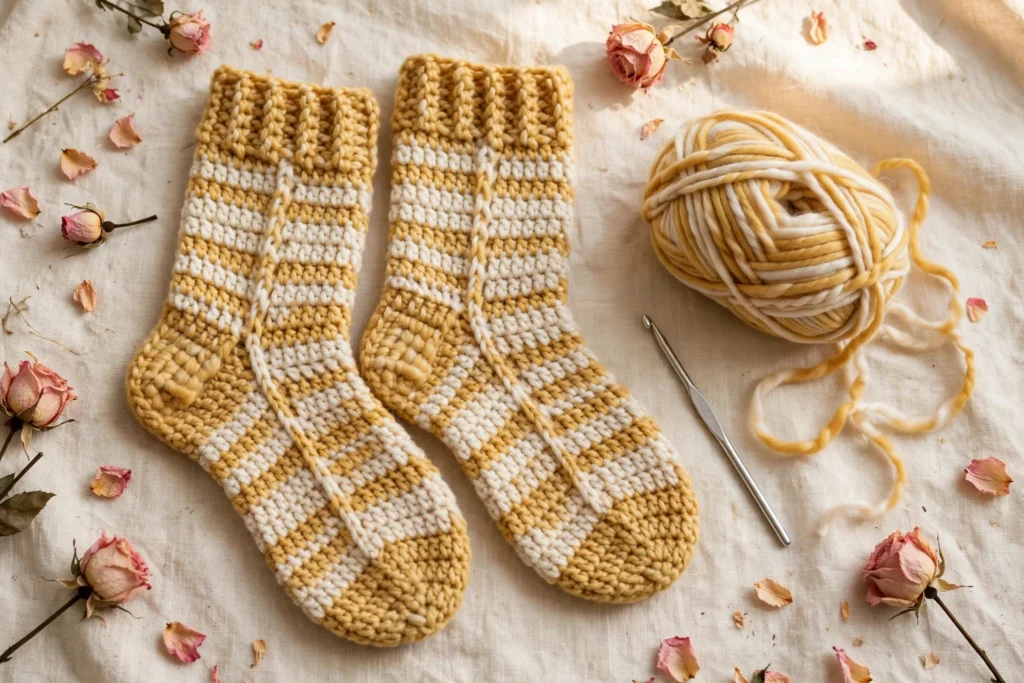
Crochet socks have a reputation as the final boss of beginner crochet — tiny yarn, heel sorcery, two of everything. The reputation is out of date. A first pair, worked cuff-down in ordinary double-knit yarn with a straightforward turned heel, is a weekend project, and the fit knowledge it teaches transfers to every wearable you make afterwards.
Jump to section
The tutorial below is Marly Bird’s My First Crochet Socks — the Yarnspirations family pattern taught stitch by stitch, sizes from child to adult — and it remains the video I point first-time sock makers to. What follows is her construction with my notes on measuring your own foot, yarn that survives the wash, and the honest differences between crochet socks and knitted ones.

Cuff-down: why the first pair starts at the ankle
The start could not be friendlier: a band of ribbing for the cuff — the part of the sock the world sees above a shoe, and the part that does the gripping — worked to the depth you like. The leg follows as a plain tube in a spiral, the same tube logic as the crochet ear warmer headband worked longer and narrower, and because you crochet from the top down you can try the sock on as it grows, checking the fit over your own ankle at every stage. This is the great advantage over patterns written for an average foot: yours is the pattern’s co-author. Measure foot length and ankle circumference before you start, write them down, and check the tube against the foot, not the clock.
The heel, demystified
Midway, the tube turns a corner: you work back and forth over half the stitches for a short section, and the turning rows build a pocket that the heel sits in. That is all a heel is — a pocket, made of rows that turn early. Work it slowly the first time, count at the end of every row, and put a marker at each side of the heel zone before you begin. If the first sock’s heel is imperfect, wear it anyway; the second sock’s heel will be better, and nobody’s two heels match on a first pair. That asymmetry is the souvenir of learning.
Yarn: the wash test decides
Socks are the most laundered, most abraded thing you will ever crochet, so yarn choice is structural, not decorative. Proper sock yarn — wool blended with nylon — exists because pure wool felts and wears through at the heel within a season. For a first pair, a wool-nylon double knit in a colour you love is the honest buy. Cotton is a trap here: no stretch, no warmth when wet, and a finished sock that bags at the ankle by lunchtime. Save the cotton for the summer makes it served so well, and make these in yarn built for feet.
Crochet socks versus knitted socks: the honest paragraph
Crochet fabric is thicker and less elastic than knitted fabric, and a crochet sock is therefore a house sock by nature — sublime in slippers and boots, a squeeze in fitted shoes. Say this plainly because disappointment lives in the gap between expectation and fabric. Worked in a finer yarn with a smaller hook, crochet socks slim down considerably, but for your first pair, embrace the house sock: this is footwear for the sofa, the desk, and the cold kitchen floor, and at that job it beats the knitted version for warmth per hour of making.
Make two: the pair discipline
The famous failure is one perfect sock. Defences: write down every number from sock one — rounds to the heel, heel rows, cuff rounds — in a notebook, not on a scrap; start sock two the same week; and use the same hook even if you have bought a nicer one since. When both exist, team them with the crochet fingerless gloves for the full cold-extremities set, and know that a pair of hand-made socks is among the strongest entries in easy crochet gift ideas — if you can bear to give the second pair away.
Cuff choices: height, ribbing and the gift question
Three small decisions shape the finished pair more than any stitch choice. Cuff height first: a short cuff makes a trainer sock for mild weather, a mid-calf cuff makes the house sock this article intends — copy the tutorial’s depth for pair one and experiment on pair two. Ribbing second: the cuff’s rib is not decoration, it is the spring that holds the sock up, so work it snugly and do not be tempted to match the leg’s stitch count loosely. And the gift question: socks are sized to a foot, which makes them the most personal make on this site — measure the recipient’s shoe size, convert it to foot length, and if the pair is a surprise, err a centimetre longer in the foot; a sock slightly long is worn, a sock slightly short is donated.
Frequently asked questions
What size hook and yarn for a first pair?
Follow the tutorial’s pairing: a wool-nylon double knit with the hook the pattern names (around 4mm). Finer sock-weight yarn makes a slimmer sock but doubles the rounds — save it for pair two, when your hands know the construction.
How do I size for someone else’s feet?
You need two numbers: foot length (heel to longest toe, standing) and ankle circumference. A shoe size converts to length reliably; trace the foot on paper if you can. Cuff-down construction forgives small errors because the sock can be tried against the tracing as it grows toward the toe.
My socks are too thick for my shoes. Did I fail?
No — you made house socks, the natural first form of the craft. Wear them in slippers and boots, make the next pair in sock-weight yarn with a 3mm hook, and the shoe fit arrives with the finer gauge.




