
Crochet Triangle Shawl for Autumn Evenings
Crochet triangle shawl for autumn evenings: the bottom-up increase rhythm, yarn that drapes, honest sizing, and the blocking that finishes it.

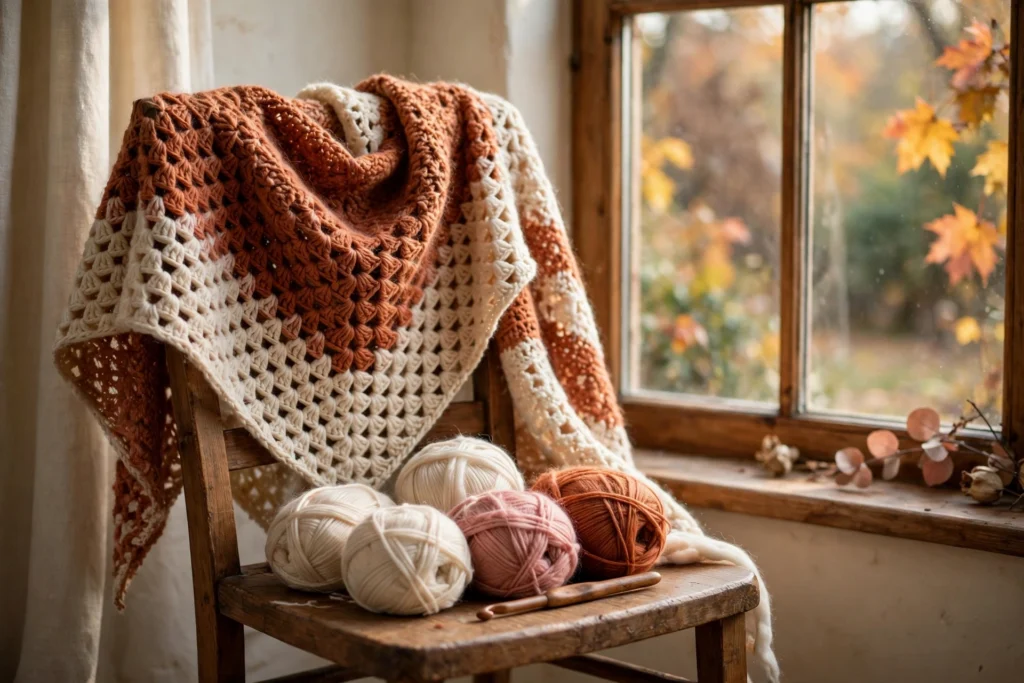
The first cold evening of September makes the same request every year: something for the shoulders. A triangle shawl is the answer crochet gives best — one growing triangle of fabric, no seams, no shaping maths beyond a rhythm of increases, and a finished piece that works over dresses, jumpers and pyjamas with equal conviction.
Jump to section
The tutorial below is Pattern Princess’s fall triangle shawl, worked from the bottom point upward in double crochet and chains — a fall palette in her version, and a construction so regular you can crochet it while watching the season change. What follows is her pattern with my notes on yarn that drapes, sizing the triangle, and blocking, the step that turns a heap of stitches into a shawl.

Bottom-up: a triangle that grows from a point
Most beginners meet the top-down shawl first, so this construction deserves a word. Here you begin at the bottom tip — a handful of stitches — and every row adds its increases at the edges, so the triangle widens as it climbs toward the long top edge. The pleasure of bottom-up is that the hard part is the first six rows, when the piece is tiny and the increases are easy to watch. After that it is rhythm: double crochet, chain spaces, increase at both ends, turn, repeat. If you can make the scarf in easy crochet scarf for beginners, you already own every stitch this shawl uses.
What you need
- Double-knit or worsted yarn with drape — 400–600g for a full wrap, less for a shoulder shawl
- A hook one size up from the ball band’s suggestion — drape lives in the looser gauge
- Two stitch markers for the increase edges — your future self says thank you
- A tape measure — the triangle is done when it measures done, not at a row count
- Blocking pins and a mat, or a bed and patience
Yarn: drape is the whole decision
A shawl is a fabric that must fall, so choose for falling. Wool and wool blends drape and block beautifully; acrylic works if it is a soft, loosely-spun one — hold a strand against your neck before committing, because this garment lives there. Cake yarns with long colour changes were invented for this pattern: the gradient happens by itself, one ball, no ends to weave. Solid colours show the stitch pattern more honestly and dress up better. Either way, buy one ball more than the estimate; the edging row is where shawls go to run out of yarn.
Sizing: wingspan and depth
Two numbers decide whether a shawl wears well. Wingspan — the long top edge — wants to be at least your fingertip-to-fingertip reach for a true wrap, roughly 140–160cm for most adults; a shoulder shawl can stop at 110cm. Depth — point to top edge — lands around half the wingspan by the geometry of the increases, and that proportion is what makes the triangle sit on shoulders instead of sliding. Try it on as you go: pin the top edge around your shoulders at the mirror. The shawl is finished when it stays.
Blocking: the step that makes it a shawl
Off the hook, a triangle shawl looks like a rumpled promise. Blocking is the transformation: soak it lukewarm, roll it in a towel, then pin it out to its full wingspan on mats or a bed, points sharp, edges straight, and leave it a full day. The stitches relax into their pattern, the drape arrives, and the piece grows by a surprising ten percent. Skip blocking and you have not made a smaller shawl — you have made an unfinished one. The same ceremony finishes the garments in how to crochet a cardigan, and it is worth learning once, properly, here.
Wearing it: three ways that stay put
Draped with the point down the back and ends crossed at the front is the classic, and a brooch or shawl pin at the crossing solves the slip problem forever. Point at the front, ends wrapped round the neck, is the scarf read — warmest, and the one for actual cold. Over one shoulder with the point at the opposite hip is the evening version. Complete the autumn set with the crochet ear warmer headband for the days the shawl alone stops being enough, and you have September’s whole wardrobe from two projects.
The edging row: small finish, large effect
When the triangle reaches size, resist stopping dead at the last increase row. One final row — a round of single crochet along all three sides, or a gentle picot along the two sloping edges — gives the shawl its hem: it stops the edges rolling, sharpens the point, and makes the whole piece read as made rather than accumulated. Work the edging in the main colour for a tailored finish, or in the deepest colour of a gradient cake for a framed one. It takes twenty minutes on a finished shawl, and it is the difference between a garment and a very large swatch.
Frequently asked questions
How long does a first shawl take?
Most beginners finish in two to three weeks of evening crochet. The rows lengthen as the triangle grows, so the second half takes twice the time of the first — plan your patience accordingly and do not start it the week you need it.
My edges are curving. What is wrong?
An increase has gone missing or doubled at an edge — the markers exist precisely to catch this. Count the edge stitches every few rows; a curve caught at row twelve is a ruffle by row forty. One careful row undone is always cheaper than blocking a wave flat.
Can I make it in cotton?
You can, and for a summer-evening shawl it is lovely — but cotton has no memory and less drape, so the shawl will hang straighter and heavier. For the autumn wrap this article intends, wool or a wool blend is the honest recommendation.




