
Crochet Gift Bags: Small Pouches for the Giving Season
Crochet gift bags for the giving season: a flat circle base, a drawstring channel, three sizes for soap, candles and bottles, and the fillings.

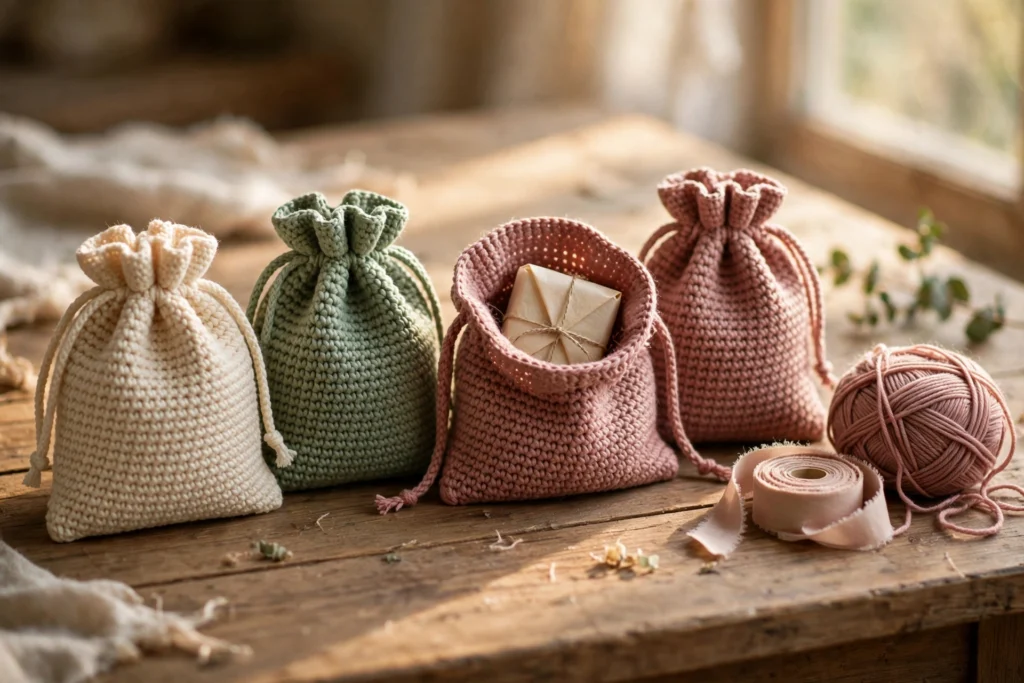
Gift-making season opens quietly in November, weeks before the December panic, and the smartest first make is the crochet gift bag. A small drawstring pouch takes an evening, uses the odd half-ball every stash is full of, and then does double duty: it is the wrapping and half the present. A bar of good soap inside a handmade bag is a gift. The same soap in paper is an errand. I have tested this theory on neighbours for three years and it has never failed.
Jump to section
The tutorial below is Crochet Hub’s easiest gift bag — a round base, straight walls, a drawstring top — and it is the pattern I hand to beginners who want a first finished object that is not a rectangle. What follows is that method with my notes on the base maths, three sizes for three kinds of presents, and the fillings that make a small bag feel generous rather than small.

The base: a circle that sits flat
Every good gift bag starts as a flat circle, because a bag that rocks on the table looks homemade in the wrong way. Work a magic ring of six single crochets, then increase evenly — six more stitches each round, spread out — until the circle matches the bottom of what it will hold: about 7 cm across for a soap or a candle, 10 cm for a mug-sized gift. The moment the circle starts to cup, stop increasing: that cup is the bag turning the corner, and from there you simply work even rounds upward. One round of back-loop-only stitches at the turn makes a crisp little ridge, like the fold in a paper bag, and it is the detail that makes the finished pouch look bought. If circles are new to you, the shaping here is the same muscle as the centres in our easy crochet heart — small, quick, and very satisfying.
Walls, and the drawstring channel
Work the walls in single crochet for a firm, stand-up pouch, or in half doubles for a softer one that slouches prettily when empty. Height is the gift’s height plus a third again for the gathered top. Two rounds from the top, work the drawstring channel: a round of (double crochet, chain one, skip one) makes a row of eyelets all the way around. Thread a cord — a crocheted chain, a length of ribbon, or baker’s twine for the kitchen gifts — in and out of the eyelets, knot the ends, and the bag cinches with that soft ruched crown in our photograph. The granny-stitch variation, where the walls are worked in little three-double clusters, makes a lacier bag that suits jewellery and lets the tissue paper inside show through.
Three sizes for three kinds of presents
The soap size (7 cm base, 10 cm tall): soap, lip balms, a folded pair of earrings on a card. The candle size (9 cm base, 13 cm tall): jar candles, a jar of homemade anything, a small plant in its pot — the bag becomes the pot cosy and stays in the recipient’s house all year. The bottle size (10 cm base, 25 cm tall, with a sturdier double-crochet wall): olive oil, bubble bath, a bottle of something festive; add a second drawstring round halfway up the neck so it grips. Make them in cream, sage and dusty rose like the photograph and any three together look like a set from a good shop — the full gifting strategy, with the other quick makes that fill a basket, is in our easy crochet gift ideas collection.
Yarn, stiffness and the finishing touches
Cotton yarn makes the crispest bags and survives the washing machine when the bag begins its second life holding cotton wool balls in someone’s bathroom. Acrylic is fine for the decorative sizes; avoid anything fluffy, which sheds onto soap and candles. If a finished bag feels too soft, a smaller hook — one size down from the ball band — firms the fabric more honestly than any stiffener. Finish with the ends woven in a circle so they cannot work loose under the drawstring’s pulling, and if you are making a batch, make one extra: somebody is always forgotten until the last week, and a ready bag with a candle in it has saved more Decembers than I can count. The same cord-and-eyelet trick closes the tops of our easy crochet tote bag scaled down — or is it the tote that is this bag, scaled up? Either way, you now own both.
Assembly-lining a batch: the November production line
When the gift list runs to six or ten bags, make them like a factory that serves tea. Session one: all the bases, worked back to back while your hands learn nothing new — six flat circles in a row. Session two: all the walls, which is the meditative part and pairs with television. Session three: the eyelet rounds, the cords threaded, the ends woven, in one finishing sitting with the good scissors. Three shorter sessions beat one long one, because the base circle is the only stage that wants your full attention and it is done before fatigue can make the sixth circle wider than the first. Label each finished bag with its intended gift on a scrap of paper tucked inside; December-you, wrapping at midnight, will be grateful beyond words. Keep the colours in one family across the batch and even the gifts for people who will never meet will look, in your own hallway, like a collection.
Frequently asked questions
How long does one gift bag take?
The soap size is one episode of television — about forty minutes once the base is familiar. The bottle size is an evening. A set of six for a whole gift list is a comfortable weekend project in November.
What yarn weight works best?
DK cotton is the sweet spot: defined stitches, firm fabric, no special care. Aran makes chunkier, faster bags for bigger gifts; 4-ply makes delicate ones for jewellery.
Can the bags be reused as storage?
That is their second career and the real point. Cotton-wool balls, charger cables, board-game pieces, the good chocolates hidden from the household — a handmade pouch is the prettiest storage a drawer can have.




