
Crochet Bed Runner: One-Row Repeat, Any Bed Size
A crochet bed runner in an easy one-row repeat: the full sizing table for single, double and king beds, straight edges, and stripes that behave.

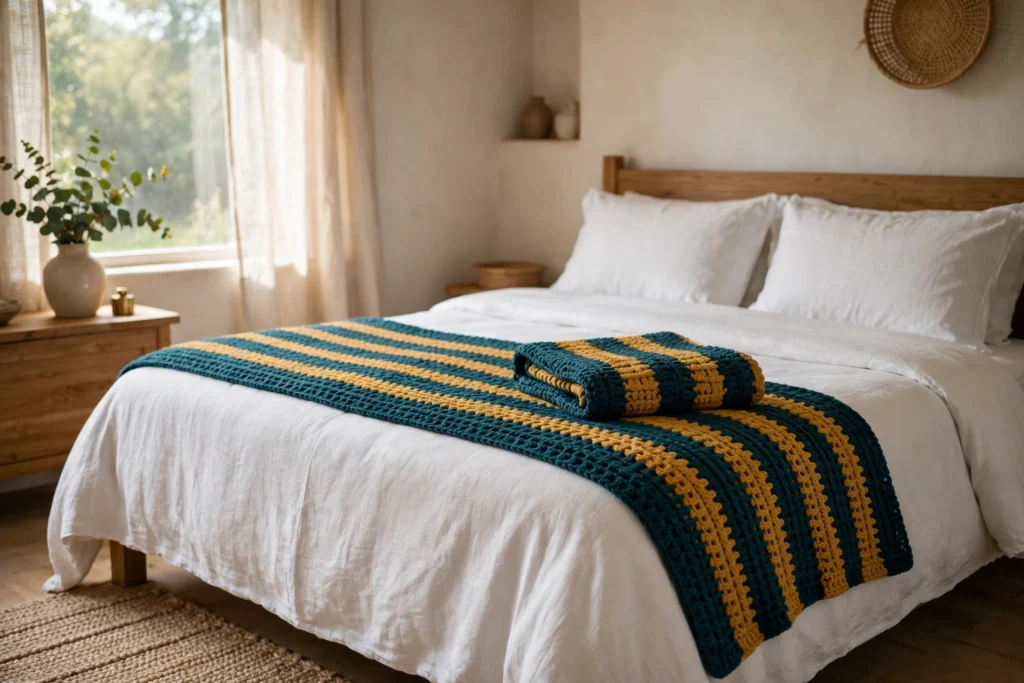
A bed runner is the most underrated make in the house: a long, narrow strip of crochet laid across the foot of the bed that changes the whole room for about a third of a blanket’s yarn and a quarter of its hours. November is when I make them — the bedroom turns cold and plain at exactly the moment guests start arriving, and a runner in deep teal and mustard, like the one in our photograph, makes a bed look dressed for the season in the time it takes to change the sheets.
Jump to section
The anchor tutorial below is Blog do crochê’s full-length bed runner — nearly three metres of it. It is in Portuguese, and I am recommending it anyway, deliberately: the stitch is a simple repeat that your hands can learn from the picture alone, and watching a maker work at full size teaches the rhythm better than any narration. The backup route in my notes — a one-row-repeat table runner pattern — sizes up to a bed with nothing but a longer starting chain. What follows is the method, the sizing table I use, and the colour rules that keep stripes well-behaved.

Why a runner beats a blanket in November
Three honest reasons. It is fast: a runner is a blanket’s width cut to a third, so a week of evenings finishes it instead of a season. It is light to wash and store, which matters for the guest-room bed that gets dressed twice a year. And it is the best possible use of a bold colour — a full blanket in deep teal would darken the room, while a runner’s stripe of it across white bedding reads as design. If the guest room also needs warming at the window end of the day, the runner pairs naturally with the smaller projects in our easy crochet gift ideas — several of those are one-evening makes that finish a room the same way.
The one-row repeat, and keeping edges straight
The classic runner stitch is a one-row repeat: a row of doubles (or a shell-and-chain rhythm) worked identically every row, with the colour changes making the pattern. One-row repeats are meditative and dangerous in equal measure — the danger is the edges, which quietly gain or lose a stitch while your attention is on the television. Count the first and last stitch of every row for the first ten rows, and put a marker in each edge stitch; after that the rhythm holds itself. Turn with the same chain count every time and work the last stitch into the top of the turning chain, not beside it — ninety percent of wavy runner edges are born in that one small choice.
Sizing by bed: the overhang rule
A runner should cross the bed’s width and drop 20–30 cm down each side, no more — longer reads as an unfinished blanket. Working width (the short side, your starting chain) is usually 45–60 cm; length is the variable. As a starting table in aran or DK: single bed, 200 cm total; double, 240 cm; king, 270 cm. The Portuguese tutorial’s 294 cm suits a wide bed with deep drops. Measure your own bed rather than trusting the table — mattress toppers have quietly changed every standard size in the last decade. Yarn: a double bed runner in DK takes roughly 600–800 metres, which makes it a legitimate stash project; in stripes of four to six rows per colour, two balls each of three colours is a comfortable shopping list. If you are sizing other long pieces this season, the same overhang thinking finishes the tops in our how to crochet a cardigan guide — measuring the body, not the pattern, is the whole skill.
Colour: stripes that behave
Two rules keep stripes looking designed rather than leftover. First, an odd rhythm pleases the eye — 6 rows, 4 rows, 2 rows — where equal stripes read as a barcode. Second, carry the yarn up the side when the gap is four rows or fewer and you will crochet over the carries in the edging; cut and weave only for long gaps. Finish with one round of single crochet in the darkest colour to frame the piece, and block it flat: a runner lives its life on display, and a blocked runner lies like linen while an unblocked one curls like a ribbon. Mine goes on the bed the day the Christmas quilts come out of storage — the same week our crochet snowflake ornaments go up — and the room is ready for whoever the season brings.
Making it a set: cushions, and the runner’s second career
A runner alone dresses a bed; a runner with one cushion in the same yarn and stitch marries it. Work a 40 cm square in the runner’s repeat, seam it around an inner, and place it against the pillows — twenty percent more yarn buys eighty percent more effect. And when the runner eventually tires of the bedroom, it has second careers waiting: across a sideboard under the winter candles, down the middle of the Christmas table (a one-row repeat has no idea it was ever bedding), or folded double as a bench pad in the hall. Long narrow crochet is the most redeployable object in the house, which is my final argument for making one every November.
Frequently asked questions
Cotton or acrylic for a bed runner?
Cotton lies flattest and washes best, acrylic is lighter and cheaper at this size, and a cotton-acrylic blend is the honest compromise most makers land on. Avoid pure wool on a guest bed — someone will eventually wash it hot.
Can I use the same pattern as a table runner?
It is the same object at a different address. Shorten the length to the table plus 20 cm of drop at each end and keep the width — the one-row repeat does not care which piece of furniture it is dressing.
How do I stop the runner sliding off the bed?
Weight and texture: a cotton runner on cotton bedding mostly stays put. If yours wanders, two small loops of ribbon sewn underneath at the mattress edge, tied to the bed frame, solve it invisibly.




