
Crochet Christmas Wreath for Your Door
A crocheted door wreath in two greens with berry clusters and a cranberry bow: two evenings of relaxed stitching, then decades of Decembers.

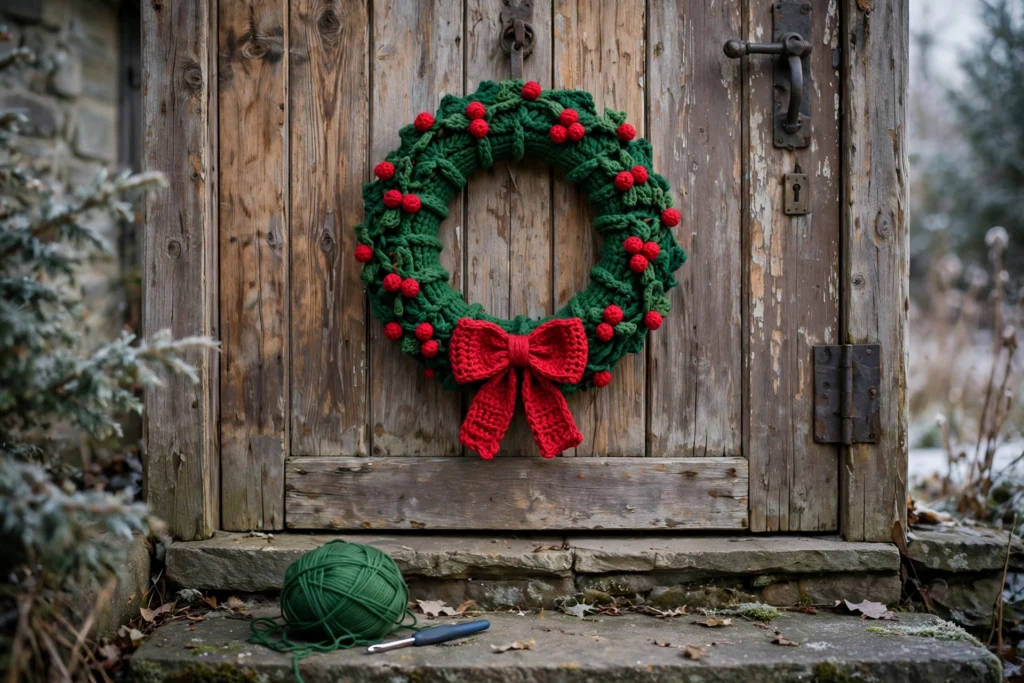
A door wreath is the one Christmas decoration the whole street sees, which is exactly why making yours in yarn feels so good. Shop wreaths shed plastic needles and cost a fortune for anything with real presence; a crocheted wreath is soft, silent in the wind, lasts for decades, and — once you have the ring covered — is honestly an evening-and-a-bit of work, most of it the relaxed kind you do with a film on.
Jump to section
The tutorial I follow is Junie’s Christmas wreath pattern, which builds the wreath the sensible way: a covered ring first, then the greenery texture, then the decorations. Below is that build with my notes on ring choices, getting the green to look like foliage rather than a scarf, and the bow-and-berries finishing that makes people ask which shop it came from.

Start with the ring
Everything hangs on the base, literally. A foam or polystyrene ring (25–30 cm is the classic door size) gives a plump, lightweight wreath that hangs from a ribbon without straining the hook. A wire frame makes a flatter, more rustic wreath. Cover the ring first with a tube or strip of crochet in your main green, worked in simple stitches and sewn closed around the back — or, the shortcut nobody will ever see, wrap the ring tightly in the same yarn before you start stitching texture over it. Work your covering slightly snug; a covered ring that peeks through gaps is the only genuinely ugly failure this project has.
Making yarn look like foliage
Flat, even stitches read as fabric; foliage needs irregularity. Three things create it. First, mix two greens — a deep forest and a slightly brighter pine — alternating as you work, because real branches are never one colour. Second, use texture: chains and doubles mixed with the occasional loop or puff cluster lift off the surface and catch light like needles. Third, work some sections looser than others and let the ring’s curve do some shaping for you. The little pointed leaves in our how to crochet a leaf tutorial also make excellent wired sprigs to pin around the wreath for a second layer of realism.
Berries, bow and the finishing hour
The decorations take an hour and do eighty per cent of the visual work. Berries are tiny balls — a magic ring, a few increases, one round even, stuff with a pinch of the yarn tail, close — made in clusters of three and sewn on at uneven intervals; odd numbers and irregular spacing look grown, even spacing looks manufactured. The bow is a flat rectangle pinched in the middle with a wrapped band, worked in a red that leans cranberry rather than scarlet, and sewn at the bottom centre or rakishly at four o’clock. Add a hanging loop of chain stitch at the back, and consider a few of our crochet snowflake ornaments wired in among the berries if your tree has spares.
Sizing, hanging and storing
Measure your door before your ring: a wreath should span roughly half to two-thirds of the door’s width, which for most front doors means 30–35 cm finished. Hang it from a ribbon over the top of the door or a proper wreath hook — never a nail through the crochet, which stretches the stitches it hangs from. In January, store it flat in a box with tissue in the centre hole to hold the shape; yarn wreaths emerge from storage needing nothing but a shake, which is more than any real fir wreath has ever managed. As a gift, a wreath is spectacular value for the hours involved — it anchors the handmade-December strategy in our easy crochet gift ideas.
Variations: snowy, rustic and miniature
The classic green-and-red build is a beginning, not a rule. A snowy wreath works the same construction in cream and white with silver-grey berries, and on a dark-painted door it is the most elegant thing on the street. A rustic version swaps the bow for a hessian wrap, adds pine cones wired in among the berries, and leans into a single deep green rather than the two-green mix. And miniature wreaths — 10 cm rings worked identically — become tree ornaments, chair-back decorations, or the finishing touch on a wrapped bottle being carried to a party. The miniatures are also the ideal first wreath: same skills, one evening, and a finished object small enough to be forgiving while your foliage technique finds its feet.
One honest note on weather: a yarn wreath hung on an exposed door will weather over the years like everything else hung there. Under a porch or storm door it lasts indefinitely; on a fully exposed door, bring it in during the worst storms and expect the reds to soften gradually over several seasons — which most of us find adds to the charm rather than spoiling it.
Frequently asked questions
How much yarn does a door wreath take?
Roughly 200–250 g of DK or aran green for a 30 cm ring including the covering, plus small amounts of red for berries and the bow. It is a satisfying way to use two full balls of a green you love.
Can I crochet a wreath without a bought ring?
Yes — a ring of thick rope, a pool noodle taped into a circle, or a circle cut from sturdy cardboard all work as forms. Foam rings are simply the lightest and most forgiving for a first wreath.
How long does a crochet wreath take to make?
Most makers finish in two evenings: one for covering the ring and building the greenery, one for berries, bow and assembly. The covering stage is pure autopilot stitching.




