
Crochet Angel Ornament for the Tree
A palm-sized crochet angel with lacy wings and a gold halo: head, cone and wings explained, plus starching advice and batch-making gift tips.

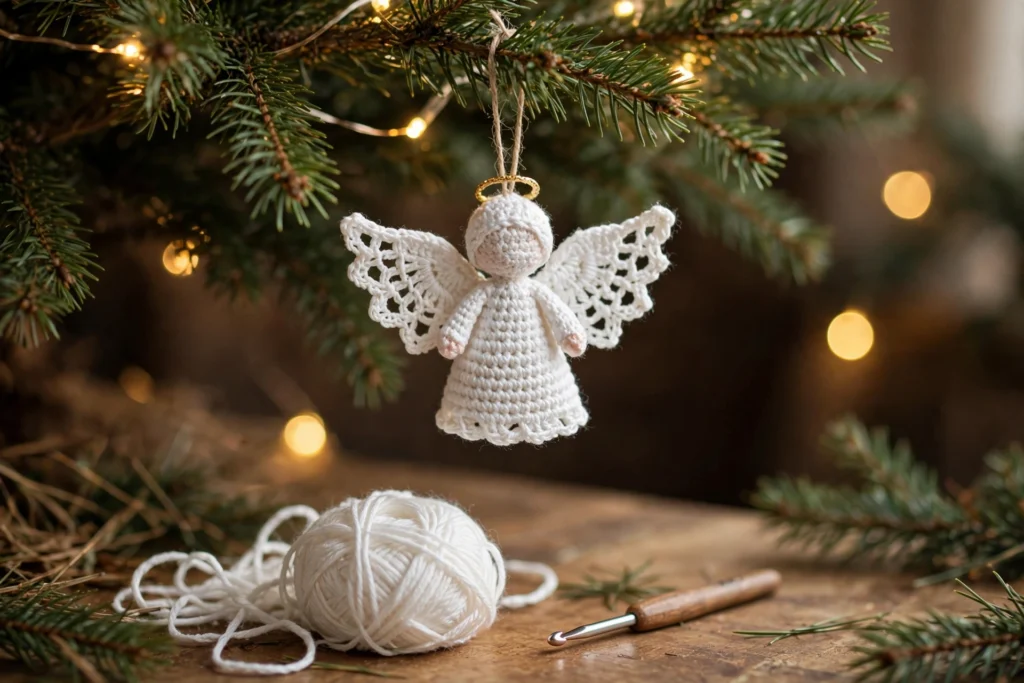
Every family tree has one decoration that gets unwrapped first and hung where the lights catch it best. For a lot of us it is an angel — and a crochet angel carries something a bought one cannot, which is that somebody’s hands made it, usually for somebody specific. The pattern below makes a palm-sized angel with lacy wings and a little gold halo, the kind that gets kept for decades and argued over by grandchildren.
Jump to section
The version I work from is Winding Road Crochet’s quick angel ornament, built the friendly way: head and cone body as one continuous piece, wings worked flat and attached, halo added last. What follows is that construction with my notes on yarn weight, the starching decision — angels stand or flop by it — and making a set of them as gifts that genuinely all look alike.

Yarn and size
Cotton yarn is the angel standard for two reasons: its stitch definition shows off the lacy wings, and it takes starch crisply, which matters for a figure that must hold a cone shape. A number 10 crochet cotton with a 1.5–2 mm hook makes a delicate, tree-sized angel of about 10 cm; a DK cotton with a 3 mm hook makes a sturdier 15 cm version that suits small hands and mantelpieces. White is classic, cream is softer against dark green branches, and a pale gold thread worked into the hem makes the whole figure glow under lights. Whatever you choose, start with a proper magic ring at the head — the closed start is what keeps the face smooth and round.
The construction: head, cone, wings
The head is a small stuffed ball worked in continuous rounds. From its base, the body flares into a cone by increasing evenly every round or two — the gentler the increases, the more graceful the skirt. A round of taller stitches near the hem gives the dress its flare and a natural place for a picot or shell edge. The wings are the only flat pieces: two mirrored fans of chains and shells, worked separately and sewn or slip-stitched to the back at a slight upward angle. Angle matters more than size here — wings set too low make the angel look tired, while wings swept upward make her look mid-carol. The halo is a small ring of gold thread or thin wire wrapped in gold yarn, stitched to the head with two firm stitches and a prayer.
To starch or not to starch
An unstarched angel in DK cotton will stand happily on a shelf but droops a little on a branch by Boxing Day. Starching — with commercial fabric stiffener, or a strong sugar-water or diluted PVA solution — pins the cone open and the wings out, and turns a soft toy into a true ornament. Pin the damp angel over a cone shape (a paper cone in a glass works), shape the wings with your fingers, and leave her a full day to dry. If the angel is destined for a tree branch and a house with a wood burner, starch; if she is for a child’s room or a stocking, leave her soft and skip anything brittle.
Making a matching set as gifts
Angels are one of the great batch-makes of December: every stage repeats, so a production line of six takes barely longer per angel than a single one does. Work all the heads, then all the cones, then all the wings, assembly-line style. Consistency tricks: use the same yarn lot for the whole set, count hem rounds out loud, and weigh the stuffing for each head in your palm against the first. Tied to a parcel with twine, an angel turns any present into the present — she earns her place in our easy crochet gift ideas on sentiment per gram alone. And if your tree theme leans snow over angels, the same cotton and hook make our crochet snowflake ornaments in twenty minutes each.
Angels beyond the tree
Once the first angel exists, uses multiply. Worked in thicker yarn at double size, she becomes a tree topper with genuine presence — stiffen the cone well and add a hidden cardboard cone inside for the branch. A row of small angels along a mantel, each holding the line of a fairy-light string in her wings, makes a garland people photograph. Tied to a christening or memorial keepsake box, an angel in cream becomes a year-round object rather than a seasonal one, which is also how many families use her: made for a new baby’s first Christmas, kept in the decorations box, and brought out annually with a story attached. That afterlife is the real reason this hour of crochet outperforms almost everything else on the tree.
Keep the first angel you ever make, even — especially — if she is imperfect. Mark the year on a tiny tag sewn inside the cone. She is the reference point every later, neater angel gets measured against, and in my experience she is the one people ask about.
Frequently asked questions
How long does one crochet angel take?
About an hour for a first one in DK cotton, closer to forty minutes once the construction is in your hands — and faster again in a batch, where the wings become muscle memory by angel three.
What can I use for the halo?
Gold crochet thread wrapped around a small ring, a snippet of gold pipe cleaner, or a circle of thin jewellery wire. Avoid anything heavy — a top-heavy halo tips the whole angel forward on the branch.
Can beginners make this angel?
Yes, if you can work in rounds and increase evenly. The wings are the only fiddly part, and even a simpler fan of plain shells looks lovely — perfection is not what handmade angels are for.




