
Crochet Velvet Scrunchies: A Set of Three in an Evening
One elastic, a handful of velvet yarn and fifteen minutes: crochet scrunchies in dusty pink, cream and burgundy, with the anti-worming tricks.

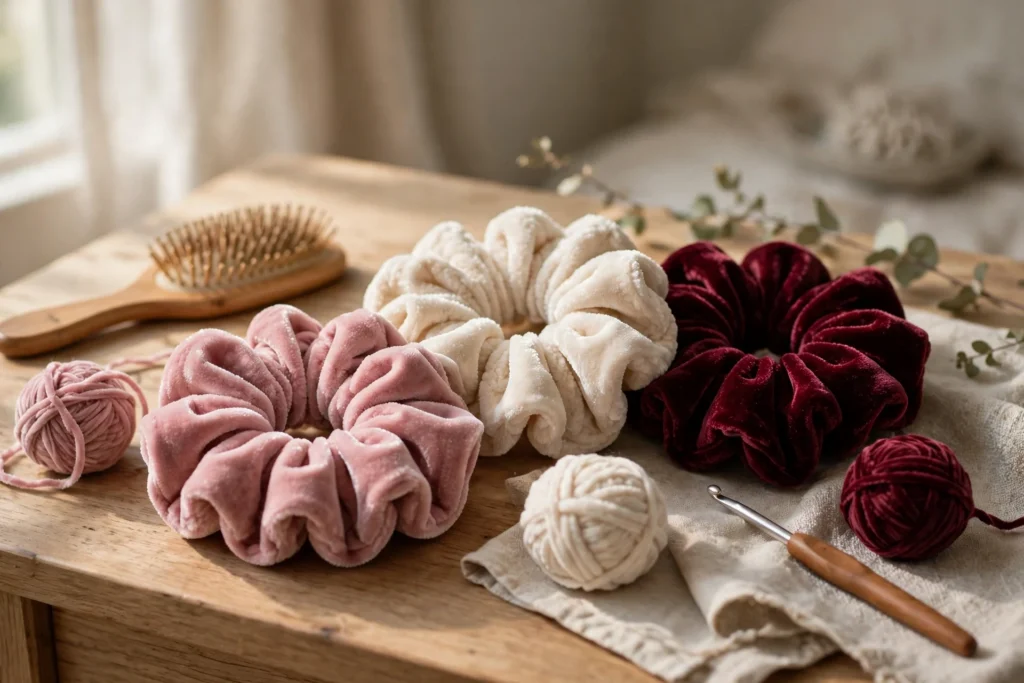
The fastest satisfying make in crochet is a velvet scrunchie: one hair elastic, a handful of plush yarn, about fifteen minutes, and a scrunchie so soft it feels like it came from an expensive shop. Make three in different colours and you have a set — one in your hair, one on your wrist, one already lost to a friend who admired it too hard.
Jump to section
The method I follow is Marching North’s velvet scrunchie pattern, which covers the elastic in single crochet first and then builds the famous ruffle with increases — two rounds, no sewing, nothing to go wrong. What follows is that approach with my notes on stitch counts, on fullness, and on the velvet yarn’s one annoying habit and how to defeat it.

What you need
You need velvet or chenille yarn — a small ball makes several scrunchies — plain hair elastics without metal joins, a hook a size up from your usual for the yarn, and scissors. Choose elastics that are firm and fabric-covered; the thin rubber kind will snap inside the finished scrunchie and there is no rescue for that. This is a flagship of our one-skein crochet projects philosophy: a remnant of yarn, an evening, a genuinely useful thing.
Round one: cover the elastic
Tie the yarn to the elastic and work single crochet around it, pushing the stitches together as you go so the elastic disappears completely under a packed ring of plush. Stretch the elastic gently as you work to check the coverage — a scrunchie spends its life stretched, and any gap in this round will grin through the ruffle later. Forty to fifty stitches is typical for a standard elastic in velvet yarn; the honest measure is not the count but the coverage. Join with a slip stitch, and the hard part — which was never hard — is done.
Step by step: the ruffle
One: cover the elastic as above and join the round. Two: chain two, then work two half double crochets into every single stitch around — doubling the stitch count is what creates the ruffle; the fabric has nowhere to go but into waves. Three: join, fasten off, and weave the tail in by travelling back through the ruffle’s base stitches, where the plush hides it completely. Four: fluff the scrunchie with your fingers, evening the waves around the ring. That is the whole pattern: the dusty pink, cream and burgundy set in the photograph took one film’s worth of evening. For a fuller, more luxurious scrunchie, work three half doubles into every second stitch in round two; for a slimmer one, alternate two-in-one with one-in-one.
Velvet yarn’s one bad habit
Velvet yarn worms: the pile lets stitches slowly work loose and creep, especially at the tail ends. The defences are simple. Start with a longer tail than usual and weave it in three directions, changing course sharply. Keep your tension a touch firm, and choose a hook a size smaller for the first round if your scrunchies feel loose. A finished scrunchie that rests for a day before wearing also settles noticeably. None of this applies to the cotton makes elsewhere on the site — this is purely a plush-yarn personality trait, and the scrunchies it produces are worth the diplomacy.
Sets, colours and gifting
A set of three in a tonal family — cream, blush, burgundy, say — looks intentional on a dressing table and generous as a gift. Tie the three together with a scrap of the same yarn and they stop looking like separate makes and start looking like a collection, which is the entire difference between a stocking filler and a present someone photographs. Crochet them in school or team colours for teenagers, in white and ivory for bridesmaids, or in black for the person whose entire wardrobe is black. They package beautifully in the little pouches from our crochet gift bags tutorial, or in a plain paper twist with a hand-written tag. And keep one in progress in your bag: there is no better use of a waiting room than a scrunchie, as the tiny makes in our crochet daisy bookmark tutorial also prove.
Beyond velvet: cotton, satin-look and scraps
Velvet is the star, but the pattern is democratic. Cotton yarn gives a crisper, smaller scrunchie that survives the washing machine and suits summer hair. A smooth acrylic with a sheen imitates satin surprisingly well at a tenth of the price, and is the easiest version for a complete beginner because the stitches stay visible. Even the last metres of a favourite yarn from a bigger project work — a scrunchie asks so little that it can be the souvenir of a beloved jumper-weight remnant. Keep the construction identical whatever you choose: cover the elastic completely, double the stitches for the ruffle, weave the ends in three directions. Only velvet demands the extra worming diplomacy; the others simply behave.
Frequently asked questions
How much yarn does one scrunchie take?
About 15 to 20 grams of velvet yarn — a handful. A single 100-gram ball makes five or six scrunchies, which is why they are the first thing to crochet from the leftovers of any plush project.
My scrunchie is not ruffled enough. Why?
The increase round was too modest. The ruffle comes from doubling — or more — the stitches in round two. If yours lies flat, you worked one-for-one somewhere; unpick that round only and double every stitch without exception.
Will a crochet scrunchie hold thick hair?
Yes, provided the elastic inside is a firm one and the first round is packed tight. The crochet adds grip rather than slip, and velvet in particular holds a ponytail kindly, without the breakage of a bare elastic.




