
Crochet Lamb Amigurumi: A Pocket-Sized Spring Lamb
A crochet lamb amigurumi with a bobble-stitch fleece and an embroidered face: the pocket-sized spring lamb that completes the Easter collection.

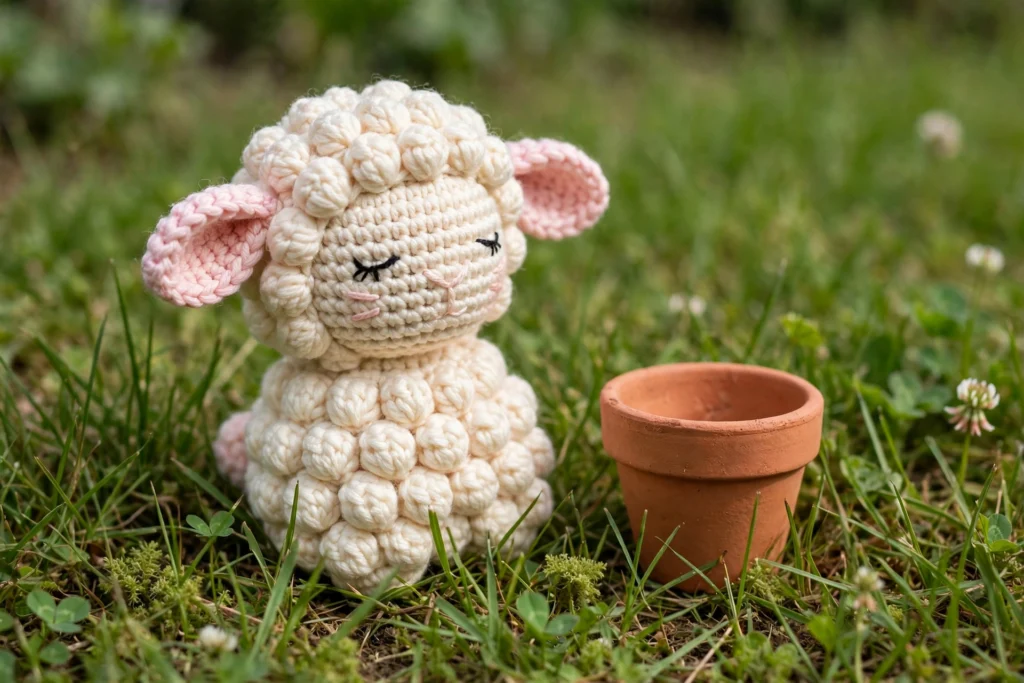
The Easter collection on this site has been missing its lamb. The eggs are made, the chick sits in hers, and the lamb — the gentlest of the spring animals — was always the next name on the list. Here he is: a pocket-sized amigurumi lamb with a bobble-stitch fleece you can feel with your eyes closed, two soft ears, and an embroidered face that takes four stitches and carries the whole expression.
Jump to section
The pattern I follow is Little Crochet Farm’s Easter lamb, from the same hand as this site’s eggs and chick, designed in the same mini scale — so the three were literally made to sit together. What follows is that construction with my notes on the fleece, the face and the finishing, the places where a lamb becomes a lamb rather than a sheep-shaped cushion.

What you need
Small amounts of DK or worsted cotton in cream for the fleece, a soft beige or blush for the face and ears, and a scrap of darker thread for embroidery. A hook a size down from the yarn’s label for tight amigurumi fabric, toy stuffing, a yarn needle and stitch markers. Cotton is the kind choice for a toy that will be handled by small hands — it washes, it holds the bobbles crisply, and it does not shed into the fleece. He stands about nine centimetres tall in DK; work him in chunky yarn with a bigger hook and he becomes a cushion-sized guardian instead.
The body and the bobble fleece
The body is a simple amigurumi egg shape — increases from a magic ring, straight rounds, decreases to close — with one transformation: the fleece is worked into it as bobble stitches. A bobble is several unfinished double crochets gathered into one stitch, and it pops out of the fabric like a curl of wool. Worked in rings across the body’s upper rounds, the bobbles become the lamb’s coat without a single sewn-on piece. Keep the bobbles even by counting, not by eye — a missed bobble shows as a bald patch, and while a real lamb would survive it, the symmetry is what makes this one look made rather than grown. The belly rounds stay smooth, which also helps him sit.
The head, ears and face
The head is a smaller sphere in the face colour, joined to the body or sewn at a slight tilt — the tilt is not a flaw, it is the personality, so place it deliberately rather than apologising for it. The ears are two flattened little leaves, worked in a few rows and pinched at the base, sewn either side of the head where the fleece begins; a blush inner ear, worked as the first row in pink before changing colour, is the one detail everyone remembers. The face itself is embroidery: two small vertical stitches or safety eyes for the eyes, and the classic lamb’s muzzle — a short vertical line with a V or Y beneath it — in dark brown. Embroider before the final closing rounds if you can; a face placed on a finished head wanders.
Legs, tail and assembly
The legs are four tiny cylinders, or two and a flattened base if he is a sitter rather than a stander — the pattern’s mini scale sits, and sits stably, which is what a shelf lamb needs. The tail is one small bobble cluster, worked or sewn at the back, and it is not optional: it is the punctuation mark that reads ‘lamb’ from behind on a shelf. Assembly order matters — legs and tail first, ears after the head is placed, face last of all once you can see where he is looking. Our crochet mini ghost amigurumi covers the same small-toy assembly discipline at Halloween scale; the stitches are identical, only the season has improved.
His place in the collection
He was designed to fit the surprise egg, and he completes a family: the eggs from the crochet Easter chick tutorial’s companion pattern gave the collection its shells, the chick gave it noise, and the lamb gives it calm. Make him in cream for the basket, in grey for a flock, in the palest pink for a nursery shelf. Alongside the bunny from our crochet bunny amigurumi he forms the whole spring menagerie this site owns — four animals, one basket, no further auditions. A ribbon collar with a tiny bell is the traditional finishing touch; choose the bell with care, because a lamb who jingles when the shelf is dusted becomes a household member very quickly.
Making a flock
One lamb is a mascot; three are a flock, and a flock wants variation that costs nothing. Work one in cream and one in the softest grey, hold a strand of brushed yarn with the cream for the third and his fleece goes cloudy, and embroider one face awake and one asleep. They take an evening each at this scale, they line a windowsill like they were always there, and they make the case — if a case were needed — that the basket was never going to hold just one animal.
Frequently asked questions
How long does the lamb take to make?
An evening for a confident crocheter, a weekend of sittings for a first amigurumi. The bobble rounds are the slow part — budget your patience there and the rest is plain sailing.
Can I use safety eyes instead of embroidery?
Yes, at 6mm for the DK size, placed before the head is closed. For a toy destined for a baby, embroider instead — stitched eyes cannot come loose, and they give the lamb his gentle expression.
My bobbles are uneven. What helps?
Count the unfinished stitches in every bobble — five is the usual — and keep the working tension identical across the round. A bobble worked loosely sinks; if one has sunk, tease it forward from inside with the yarn needle before closing.




