
Crochet Easter Basket: Sturdy Walls and a Proper Handle
A crochet Easter basket with sturdy walls and a handle that holds: the flat base, the back-loop turn, and the joins that survive an egg hunt.

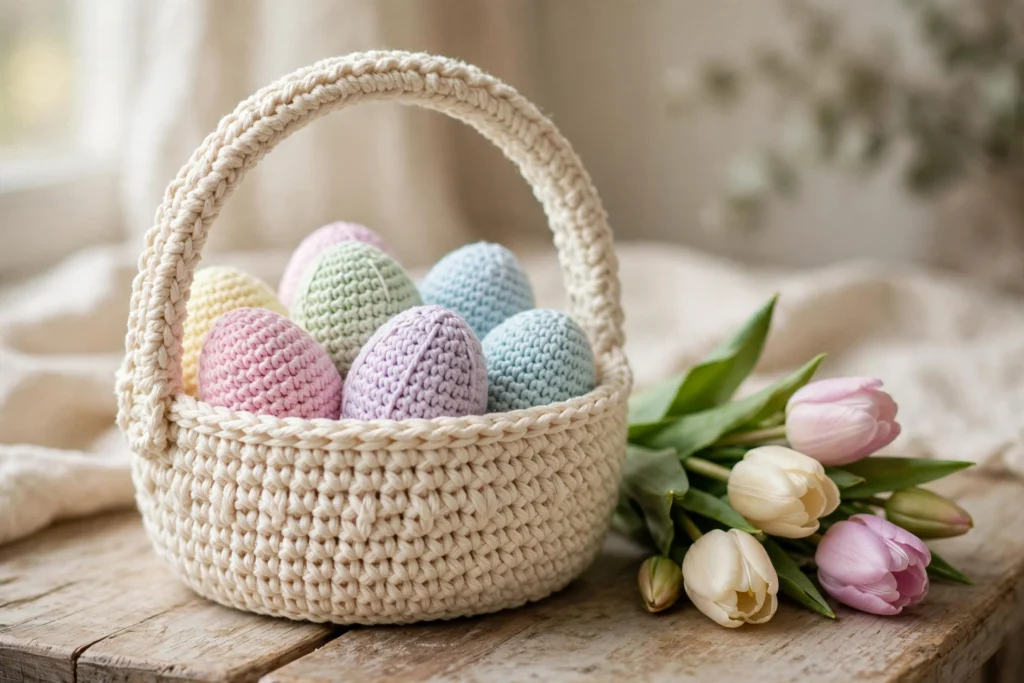
Some spring makes were promised a long time ago. When this site’s Easter collection was built, the eggs and the chick got their tutorials and the basket they belong in was left as the very next job — so here it is: a sturdy crochet Easter basket with straight walls and a handle that actually holds, sized for eggs, chocolate and one small lamb, and worked in a single determined evening.
Jump to section
The tutorial I work from is Secret Yarnery’s easy Easter basket, which builds its sturdiness the honest way — multiple strands held together — and keeps the stitch pattern simple enough for beginners. What follows is that construction with my notes on sizing, stiffening and the handle, the three places baskets go wrong.

What you need
Worsted-weight cotton or a stiff acrylic, held double — or a single strand of chunky — with a hook a size smaller than the yarn suggests, because baskets are architecture and architecture wants tight stitches. Add a stitch marker, a yarn needle, and something to fill it with. Cotton is my choice for a basket that will hold chocolate: it washes, it keeps a crisper wall, and it does not fuzz against foil wrappers. If you have only soft acrylic, hold it double and drop another hook size; structure can nearly always be bullied out of yarn by tension.
The base: a circle that stays flat
The basket begins as every round basket begins: a magic ring and a flat circle of increases, worked in single crochet, until the disc is the width you want the basket to be — about fifteen centimetres for a table basket, twenty for an egg hunt with ambitions. The flat-circle law rules here as it does under every round make: six increases per round, evenly spaced, and a marker moved up faithfully. The base is the foundation in the literal sense; a wavy base makes a wobbly basket no wall can rescue, so if the disc ripples, the round comes out. Our crochet storage basket teaches the same base at room scale — this is its spring sibling, shrunk and handled.
The walls: turning the corner
The turn is one round worked into the back loops only, which folds the work upward at a crisp angle, and after that the walls are simply rounds without increases until the basket stands as tall as you want it — eight to ten centimetres for eggs. Keep the tension honest; walls worked loosely lean, and a leaning basket sheds eggs. A final round of crab stitch or a simple folded cuff gives the rim its finished edge and a surprising amount of extra stiffness. Fill as you go to check the silhouette: it should hold the shape of its contents without hugging them.
The handle: the part that must not fail
A basket handle fails at its joins, so build it like you mean it. Work a chain the length of the arc you want, then single crochet back along it — twice, for a handle with a spine — or crochet a flat strip of four stitches worked in rows to the same length. Attach each end across several wall stitches with the yarn needle, sewing through the rim and at least two rounds of wall, and reinforce with a second pass. Then lift the basket by the handle, loaded, over a cushion, before you trust it above a floor. A handle tested is a handle trusted; the egg hunt is not the place for a first experiment.
Filling it properly
The basket exists for its company. It carries the eggs from our how to crochet Easter eggs tutorial without a rattle if you nest them on a handful of shredded paper or a crocheted grass mat — a flat green disc worked exactly like the base, in the brightest green you own. The chick from our crochet Easter chick sits on top like it owns the place, which it does. For the table, line it with a linen napkin and let the rim show; for the hunt, add a name tag tied to the handle in the hunter’s colour, so that found eggs and their ownership are never disputed.
After Easter
A basket this size earns its keep all spring. It holds fat quarters and yarn scraps by the sofa, eggs of the kitchen kind by the stove, and the first picked flowers with a jam jar of water hidden inside it. Make it in cream for Easter, in sage for the garden table, in leftover stripes for the craft room — the pattern does not change, only the wardrobe does. And pack it away with the eggs in it, nested and labelled, so that next spring the whole collection comes out of the box together, which is how traditions are actually built: one promised basket at a time.
One pattern, three sizes
The same construction scales without a single new skill. Stop the base at ten centimetres and the walls at six and you have the egg-cup basket for a single hunter’s haul or a place setting. Push the base to twenty-five and the walls to twelve, with the yarn held treble, and it is a yarn basket for the sofa-side project pile. The handle maths never changes — an arc half as long again as the span it crosses — and neither does the rule that the joins get sewn twice.
Frequently asked questions
How do I stop my basket walls from flopping?
Tighter stitches and thicker walls: hold the yarn double, use a smaller hook than the label suggests, and finish with a crab-stitch or folded rim. A light spray-starch press rescues a finished basket that leans.
What size should an Easter basket be?
A fifteen-centimetre base with nine-centimetre walls holds a dozen crochet eggs or a respectable chocolate haul. Go to twenty centimetres only for a dedicated egg hunt — big baskets invite lean walls.
Can I crochet the basket in one colour?
Yes, and the classic version is. Stripes are worked by changing colour at the rim round or mid-wall; keep the base and the handle in the main colour so the structure reads as one piece.




