Watermelon Nails: The Slice You Can Wear
Watermelon nails put the whole slice on your hands: juicy pink flesh, a white pith line, a green rind and three honest seeds per nail this June.

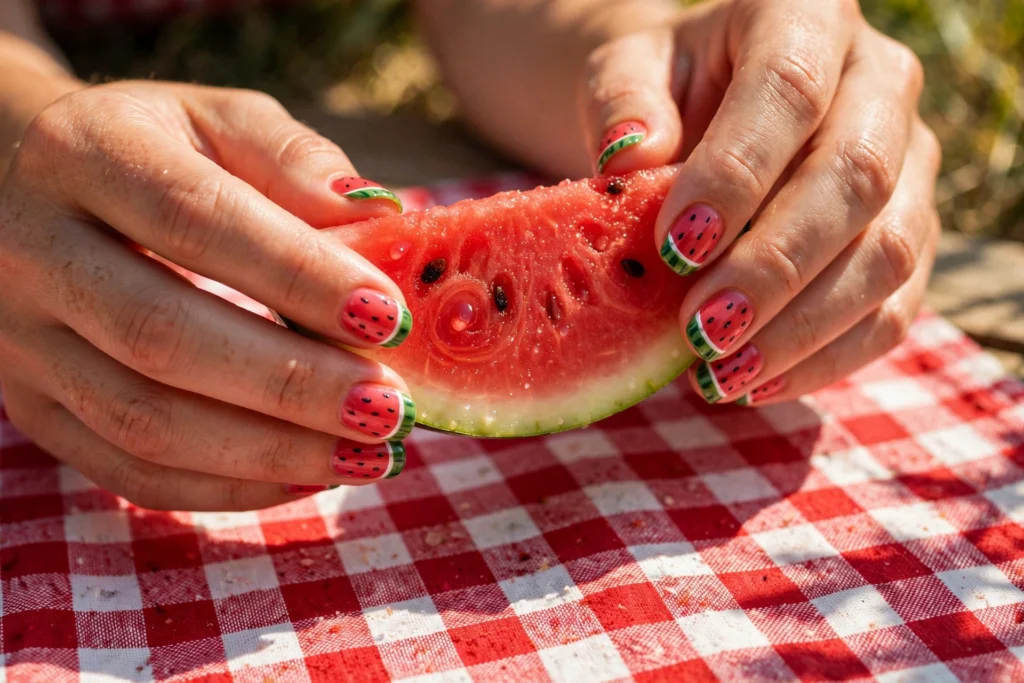
Watermelon nails are the loudest fruit in the bowl and they know it: a red-pink flash, a white line, a green rind, and suddenly your hands are the most summer thing in the room — more summer than the actual melon, which is mostly water and disappointment seeds. This is the design that gets photographed at every picnic, and it is built from straight lines and dots, which is why it works on real hands at kitchen tables.
Jump to section
The tutorial I work from is MelzyGames’ watermelon nail art tutorial — a full design walkthrough, as its title states — and the approach is the classic slice construction: the nail becomes the wedge, with the rind at the tip or the cuticle depending on which way you slice it. What follows is that construction with my own notes on the two decisions that make or break the design — where the rind goes, and how few seeds is enough — plus the French-tip variant for readers who want the joke at a lower volume.

What you need
Four colours and one tool: a watermelon red or hot pink for the flesh, white for the pith line, leaf green for the rind, black for the seeds, and a toothpick or the smallest dotting tool you own. A striping brush helps the rind line but a steady toothpick does the job. The colour choice is the design’s whole drama — the red must be juicy, bordering on coral-pink, because a brick red reads as tomato and starts a different conversation. If your shelf already holds our strawberry nails red, hold it against a real melon slice: watermelon flesh is pinker and brighter than strawberry skin, and the difference shows at arm’s length.
The slice, two ways
Construction one, the full slice: flesh colour over the whole nail, then the rind built at the free edge — a green band at the very tip, a thinner white band inside it, seeds dotted through the red. Construction two, the reverse slice: the rind sits at the cuticle, green first, white line, then the flesh sweeping to the tip. The first reads better on longer nails, where the tip has room for two bands; the second flatters short nails, because the colour weight sits where the nail is widest and the tip stays clean. Both are painted in the same order of logic — dark structure first or last depending on your hand’s steadiness — and both want each band fully dry before the next, because green over wet white makes a swamp colour nobody ordered. The tutorial’s pacing here is the patience part of the design; the painting itself is beginner work.
Seeds: restraint is the realism
Real watermelon seeds arrange themselves loosely towards the centre of the slice, shrinking as they go — and on a nail, three to five seeds per nail, placed off-grid, is the whole truth. Ten seeds in rows is a dalmatian. Use the toothpick’s point, dip once per seed, and taper the last dots to pinheads. On the ring finger only, you may cheat one seed into a tiny heart; the internet has opinions but the picnic will forgive you. Seeds are also where the design forgives beginners: a wobbled seed is still a seed, because nature’s are not symmetrical either. Our gingham picnic nails make the same point about pattern — the hand-drawn irregularity is the charm, not the flaw.
The French variant and the accent compromise
If the full slice is a shout, the watermelon French is the same joke told quietly: a green tip where the white would go, a whisper of white under it, flesh-pink sheer over the bed, seeds on two nails only. It takes the design into offices and weddings while keeping the punchline. The accent compromise — full slices on ring fingers and thumbs, plain red-pink on the rest — is what most people actually wear past day two, because the full set’s charm is real but its company is constant. Match the plain nails to the flesh colour exactly; a near-miss pink next to the slices looks like a printing error. Top coat everything in high gloss: watermelon is a wet fruit, and matte top coat on this design is a lie about its nature.
Skin tones and nail lengths
The flesh colour does the flattering. Cool skin wants the pink-leaning melon; warm and olive skin glows against the coral-leaning one; deep skin carries the brightest, almost-neon melon red with the authority it deserves — if in doubt, go brighter on deep skin, never murkier. Short nails take the reverse slice or the French; long almonds can hold the full slice with a curved rind that follows the tip’s smile line, which is the version that stops strangers. Square nails give the straightest rind bands and the most graphic result — the design’s poster form. And the green matters more than the red: a yellow-leaning green reads unripe, a blue-leaning green reads rind. Test the green on one tip first; it is the band the eye checks for truth.
Wearing and keeping them
Expect the design to peak at days two to five — the gloss settles, the colours look eaten-in. Refresh the top coat at day three and the seeds stay sharp. The rind bands chip first at the tip’s corners, as all tips do; a two-minute rescue with the green and a toothpick restores them without repainting the nail. Removal is ordinary, though the green may haunt dry cuticles for a day — oil fixes it. Pair the set with actual melon at least once while wearing it; the photograph is obligatory and our lemon nails for summer readers will confirm that fruit-on-fruit is this site’s favourite genre.
Frequently asked questions
Are watermelon nails hard to paint?
No — they are bands and dots, no freehand drawing beyond straight-ish lines. The only skill is patience between bands. A first attempt on one hand, French-style, takes about twenty minutes.
Can I do watermelon nails on short nails?
Yes — choose the reverse slice (rind at the cuticle) or the watermelon French. Both were made for short nails; the full tip-rind slice is the one that wants length.
What red should I use for the flesh?
A bright pink-red, closer to coral-pink than to brick. Hold the bottle against a real slice in daylight: if the polish looks darker and browner than the fruit, it is a tomato waiting to happen.