Sunset Nails: The Whole Sky on Ten Fingertips
Sunset nails sponge the whole sky onto each fingertip: orange at the horizon, pink in the middle, violet at the top. No mud, guaranteed at home.

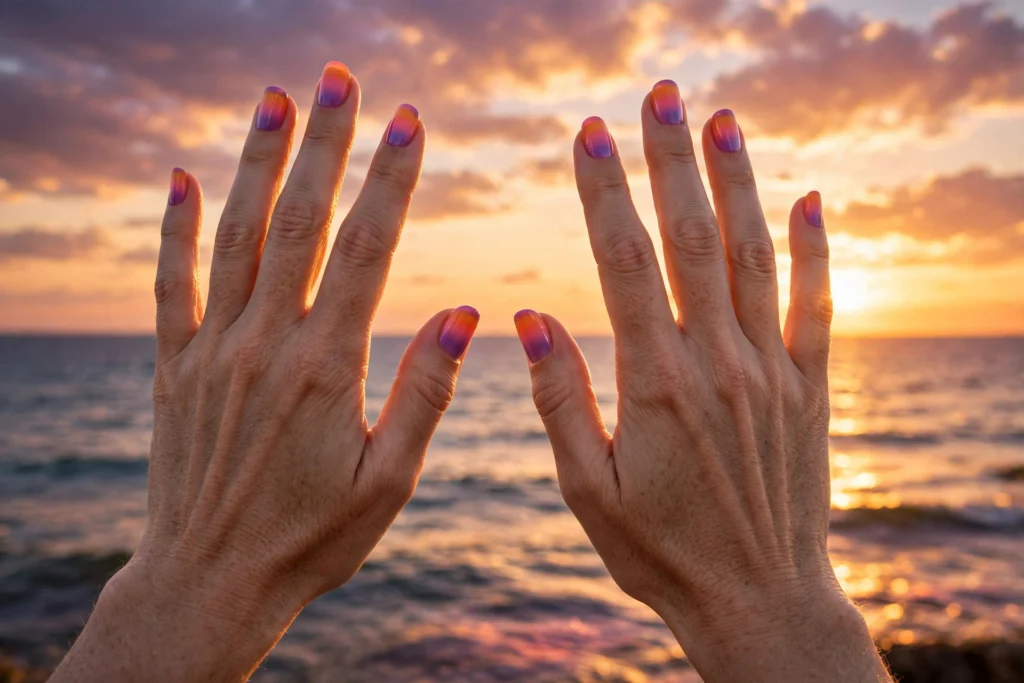
A sunset is the one gradient nobody has to explain: orange at the floor of the sky, pink in the middle, violet at the top, and every human who has ever watched one agrees on the order. Sunset nails borrow that agreement. Sponged in three bands, they carry the whole evening on each fingertip — and they hide their own secret, which is that a gradient is the most forgiving design in nail art, because the sky never blends perfectly either.
Jump to section
The reference is Nail Canvas’s sunset nail art tutorial — a design-led build, as the title says — and the method is the sponge gradient with the horizon placed deliberately rather than wherever it lands. What follows is that construction with my own notes on colour order (the mistake everyone makes first), the silhouette question — a sunset with or without its palm trees — and how to keep the blend from going muddy, which is the only way this design fails.

What you need
Three gradient colours — a true orange, a coral-pink, a violet — plus a makeup sponge, a white or pale base, and optionally black polish and the finest brush for silhouettes. The base is strategy: painting the gradient over white makes the colours pay full saturation, the poster-sunset look; over a pale pink base it goes duskier and softer. The technique is a cousin of our ombre nails with a sponge — same tools, but ombre fades one colour into another while a sunset keeps three citizens in their districts, banded, not blended into one.
The order of the sky
Here is the mistake: beginners arrange the colours by preference — prettiest in the middle — and the nail reads as a rainbow’s cousin. The sky’s order is not negotiable and it is also counter-intuitive on a nail: the light lives at the horizon. On the nail, the horizon sits at the tip or the cuticle depending on your composition, but the sequence runs the same — yellow-orange where the sun is, then orange, then pink, then violet where the day ends. Four bands beat three if your nails are long enough; on short nails, three honest bands beat four cramped ones. Paint the stripes on the sponge in the sky’s order, sponge, and do not inspect after one pass — gradients declare themselves at the second pass, and the first always looks like a rumour.
Blending without mud
Mud is over-blending: colours sponged so many times they surrender their borders and become brown’s extended family. The defence is restraint and chemistry. Two passes, three at most, dabbing straight down without dragging sideways. Keep the middle band — the pink — wide, because it is the diplomat that lets orange and violet share a nail without mixing into each other. If a border does go muddy, the rescue is a whisper of the middle colour re-sponged exactly on the border, not a full repaint. Let each nail rest a full minute before top coat, and use a top coat that advertises itself as non-dragging, or float it on with a loaded brush: a dragging top coat smears the sky sideways, and a smeared sunset is just weather.
Silhouettes: the palm-tree question
The silhouette — black palm fronds, a bird or two, a sailboat — is what turns a gradient into a scene, and it is optional in the strong sense: the design is complete without it. Add silhouettes when you want the postcard; the rules are smallness and placement. One frond entering from a corner, birds as two-stroke marks high in the violet, everything kept near the edges so the sky remains the subject. The finest brush, polish thinned by its own freshness (old polish drags into tar), and the confidence to stop: a silhouette repainted three times becomes a blot with a biography. Our aura nails without airbrush make the twin point about restraint — atmosphere first, incident second, incident optional.
Sunset variants: dusk, dawn and the neon hour
The same sponge holds other skies. Dawn reverses the drama: pale gold at the cuticle rising to the powder blue of our sky blue nails, softer, the version for people who find sunset loud. Tropical dusk swaps the violet for a deep teal and runs the orange hotter — the sea enters the composition. The neon sunset electrifies everything a register up, hot pink into tangerine into acid yellow, and joins the family of our summer brights as the one neon design with a landscape excuse. Matte top coat over a sunset is unexpectedly moving — it reads as paper, a print of the sky — while gloss keeps it photographic; choose per mood, and know that gloss photographs truer to the tutorial’s finish.
Lengths, wear and the photograph rule
Long nails are the design’s cinema screen — the full four-band sky with a silhouette earns its canvas. Short nails take the three-band dawn version with no silhouette and lose nothing but acreage. Wear is kind: gradients hide tip wear inside their own variation, and regrowth at the cuticle is softened if the cuticle band is the pale one — design your direction with regrowth in mind and the set ages like a photograph, not a deadline. And the photograph rule: sunset nails must be photographed against an actual sunset once. It is not vanity; it is peer review.
Frequently asked questions
Why does my sunset gradient look muddy?
Too many passes, or colours blended sideways. Dab straight down, stop at two or three passes, keep the pink band wide as a buffer between orange and violet, and re-sponge a whisper of pink on any border that browns.
What order do the colours go in?
The sky’s order: lightest at the horizon (yellow-orange), then orange, then pink, then violet at the top. On the nail the horizon can sit at tip or cuticle, but the sequence never shuffles.
Do I need the palm tree silhouette?
No. The gradient alone is the finished design; the silhouette is an optional postcard detail. If you add one, keep it small, black and at the edges — the sky stays the subject.