
Crochet Pineapple: The Welcome Symbol, in Yarn
The crochet pineapple carries three centuries of welcome in yarn: a cross-hatched golden body, a crown of green spikes, keyring to doorstop.

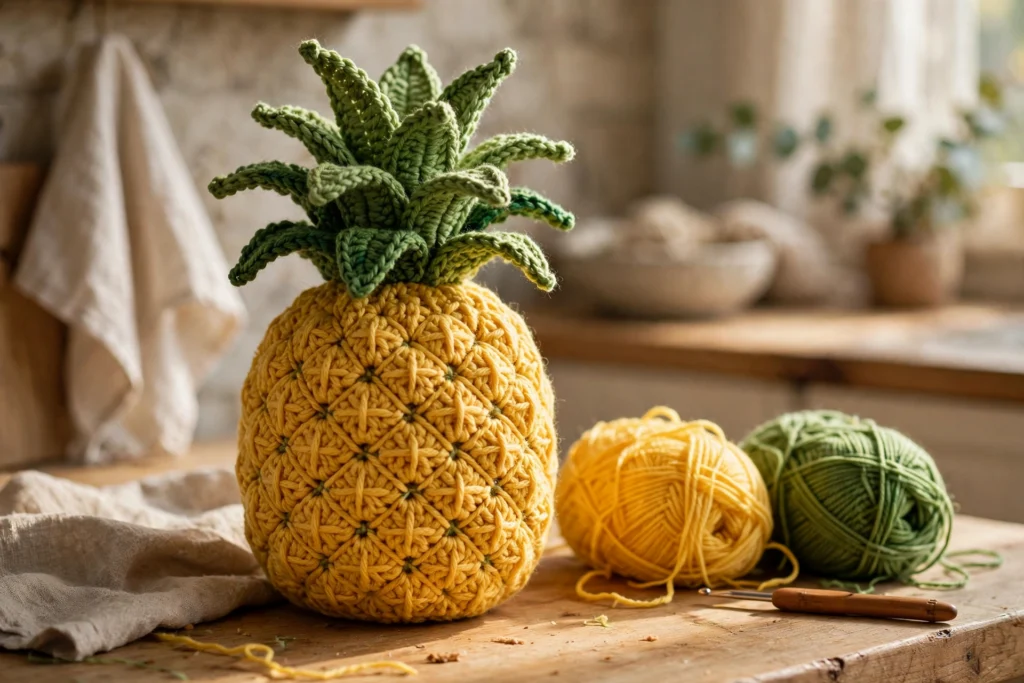
The pineapple has been the symbol of welcome for three hundred years — carved over doorways, cast in brass, printed on tea towels. The crochet version earns its place in that lineage: a golden, cross-hatched body under a crown of green spikes, palm-sized, and smug about never going brown at the edges. It is the fruit bowl’s extrovert and the keyring’s final boss.
Jump to section
The tutorial I work from is Happygurumi’s pineapple — a step-by-step amigurumi pattern, free as its title says — and its defining choice is the body stitch: a textured, diagonal-crossed surface that reads as pineapple skin before a single colour change happens. What follows is that build with my own notes on where the texture can go wrong, how the crown leaves get their architecture, and the sizing ladder from keyring fruit to doorstop.

What you need
Golden-yellow yarn — mustard’s brighter cousin, not lemon and not orange — green yarn in two shades if you have them, a hook small enough for a stuffing-proof fabric, stuffing, and a needle. The yellow is the decision: too pale and the fruit reads as a lemon with a hat; too orange and it is a mango in fancy dress. Hold the ball against a real pineapple’s photograph in daylight. A few black or brown embroidery stitches are optional — the texture carries the skin on its own, which is the elegance of this design next to our crochet strawberry, whose seeds must all be added by hand.
The body: an oval that stands its ground
The pineapple body is an egg’s taller relative: a rounded base that flattens just enough to stand, a gentle swell through the middle, and a top that closes only slightly before the crown takes over. The tutorial shapes it with the standard amigurumi increase ladder, then holds the middle rounds plain — and those plain rounds are where patience pays, because a pineapple is mostly middle. Stuff it firmer than feels polite: the textured stitch sits proud of the surface, and a softly stuffed body lets the cross-hatch sink into quilting. A flat base is engineered, not hoped for: the last base rounds are worked without the final increases your instincts suggest, and the fruit is stood up and checked before the crown begins.
The skin: texture does the talking
The cross-hatch is the pattern’s signature — a stitch worked so each round’s texture slants against the last, building the diamond lattice of the real skin without a single colour change. It is a rhythm stitch: two rounds in, your hands know it, and the only discipline left is tension. Work the texture rounds slightly tighter than the shaping rounds, or the diamonds stretch vertically as the body swells and the lattice turns to netting. Count the repeats at each round’s end — a dropped repeat in a texture pattern does not show immediately; it shows three rounds later as a spiral where diamonds should be, and by then the frogging is real. The payoff for the care is a surface that catches light like the fruit itself, which is why this design needs no painted details at all.
The crown: architecture in green
A pineapple is half crown, visually — and the tutorial treats the leaves as a built structure, not a garnish: several pointed leaves in two lengths, the tall ones at the centre, shorter ones ringing them, each leaf stiffened by its own stitch density and angled outward as it is attached. Work the leaves in two greens — deep for the outer ring, brighter for the new growth at the centre — and the crown gains the depth of the living plant. Attach leaves one at a time, standing the fruit up between each to check the silhouette: the crown should flare, not spike straight up like a mohawk, and not flop like a bad hair day. A thirty-degree outward lean is the living angle. Our crochet butterfly notes make the same point about wings — the angle of attachment is the difference between made and alive.
Sizes: from keyring to doorstop
In DK yarn the fruit stands about fifteen centimetres, crown included — fruit-bowl scale, true to life. In fingering yarn with a small hook it becomes the keyring and bag-charm size, the version that gets ordered by colleagues; in chunky yarn it turns into the doorstop and the playroom fruit, stuffing swapped partly for weight at the base. Keep the crown proportional as you scale: the leaves are a third of the total height at every size, or the fruit reads as all body. A trio — one true-size, two small — is the classic still life,. They make their way into our easy crochet gift ideas for exactly that reason: nobody has ever been given a crochet pineapple and failed to smile.
Pairs and presentation
The pineapple plays well with others. With the strawberry and the ice cream it completes the summer fruit-bowl set this batch has been quietly building; on its own, tied with raffia through the crown, it is a housewarming gift with three centuries of symbolism doing the talking.
Care and keeping
Surface-clean with a damp cloth; the textured skin traps dust in its diamonds, so a soft brush or a cool hairdryer pass every so often keeps the gold bright. Full washes are safe if the stuffing is synthetic — reshape the crown while damp, teasing each leaf back to its lean, and dry standing up. Kept out of harsh sun the yellow holds for years; the crown greens are the first to fade, and a faded crown on a golden body reads as a ripe fruit in September, which is hardly a failure.
Frequently asked questions
How long does a crochet pineapple take?
Two to three hours in DK yarn, split between the textured body and the crown. The body alone is an evening; experienced hands finish the whole fruit in one long sitting.
Is the textured stitch hard?
No — it is a variation on standard stitches, demonstrated slowly in the tutorial, and it settles into rhythm within two rounds. The skill it teaches is tension-keeping, which every later amigurumi project will thank you for.
How do I stop the crown leaves flopping?
Dense stitches, a smaller hook for the leaves than for the body, and attachment angles checked standing up. A leaf worked firmly holds its lean without wire — wire only enters play at doorstop scale.




