
Crochet Watermelon Coasters: A Slice Under Every Glass
Crochet watermelon coasters dress every cold glass for summer: red flesh, white pith, green rind, ten minutes a slice, a set by the evening.

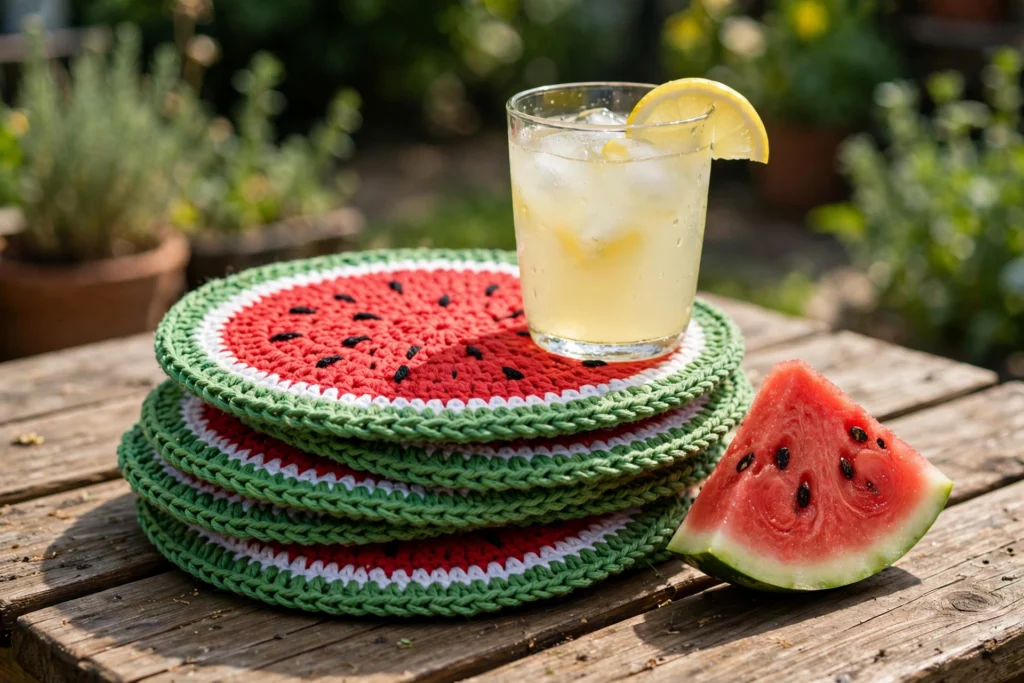
A watermelon slice that never drips on the table — because it is the thing protecting the table. The crochet watermelon coaster is the summer make that photographs like a lifestyle shoot and works like a farmhand: ten minutes a slice, a stack of six by the evening, and every cold glass in the house suddenly dressed for the season.
Jump to section
The tutorial I follow is RonariCrochet’s watermelon coaster, taught step by step as its title promises, and the design is the classic one: a semicircle slice in three rings of colour — green rind, white pith, red flesh — with the seeds added last. What follows is that build with my own notes on flatness (a coaster that curls is a small bowl with ambitions), seed placement, and the set-building maths that turns one slice into a whole fruit’s worth of table dressing.

What you need
Cotton yarn in four colours — watermelon red, white, leaf green and a scrap of black — a hook sized for a firm, flat fabric, and a needle for the seeds. Cotton is not a preference here, it is the job specification: coasters meet cold glasses and condensation, and acrylic slides, stretches and insulates poorly, while cotton grips the glass, absorbs the drip and washes back to new. One ball of red makes a family of slices. The design kinship with our crochet strawberry is obvious — the same summer fruit bowl, worked flat instead of stuffed — and the two read beautifully as a set.
The slice: three rings, one flat circle
The coaster is a circle worked in colour bands, then folded by nothing more than presentation — most watermelon coasters are full circles styled as slices by their seeds, or true semicircles worked in rows. The tutorial’s version builds the round slice: red first, out to the flesh’s edge, a single round of white for the pith, then green for the rind. Flatness is decided in the increase rhythm — too few increases and the edge ruffles like a lettuce; too many and the centre humps. The standard circle maths holds: increase evenly, count every round, and lay the work flat at each colour change to check. A coaster has one job beyond beauty — a glass must stand on it without rocking — so check with an actual glass before the seeds go on. Steam or a firm press under a book finishes what good counting started.
The white ring is doing more than you think
Beginners are tempted to skip from red straight to green. Do not. The thin white pith ring is what makes the slice read as watermelon rather than as a Christmas bauble: it is the colour break the eye uses to parse rind from flesh, exactly as in the fruit. One round is enough; two rounds push the slice towards target practice. The same discipline — the quiet in-between colour doing the realism — governs our crochet heart coasters, where the edge round defines the whole shape. Keep the white round’s stitches the same height as its neighbours or the pith will ridge, and join each colour change at the same point of the circle so the joins stack into one tidy seam line at the back of the set.
Seeds: embroidery, placement and restraint
Seeds go on last, as short black stitches or tiny knots, and their placement follows the fruit: scattered through the red in loose arcs, never in rows, never at the very edge, and fewer than instinct suggests — six to nine per slice. Real watermelon seeds near the rind are small and pale; crochet seeds are a graphic device, so treat them as punctuation, not confetti. Work them with the yarn tail threaded on a needle, entering and leaving through the same holes so the back stays smooth — a coaster’s back is on display every time it is lifted, and a knotted battlefield underneath will also rock the glass. For a child’s set, embroider the seeds as tiny cream stitches instead: seedless watermelon, zero choking hazards, same joke.
Building the set
Six slices make a set; eight make a party. Work them production-line style — all the red rounds, then all the white, then all the rinds, seeds last across the whole batch — and the set keeps one tension and one size, which individual evening-by-evening coasters never quite manage. Vary one thing only if you must: a single slice in pink flesh, the variety the supermarkets call unique, as the odd one that starts conversations. Stacked and tied with twine, a set of these is the summer house gift that never gets regifted, and a slice slipped into a card has rescued more forgotten birthdays than any of us will admit. For the full table, they sit naturally inside our garden party crochet projects — bunting above, slices below.
Beyond coasters: the slice’s other lives
The same motif scales. Worked in chunky yarn it is a trivet for the lemonade jug. Worked in fine thread it is a keyring or a zip pull. The semicircle variant — worked in rows from a chain — drapes over a glass as a cover against summer insects, which is the slice’s oldest job in Mediterranean kitchens and a genuinely useful one at every picnic.
Care and keeping
Machine wash cool, dry flat, press briefly if the edge waves. Cotton coasters actually improve with washing — the stitches settle and the slice lies flatter. Expect the red to hold for years if you keep the set out of permanent sun; a windowsill stack will fade to a charming vintage pink by August. Replace singles without ceremony: the pattern is ten minutes, and a fresh slice among veterans looks like the fruit was topped up, not repaired.
Frequently asked questions
How long does one watermelon coaster take?
About ten to fifteen minutes once the circle rhythm is familiar — the fastest full make in this batch. A set of six, worked production-line style, is a single relaxed evening.
Why must coasters be cotton?
Absorbency and grip. Cotton drinks the condensation ring before it reaches the wood and holds the glass steady; acrylic repels the water into a puddle and slides. For anything that meets a cold glass, cotton is the working yarn.
How big should a coaster be?
Aim for ten to eleven centimetres across — wide enough for a mug’s base with a margin for the drip. The tutorial’s slice lands in that range in DK cotton; adjust the final rind round if your tension runs small.




