Crochet Beach Cover-Up: More Than a Swimsuit, Less Than a Dress
A crochet beach cover-up is two rectangles of open stitch honestly joined: more than a swimsuit, less than a dress, truly beginner-achievable.

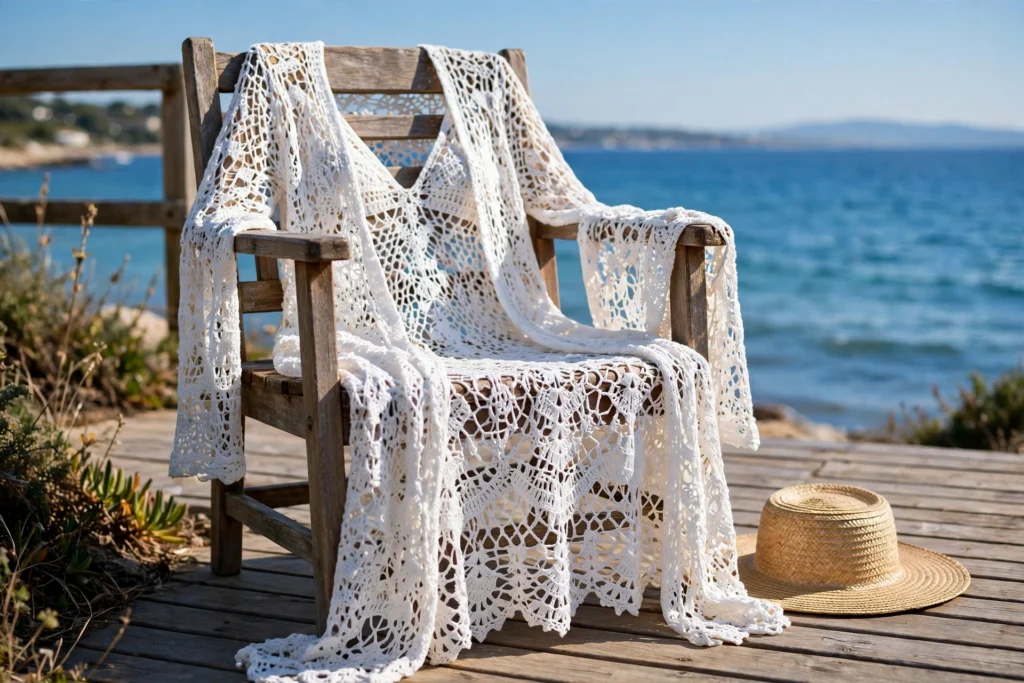
The beach cover-up is the garment with the easiest job description in fashion: be more than a swimsuit and less than a dress, survive sand, salt and a beach-bar lunch, and look like you planned it. The crochet cover-up owns this category — open stitches, zero tailoring, inherently glamorous — and it is achievable by genuine beginners, which is the part nobody believes until they have one.
Jump to section
The reference is The Crochet Crowd’s beach cover-up tutorial — easy and beginner-billed in its title, from one of crochet’s most patient teaching channels — and the construction is the friendly one: simple panels in an open stitch, joined at the shoulders and sides, sized by measuring your own body rather than decoding a fashion pattern. What follows is that build with my own notes on drape (the whole game with cover-ups), the measuring method, and length decisions, because a cover-up’s hemline is its personality.

What you need
Cotton or a cotton-rich yarn in a DK or light worsted weight — enough for a garment, so think in hundreds of grams: 400 to 600 covers most sizes, openwork being mercifully economical. Cotton wins for the established reasons: it dries fast, survives washing, and its weight gives the openwork its drape rather than a cling. Bamboo blends drape even silkier and are the luxury pick. The hook runs a size larger than the band suggests — cover-up fabric must be fluid, and a beginner’s instinct towards tight stitches is the one thing to unlearn here. You are not making armour; you are making a suggestion of a dress. Our crochet summer top is this garment’s fitted cousin — same yarn logic, tailored ambitions.
The stitch: open, simple, repeatable
Cover-ups live on a paradox: the lacier the stitch, the more expensive the garment looks. The tutorial builds on a simple openwork repeat — chains and tall stitches in a forgiving rhythm — that a beginner can hold without counting every third stitch, and that produces the netted, breezy fabric the beach wants. Gauge discipline is relaxed but not absent: the fabric must be even, not exact, and a swatch washed and dried tells you the truth about the finished drape, because cotton openwork relaxes by about ten per cent on first contact with water. Work the swatch. The cover-up you measure unwashed is a size smaller than the one you will wear, and it will choose the hottest day of the year to reveal this.
Construction: panels, shoulders, sides
The architecture is two rectangles — front and back — joined at the shoulders and seamed partway up the sides, leaving the lower sides open as slits and the upper sides open as armholes. That is the whole engineering, and its kindness is that fitting happens with a tape measure and pins on your own body: shoulder join depth decides the neckline, side seam height decides the modesty, and both are adjustable until the moment you sew. Try it on over the swimsuit it will serve. The neckline can be squared by the shoulder joins or scooped by joining less and adding a chain bridge — the tutorial shows the straightforward version, and a hundred summers of makers have personalised from there. Among our summer crochet projects, this is the one that teaches garment confidence: rectangles, honestly joined, become clothing.
Length: the personality decision
Hip length is a top with ambitions — good over shorts, shy at the beach bar. Mid-thigh is the classic cover-up, the one in every holiday photograph since 1975. Knee length and below is the drama register: a long openwork cover-up over a swimsuit, moving in sea air, is a full outfit and asks nothing else of the day. Decide by your actual itinerary — the walk from beach to lunch is the cover-up’s catwalk, and its length should suit the journey you really take. Because the panels grow from the hem or the shoulder in one repeat, length is adjustable almost until the end: hold the panel against yourself at every ten centimetres in the decision zone, in a mirror, in the swimsuit. The mirror is a better counsellor than the pattern.
Edges and finishing
Openwork needs a frame. A round or two of firm stitches at the hem, neckline and armholes gives the lace its finished edge and stops the stretch creeping where bodies pull it. The hem edge takes the most weather — bags, bicycle baskets, car doors — and a slightly denser hem band also weights the drape beautifully, the way a chain weights a curtain. Ties or a belt are optional architecture: a crocheted cord at the waist turns the beach layer into lunch dress, and a wooden bead at each end is the whole jewellery budget.
Colour and styling
White and ecru are the eternal cover-up colours because they make every swimsuit underneath look deliberate and every skin tone look rested. Black is the city-beach sophisticate. The brave and correct third option is the colour of your favourite swimsuit repeated — a coral cover-up over a navy costume is a designed outfit, not a thrown layer. Teamed with our crochet sun hat and the beach bag from this same batch’s table, the cover-up completes a fully handmade walk to the water — the quiet flex of the summer crocheter.
Care and keeping
Wash cool, dry flat or draped over a chair back — never hung by the shoulders wet, which stretches the joins into a permanent shrug. Salt rinses out the same day if you can; cotton tolerates it, but the fabric’s hand stays silkier for the rinse. Store folded, not hung, in winter. A cover-up made to these sizes and this stitch will serve for years.
Frequently asked questions
Can a real beginner make a cover-up?
Yes — it is two rectangles of one repeating open stitch, joined in straight lines. If you can chain and work a tall stitch evenly, the garment is within reach, and the tutorial teaches at a beginner’s pace throughout.
How much yarn does it take?
Roughly 400 to 600 grams of DK cotton for mid-thigh length, depending on size — openwork is economical. Buy one ball more than the estimate; dye lots are unforgiving and a spare ball becomes the matching hat.
How do I get the size right without a pattern model?
Measure your own body at bust and hip, work a washed swatch, and count your stitches to those measurements rather than copying a size label. The panels are rectangles: your tape measure is the pattern.