
Crochet Heart Garland: A String of Little Hearts
A crochet heart garland from one small motif, repeated: sizing and spacing maths, two ways to string the hearts, and colour stories beyond February.

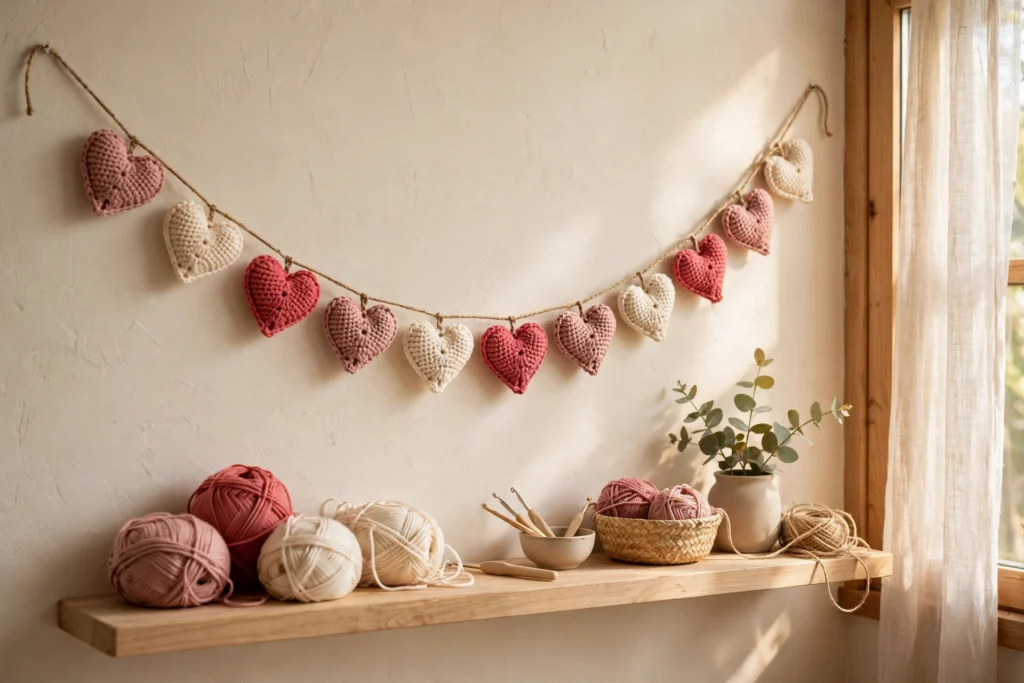
There is a particular pleasure in decorating with something you made from a ball of yarn and an hour. This heart garland is my February ritual: a string of small, plump crocheted hearts in rose, red and cream, draped over the mantelpiece, and every year I add a few more hearts to the string. It is also the friendliest first decoration a beginner can make, because the whole project is one small heart, repeated.
Jump to section
The tutorial I follow is Simply Made by Erin’s, below — her heart shape is the neatest I have found, worked in the round so there are no seams. My additions: how to size the hearts, the spacing maths for different drops, and the two ways to string them depending on whether you want rustic or neat.

The heart itself
Each heart starts with a magic ring — if that is new to you, my how to crochet a magic ring walk-through breaks it into four moves — and is worked in a single round of increasingly tall stitches: trebles bunched at the top to form the two lobes, doubles and half doubles down the sides, and one pointed chain stitch at the bottom. The whole heart takes about ten minutes once your hands know it. Work the first one slowly and count out loud; by heart three you will be watching television while you make them, which is rather the point of a garland.
What you need
- Worsted (aran) cotton or acrylic yarn in two or three colours — a ball of each makes a long garland
- A 4mm or 5mm hook, to match your yarn
- Scissors and a yarn needle
- Twine or a length of yarn in a neutral shade for the string
- Optional: a little stuffing if you want plump, padded hearts
Sizing and spacing: the garland maths
Decide the drop first. Measure where the garland will hang, then add a third again for the swag — a garland that hangs in a curve needs more length than the straight-line measurement suggests. For a mantel of about 120cm, I make a 180cm string with nine hearts spaced roughly 18cm apart, plus a plain tail at each end for tying. Table garlands can be denser and shorter. If you want bigger hearts, go up a yarn weight rather than adding rounds; the shape scales cleanly in chunky yarn and looks wonderfully bold over a doorway.
Two ways to string them
The neat way: thread the string through the top of each heart with a yarn needle, passing behind the two lobes so the heart hangs straight, and tie a tiny knot behind each one to lock its position. The rustic way — my favourite — is to crochet the cord itself: chain a long foundation, and as you reach each spacing point, slip-stitch through the top of a heart and keep chaining. The hearts become part of the cord, nothing can slide, and the whole garland is one unbroken piece of crochet. Whichever you choose, hang it and step back before finalising spacing; hearts bunch differently under gravity than they do laid flat.
Colour stories and where it earns its keep
Classic Valentine is rose, red and cream in rotation. But the same garland in all cream is wedding-pretty, in pastels it becomes nursery bunting, and in mustard and rust it carries straight into autumn. I keep one neutral string up all year and swap the coloured hearts by season — the stringing method makes that a five-minute job. As a gift, a short five-heart garland folded into a card is the grown-up version of a Valentine, and it uses the same heart as my easy crochet heart tutorial, so if you learned the motif there, you already know this project. More ways to turn small makes into presents live in easy crochet gift ideas.
Troubleshooting: twisting hearts and sagging strings
Hearts that twist sideways on the string were threaded through one lobe only — the cord must pass behind both lobes, or through the heart’s top centre stitch, so the weight hangs evenly. A garland that sags in deep scallops between fixings needs either a shorter span or a third fixing point in the middle; twine stretches under a wet-weight of yarn more than you expect, so hang it, wait an hour, and re-tension before you call it done. Hearts of slightly different sizes in one garland are not a problem to hide but a rhythm to use — alternate large and small deliberately and the eye reads pattern instead of error. And if your hearts’ lobes keep coming out uneven, count the treble cluster aloud on the next three; lobe symmetry is a counting issue nine times out of ten.
Making it a tradition
The reason my garland grows every year is that hearts are dated little artefacts: the cream ones from my first attempt are visibly less neat than this year’s, and I would not replace them for anything. Consider making two hearts a year in the year’s colours and adding them to the ends — in a few seasons the string becomes a timeline. It is also a gentle project to hand a visiting friend or a teenager who “can’t craft”: ten minutes later they have made a heart, and the garland keeps it.
Frequently asked questions
How long does a garland take to make?
About ten minutes per heart once you know the shape, plus stringing. A nine-heart garland is a comfortable two-evening project for a beginner, or one long film for an experienced crocheter.
My hearts keep curling. How do I flatten them?
Cotton yarn and a quick steam block fix most curl: pin each heart to shape, hold a steam iron above (not on) it for a few seconds, and let it cool flat. Acrylic hearts flatten with a warm — never hot — iron over a cloth.
Can I make the hearts two-sided and plump?
Yes: make two hearts per motif, join them around the edges with slip stitches, and tuck in a pinch of stuffing before closing. Plump hearts hang straighter and look especially good in the crocheted-cord method.




