
Crochet Hooded Scarf: Turn a Simple Scarf into a Scoodie
A crochet hooded scarf from one ribbed rectangle: the fold, the seam, honest sizing for adults and children, and yarn that keeps its hug.

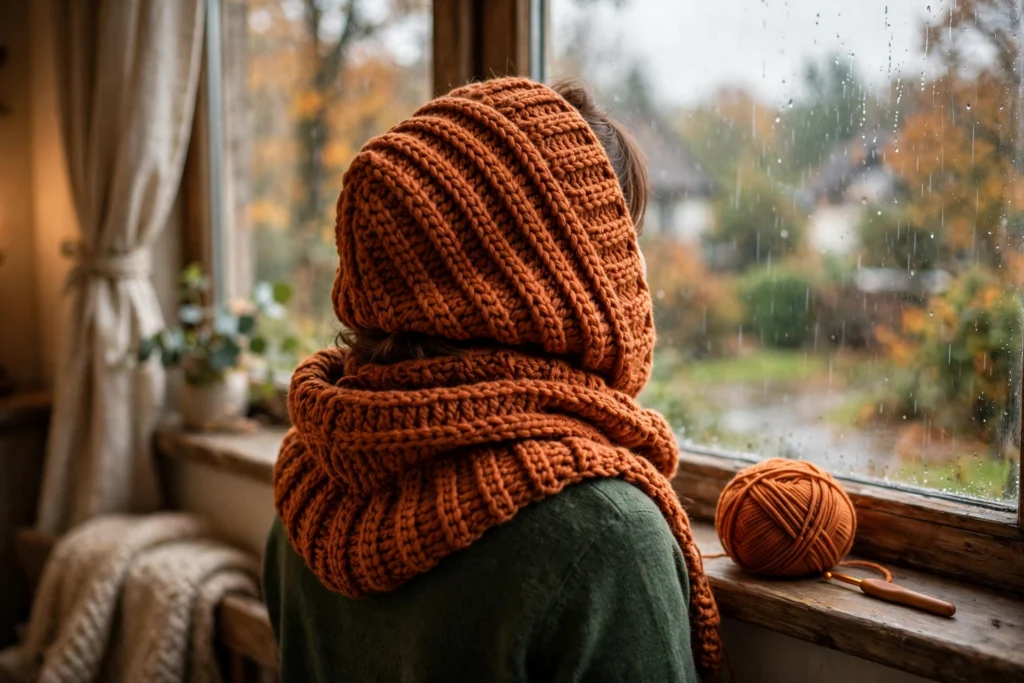
Some projects are clever, and some are simply a rectangle that changes its life. The hooded scarf — the scoodie, if you like a word that sounds like a hug — is the second kind. You crochet a long, simple scarf, fold one end, sew one short seam, and suddenly you own the single most useful thing in a November wardrobe: scarf and hood in one, no hat hair, no gap at the back of the neck where the wind gets in.
Jump to section
The tutorial below is Diving Ducks Crochet’s version, which turns a plain scarf into a hooded one with exactly that fold, and it is the clearest demonstration I have found of why the seam goes where it goes. What follows is that method with my notes on ribbing, honest sizing for adults and children, and the yarn choices that keep a hood graceful instead of bulky.

The rectangle trick, explained once
Here is the whole pattern: crochet a rectangle roughly 25–30 cm wide and 180–200 cm long. Lay it flat, fold the top 40 cm down at a right angle — or fold one end back on itself, depending on the construction you follow — and seam the folded edge. That seamed corner becomes the hood; the rest hangs as a scarf. It sounds too simple to work, and then you put it on and the hood sits exactly where a hood should, because heads, it turns out, are also mostly a fold away from a scarf. If you have made our easy crochet scarf for beginners, you have already made ninety percent of this project — the hood is a finishing decision, not a new skill.
Ribbing that hugs instead of sagging
Work the rectangle in back-loop-only half double crochet, or alternate front- and back-post doubles, and you get a fabric with ribs running across the width. Ribs matter twice here: around the face they stretch and recover like knitting, framing the hood instead of letting it slump, and along the scarf they give the drape a corduroy elegance that plain stitches cannot. Keep your tension unhurried. A ribbed rectangle worked too tightly becomes a plank, and a plank makes a hood that stands away from the head like a satellite dish — hold the fabric up every ten rows and check it still folds like a scarf.
Sizing honestly: adults, children, and the try-on fold
Before the seam, do the try-on fold: drape the rectangle over your head with the fold where the hood will be and check two things — that the hood’s point reaches mid-back-of-head without pulling the scarf tails short, and that the tails still cross your chest. Adults usually want 45–50 cm of the length given to the hood fold; children, 30–35 cm of a shorter, narrower rectangle (20 cm wide, 120 cm long is a kind starting point). Seam with a yarn needle and the same yarn, whipstitch loosely, and try it on again before weaving ends — the seam can move two centimetres either way and it changes the fit more than any other decision in the project. Pair the finished scoodie with our crochet ear warmer headband on the days the hood stays down.
Yarn and finishing
Choose a soft worsted or aran yarn with some memory — wool or a wool blend springs back around the face where pure acrylic slowly relaxes. Chunky yarn halves the making time and doubles the wind resistance, at the cost of a hood with real presence; the rust scoodie in our photograph is chunky, and it is the one that gets borrowed. Add a single large button and loop at the throat if your winters are serious, and weave the ends along the ribs where they disappear. On the coldest mornings, mine goes over our crochet fingerless gloves and under nothing else — that is the whole outfit strategy, and it has never once let the wind in.
Upgrades: pockets, tassels and the two-colour hood
The base scoodie is a perfect plain thing, but three upgrades are worth knowing. The kangaroo pocket: work a small rectangle, seam it to the front of the scarf section where your hands naturally meet, and you have somewhere for cold fingers and a phone — line the pocket’s top edge with a row of single crochet so it does not stretch into a hammock. Tassels or a fringe on the scarf ends add movement and use up the last awkward half-ball; keep them short and thick rather than long and stringy. The two-colour hood — working the folded hood section in a second, deeper shade — is the prettiest variation of all, because the fold puts the contrast exactly where the eye lands; plan it before you start by counting rows, since the colour change must fall at the fold, and the fold is decided by your try-on. Each upgrade costs an evening at most. The plain version, though, is the one I reach for daily, and there is no shame in a rectangle that knows what it is.
Frequently asked questions
How much yarn does a hooded scarf take?
For an adult in aran weight, plan on 400–500 grams — roughly five to six standard balls. Chunky yarn needs similar yardage by weight but fewer balls. Buy one extra; dye lots change, and a hood in a slightly different rust is worse than a spare ball in the stash.
Can a complete beginner make this?
Yes — it is a rectangle, a fold and a seam. The only skills are one stitch repeated and a whipstitch. It makes an excellent second project after a plain scarf.
How do I wash a wool scoodie?
Cool hand wash, rolled in a towel, dried flat with the hood shaped over a folded towel. The ribbing recovers its hug if you dry it in shape rather than hanging it, which stretches the seam.




