
Crochet Market Bag: The Mesh Bag That Folds Flat
Crochet market bag: a one-skein mesh net that folds flat, stretches around a whole shop, and has handles strong enough for a load of jars.

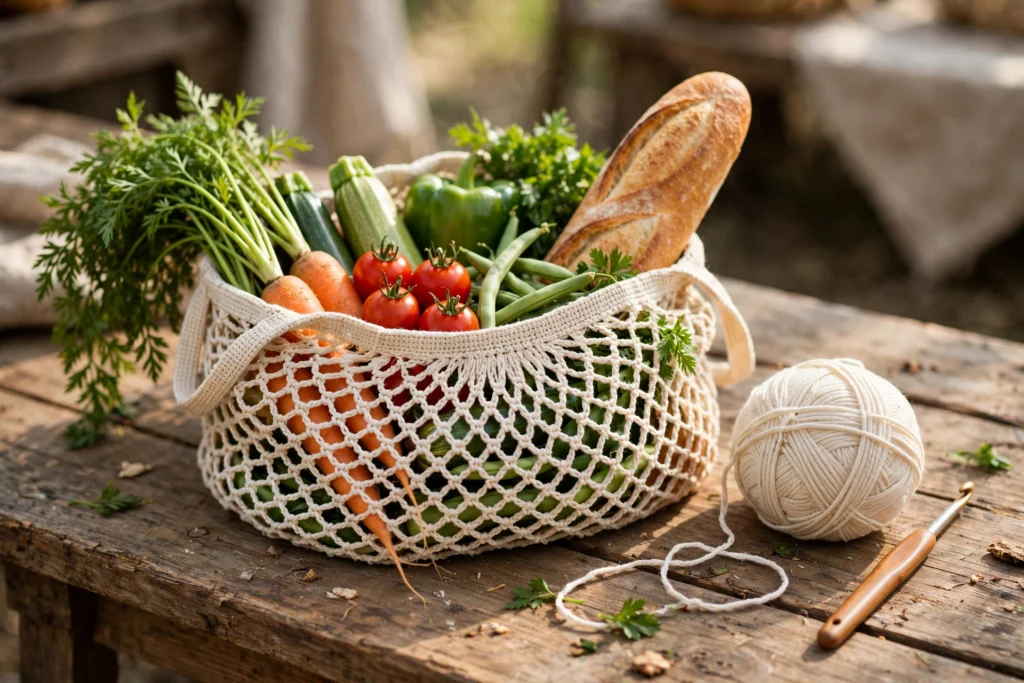
There is a particular smugness in unfolding a bag from your coat pocket at the market stall while everyone else pays for a carrier. The crochet market bag earns that smugness honestly: it is a net of chains and trebles that stretches around a whole shop, then collapses to the size of a satsuma when it is empty.
Jump to section
The tutorial below works the classic one-skein version from a solid base upward, and Zeens and Roger’s market bag is the pattern I have made more times than any other on this site. What follows is her construction with my notes on cotton choice, handle strength, and sizing the mesh so a jar cannot escape through it.

Market bag versus tote bag: the honest difference
A market bag is a net — open mesh, no lining, built to stretch. A tote is a fabric — closed stitches, structured, built to hold its shape. This site already has a closed-stitch easy crochet tote bag for books, laptops and everyday carrying; the market bag is its specialist cousin for produce, bread and beach towels, where stretch is a feature and sand falling through is a bonus. Own both and each does the job the other is bad at.
What you need
- One 100g ball of worsted or aran cotton yarn — cotton, not acrylic (see below)
- A 5mm hook, or the size that gives you a firm mesh
- A stitch marker for the base rounds
- Scissors and a yarn needle for two ends — that is all the finishing there is
Step one: the solid base
The bag starts with a closed circle of trebles that grows until it is saucer-sized — this is the floor your shopping stands on, and it is worked in ordinary rounds from a magic ring start. Keep the base smaller than you think: the mesh above it stretches generously, and an over-wide base makes a bag that drags. Count your stitches on the final base round and write the number down; the mesh maths and the handles both hang off it, and recounting a net at midnight is nobody’s idea of an evening.
The mesh body: chains, spaces, rhythm
The body is a repeating round of treble, chain three, skip, treble — a diamond net that works up astonishingly fast once your hands learn it, which takes about two rounds. The rhythm is the whole pleasure of this project: no counting beyond the first round, no pattern to consult, just the net growing in your lap. Work until the bag is as deep as a carrier bag stood on its end, then work two closed rounds of trebles or double crochet to firm the top edge before the handles. Mesh gauge is forgiving, but check the holes against a jar lid: if a chutney jar could slip through, your chains are too long — drop to chain two and the net tightens beautifully.
Handles that carry weight
Handles are where market bags live or die. The strong method: work chains for the strap length, skip the matching stitches, then work back along the chain with double crochet for a second pass — a doubled, slightly padded handle that does not cut into your hand under a load of potatoes. One long shoulder handle suits market wandering; two short handles suit car carrying. Whichever you choose, reinforce the four join points with extra stitches; every gram of the shopping hangs off them. A finished bag weighs almost nothing and lives in a pocket, a glovebox, or — my favourite — inside a crochet daisy bookmark-sized pouch clipped to a handbag strap, always there when a stall appears.
Why cotton, and only cotton
Acrylic mesh stretches and keeps stretching; a bag that starts at knee height ends at ankle height under a melon. Cotton stretches a little on first load and then holds, it washes at sixty degrees after a leek incident, and it softens rather than pills. Recycled cotton is ideal and cheap. One ball makes a standard bag — the rare project where the one-skein promise on the label is actually true.
Sizing it up and down
The pattern scales with the base: a smaller circle and fewer mesh rounds makes a produce bag for onions and oranges — make three of those first if you are new, as they are an evening each and immediately useful. A wider base and a longer body makes the beach version, sized for two towels and a paperback, where the mesh earns its keep by letting the sand fall straight through on the walk back. The standard middle size described here is the market workhorse. Whichever size you land on, finish with the same two firm rounds at the top; the handles attach to that firm edge, and a bag whose handles are anchored in mesh will stretch its top out of shape within a month of shopping.
Make the first one in the brightest cotton you own, by the way. A market bag gets left in cafés, on stall counters and in other people’s cars, and a conspicuous colour is the difference between a bag that comes home and a bag that becomes a story.
Frequently asked questions
How much can a crochet market bag actually carry?
A cotton mesh bag in this construction comfortably carries 5–7 kilos — a full market shop of vegetables, bread and jars. The handles fail before the mesh does, which is why the doubled-handle method matters.
Can a beginner make this bag?
Yes — it is chains and trebles in the round, and the base is the only counted part. If you can work a treble and count to twelve, you can make this bag in a weekend of evenings.
How do I wash it?
Machine wash with the towels, reshape while damp, dry flat. Cotton market bags get softer and stronger-feeling with washing; the mesh relaxes back to its unloaded size as it dries.




