
Crochet Table Runner for the Autumn Table
Crochet table runner for the autumn table: cotton only, the overhang rule for sizing, a washable texture repeat, and styling with leaves.

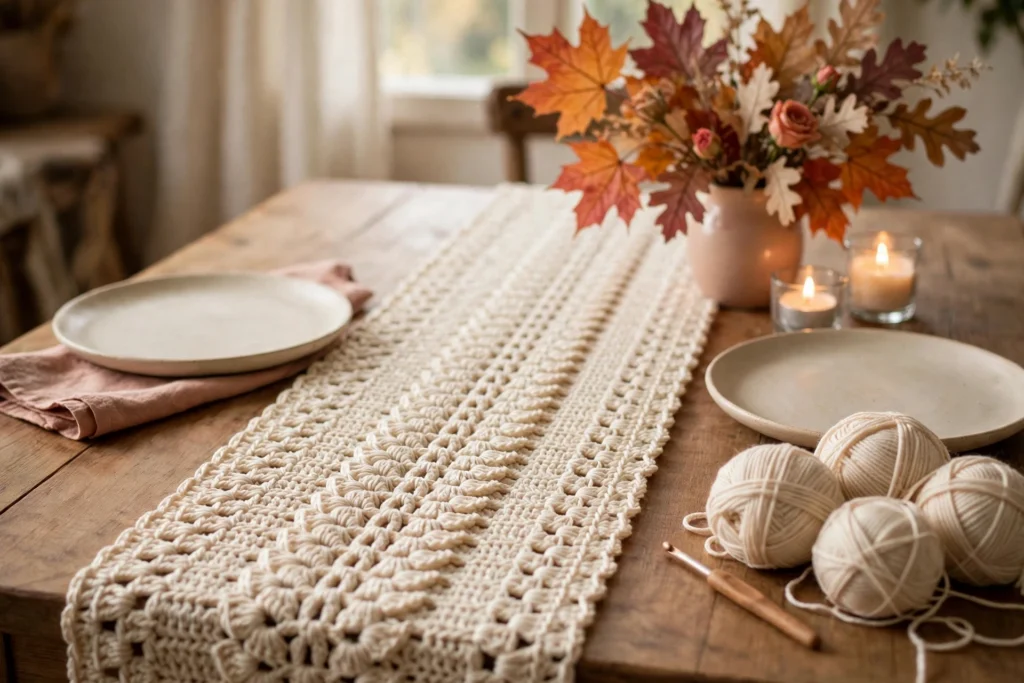
The autumn table does a lot of hosting before the year ends — harvest suppers, the first roast of the season, eventually the big December days — and a crochet table runner is the hardest-working piece of dressing it owns. One long, narrow rectangle of texture down the table’s centre: under the candles, under the serving dishes, turning an ordinary table into a set one in ten seconds.
Jump to section
The tutorial below is Stephanie Anderson’s table runner — a beginner-friendly cotton design built on a simple textured repeat and sized by measuring your own table — and it is the pattern I recommend when a reader wants home crochet that guests actually see. What follows is her construction with my notes on cotton, sizing, and styling the runner for the autumn table.

Why cotton, and only cotton
A runner lives under hot dishes, candle wax and gravy; its yarn must wash, press and forgive. Cotton does all three: it lies flat by nature, irons crisp, and shrugs off the machine wash that table linen demands. Acrylic melts near a casserole dish and wool felts in the wash — this is the one project where the fibre rules are absolute. The site’s cotton shelf earns its keep repeatedly here — the same qualities powered the summer in crochet doily coasters — and a worsted-weight cotton in cream or flax shows texture best, because autumn styling will bring the colour.
What you need
- Worsted (aran) cotton yarn — 200–300g for a standard table
- A 5–5.5mm hook, as the pattern directs
- A tape measure that reaches your table’s length — measure before you chain
- An iron and a pressing cloth — the runner is blocked by the iron, not the mat
- Optional: a second colour for the end borders or a fringe
Sizing: the overhang rule
A runner should end in one of two deliberate places: flush with the table ends (the tailored read) or overhanging by 15–25cm at each end like a tablecloth (the generous read). What it must not do is stop 5cm short, which reads as a mistake in either direction. Width is more forgiving: a third of the table’s width is the classic proportion — about 30–35cm on most dining tables — leaving room for place settings on both sides. Measure your table, choose your ending, and write both numbers at the top of the pattern; a runner’s rows are long, and discovering a sizing error at row forty is a special kind of sorrow.
The stitch: texture that survives the iron
The pattern’s virtue is its repeat: a simple two-row texture that builds a fabric interesting enough to sit under plain crockery and regular enough to crochet through a whole film. Texture, not lace, is the right call for a working runner — lace holes catch cutlery and show every crumb, while a close textured stitch wipes and washes clean. Work a tension square and wash it before the real chaining: cotton relaxes, and a runner sized from unwashed tension can grow a surprise 10cm in its first wash.
Styling the autumn table
The runner is the stage; autumn provides the actors. Down its centre: a line of the season’s own produce — small pumpkins, quinces, candle jars in amber glass — nothing taller than a wine glass, so conversation survives. Crocheted leaves from how to crochet a leaf scatter beautifully along it in rust and gold, and they launder with the runner. At each setting, the crochet mug cozy on the coffee cups closes the handmade story. Cream runner, coloured accents: reverse it (coloured runner, cream tableware) only if your table is dark wood, where the contrast earns it.
Ends, fringe and the last decision
A runner is finished at its ends, and there are three honest ways to finish them. Square and plain is the tailored choice — a final row of single crochet and done — and it suits modern tables and patterned crockery. A short fringe, five centimetres of cut strands knotted through the last row, is the farmhouse choice; it moves when the table is set and softens a dark wood table beautifully, at the price of combing it straight after every wash. A pointed end — a few decrease rows worked to a shallow V — is the formal choice, and it echoes the shawl’s geometry if the two will ever share a room. Decide before the last ten rows, because the pointed end must be worked into the fabric rather than added to it, and weave every end in as you go: a runner has nowhere to hide its tails, and thirty ends on ironing day is a sorrow nobody needs.
Store it rolled, not folded, around the tube from a finished kitchen roll if you must put it away between seasons: cotton remembers creases as faithfully as it remembers everything else, and a rolled runner comes back to the table flat.
Frequently asked questions
How long does a table runner take?
A standard-table runner in worsted cotton is a week of evenings for most crocheters — the rows are long but the repeat is meditative. It is an ideal first home project precisely because the commitment is measured in evenings, not months.
Will hot dishes damage it?
Cotton tolerates ordinary table heat well — it is one of the reasons cotton is the rule — but a dish straight from the oven belongs on a trivet on any textile. Treat the runner as you would a linen cloth and it will outlast the table.
My runner curls at the edges. Can that be fixed?
Almost always by the iron: press it firmly under a damp cloth and let it cool flat. If curl persists, add a single-crochet border round — it is the standard cure and it frames the runner handsomely besides.




