Winter Nail Care Routine: Cuticle Oil, Gloves and Gentle Habits
Cold air and central heating are rough on nails. A gentle winter care routine: oil, gloves, kind filing and a rescue plan for peeling edges.

By the middle of January my hands always tell the story of winter: cuticles like tissue paper, nails that peel at the corners, skin that drinks hand cream and asks for more. Cold air outside, heating inside, constant handwashing — it is a rough season to be a fingernail. So every year I reinstate the winter routine: ten unhurried minutes, twice a week, that keep my nails presentable until spring.
Jump to section
Nothing here is medical and none of it needs special equipment. This is cosmetic care of the ordinary kind — moisturising, gentle filing, and not doing the three or four harsh things that winter tempts us into. If you already follow how to do a manicure at home, think of this as its winter coat: the same basics, with the emphasis shifted to moisture and protection.
The routine below follows Kelli Marissa, whose updated winter nail and cuticle care video is the one I rewatch every January — her product-light approach is in the video below. I have added my own glove rules, oil timing, and the rescue plan for a peeling nail.

Why winter is hard on nails
Nails are porous. In summer they pick up enough moisture from the air and from ordinary life to stay flexible. In heated winter rooms the air is dry, so nails lose water, and dry nails are brittle nails: they snap instead of bending and peel in thin layers at the free edge. Add hot showers, washing-up without gloves, and acetone-heavy polish changes, and you have the full recipe for the January nail slump. The fix is boring and effective — put moisture in, and stop taking it out.
The twice-a-week routine
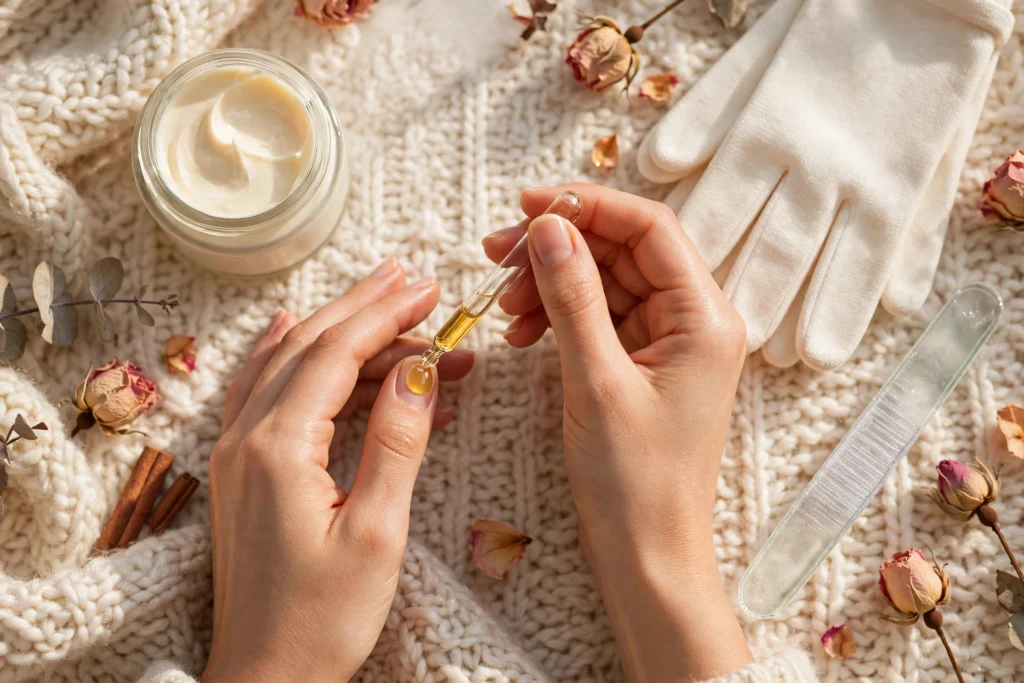
Start with a warm-water soak for five minutes, with a drop of gentle soap — it softens cuticles far better than pushing at them dry. Push cuticles back softly with an orange stick; trim nothing but true hangnails. File any rough edges in one direction with a fine grit file, keeping the shape you already have rather than redesigning weekly. Then oil: one drop of cuticle oil per nail, massaged in for a full minute. Follow with hand cream, worked over the nails as well as the skin. If you are heading to bed, cotton gloves over the cream turn it into an overnight treatment while you sleep.
What you need
- Cuticle oil — jojoba-based oils sink in beautifully
- A rich hand cream you actually like the smell of
- A fine-grit glass or 240-grit file
- An orange stick and small nippers for hangnails only
- Cotton gloves for overnight treatments
- A strengthening base coat for bare-nail days
Daily habits that do the heavy lifting
The twice-a-week session is the ceremony; the daily habits are the substance. Oil lives by the kettle and goes on while it boils. Gloves live by the sink and go on for every wash-up — hot water and detergent strip nails faster than anything else in a normal week. Cream goes on after every handwash, not just at night. And file tiny snags the day they appear: a two-second fix now is a millimetre of nail saved later, because a snag left alone becomes the break that costs you the corner.
Rescue plan for a peeling or broken nail
Peeling happens at the free edge, where dry layers separate. File the peel smooth rather than picking at it — picking pulls the layer further back. A strengthening base coat worn alone for a week gives the edge protection while it grows out. For an actual crack or break, the teabag-and-glue patch in how to fix a broken nail is still the home repair I trust, and it buys the nail the fortnight it needs to grow past the damage.
Polish breaks are fine — naked neglect is not
You will hear that nails need to breathe. They do not — they are not lungs — but a polish break in January is still a good idea for a simpler reason: it lets you oil the whole nail plate directly instead of just the cuticle. When you do take colour off, choose a gentle remover and follow it with oil the same evening, because remover is drying by design. My method is in how to remove gel polish at home. A week of base coat, oil and gloves does more for winter nails than any single miracle product on the shelf.
What to stop doing until spring
A short amnesty list. Stop peeling off polish — it takes nail layers with it, and winter nails have none to spare. Stop using your nails as tools; cold, dry nails snap where warm, flexible ones bend. Stop the daily acetone habit: if you change colour often, switch to an acetone-free remover for regular polish and accept the extra minute it takes. Stop biting or picking at dry cuticle skin, which only manufactures hangnails. And stop filing in a sawing motion — one-direction strokes with a fine file are slower and kinder, and January is not the month to be in a hurry with fragile edges anyway.
Frequently asked questions
How often should I use cuticle oil in winter?
At least once a day, twice if your hands live in water or your home is very dry. It takes thirty seconds: the trick is placing the bottle where you already pause — kettle, desk, bedside.
Should I cut my cuticles in winter?
No. Trim only hangnails — the loose, torn bits at the sides. The cuticle itself is a seal; cutting it back in the driest season invites exactly the raggedness you are trying to fix.
Do bare nails need a break from polish?
Nails do not breathe, so there is no medical need. A short break is still useful in winter because oil reaches the bare plate better — treat it as a moisturising week, not a detox.