Nail Art for Short Nails: Easy Designs That Love a Small Canvas
Short nails are a look, not a limitation. Micro French tips, dots, side stripes and corner art sized for a small canvas — easiest first.

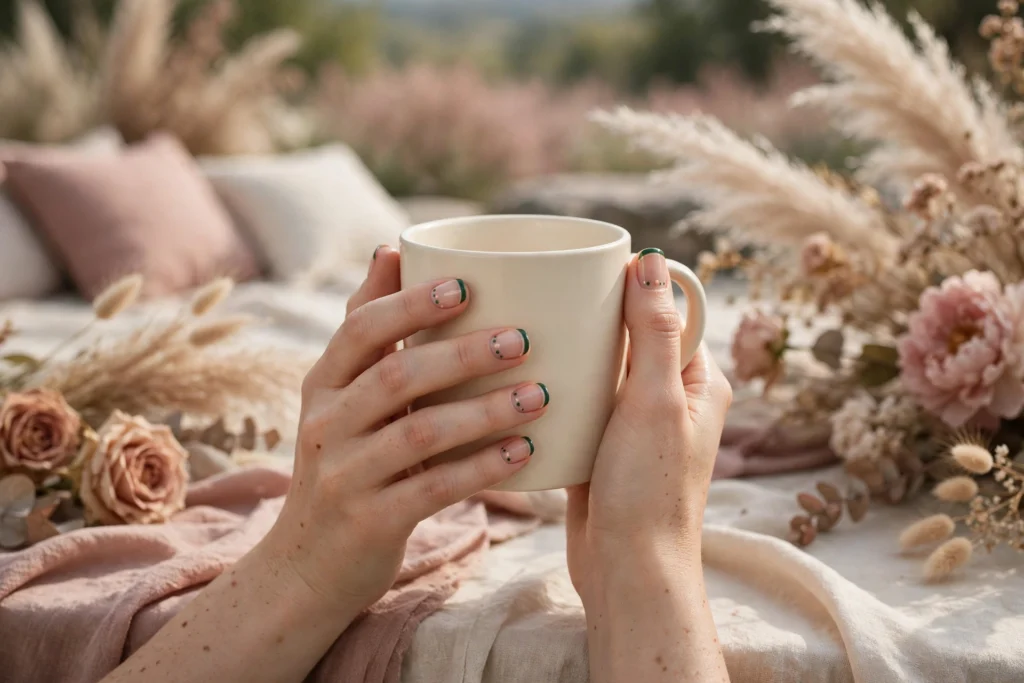
January is also the month a lot of us file our nails right down — a break over Christmas, a resolution to grow them evenly, or simply one break too many. Short nails used to mean sitting out nail art entirely. Not any more. Short nails have become a look in their own right, and the right designs do not fight the length — they use it. Small canvas, bold choices.
Jump to section
The secret is scale and placement. A design that covers a whole long nail needs shrinking, moving to a corner, or reducing to its boldest element. Dots, micro-French tips, single stripes, tiny hearts and negative-space frames all thrive on short nails because they were small designs to begin with. If you enjoy the pared-back mood of nail art ideas in their simplest form, this is that energy, sized for real life.
The video below is from The Beauty Allure, whose short-nail design roundup is full of looks that genuinely respect a short canvas — eight of them, all beginner-feasible. I have organised my notes by how much skill each design actually needs, easiest first.

Start with shape: short is a style
Short nails look intentional when the shape is deliberate. A soft squoval — straight sides, corners knocked off — suits almost every hand and makes the nail bed look longest. File all ten to the same length and shape in the same session; mismatched lengths read as accidental, matched short nails read as a choice. Keep the free edge minimal and even, moisturise the cuticles so the frame looks as tidy as the canvas, and choose glossy top coat: shine is the cheapest length-illusion there is.
Designs that love a small canvas
Micro French: a hairline of colour at the very tip — white, black, or cherry red. It elongates short nails better than any other design because the eye reads the tip line as extra length. Dot accents: one dot at the cuticle, or a descending trio, on a nude base. Side stripe: a single vertical line off-centre, which draws the eye lengthways. Corner art: a tiny heart, star or flower parked in one corner of an otherwise bare nail. Negative space: bare half-moons or a diagonal split between nude and colour. Each of these takes under five minutes a hand once your base is on, and none of them needs a brush thinner than a toothpick.
Colour rules for short nails
Dark colours look chic on short nails — the fashion-editor special — but they demand a perfect application because every wobble shows at the cuticle. Sheers and nudes are the forgiving opposite: near-invisible mistakes, and they grow out gracefully, which matters in January when salon visits and motivation are both sparse. Brights sit in the middle: gorgeous, but keep the shape immaculate. My rule for short nails is one strong idea per hand — all the nails in one colour with a single accent nail beats five competing designs on five small canvases.
Tools: you need less than you think
- A dotting tool, or a hair grip’s round end, or a toothpick
- A fine liner brush for stripes and micro tips
- Two or three polishes: a nude base, one colour, one dark
- Top coat — glossy, always glossy on short nails
- A cleanup brush for the cuticle line
Designs to save for longer nails
Honesty section: full-nail gradients lose their blend on a short canvas, big floral scenes turn to porridge, and long French smiles look cramped. Adapt rather than abandon — take the gradient’s two colours and do one per hand’s accent nail, or shrink the floral to a single corner flower. The marble effect in marble nails for beginners actually survives the shrink well, since its pattern is abstract. And the checkerboard in plaid nail art tutorial works as a single accent nail even when a full set would overwhelm.
Making short sets last
Short nails chip at the corners first, so wrap the tip with every coat — the brush should kiss the free edge on base, colour and top coat. Re-apply top coat on day three. Type with your fingertips’ pads where you can, and treat your nails as the not-tools they are: can tabs and parcel tape are what scissors and keys are for. A short set that stays neat for a week looks better than a long set that does not, and neatness, in the end, is the whole design.
The two-minute manicure refresh
Short nails reward maintenance over drama. Once a week, push the cuticles back after a shower, file any edge that has gone uneven, and re-gloss with a single coat of top coat over the whole set — two minutes, and a five-day-old manicure looks freshly done. Keep one nude polish in your bag for the chip emergency: a sheer colour dabbed over a chip and sealed with top coat disappears in a way no opaque shade ever manages. This low-effort rhythm is exactly why so many people who file down in January never bother growing their nails back out. Short, neat and glossy turns out to be a destination, not a compromise.
Frequently asked questions
What nail shape makes short nails look longest?
A soft squoval or gentle oval. Oval shapes remove the visual corners that make nails look stubby, and keeping all ten nails the same length matters more than the shape itself.
Are dark colours a mistake on short nails?
Not at all — deep shades on short, immaculate nails are a classic editorial look. The catch is application: dark polish shows every cuticle wobble, so slow down and clean up as you go.
How do I do a French tip on very short nails?
Go micro: paint a hairline tip following your natural smile line rather than a deep salon smile. A liner brush, a steady rest for your hand, and a cleanup brush make it very achievable.