
Crochet Summer Top: The Two-Rectangle Tee
Crochet summer top from two rectangles: the swatch that matters, stitch choices for drape, pin-and-try seaming, and a tee you will live in.

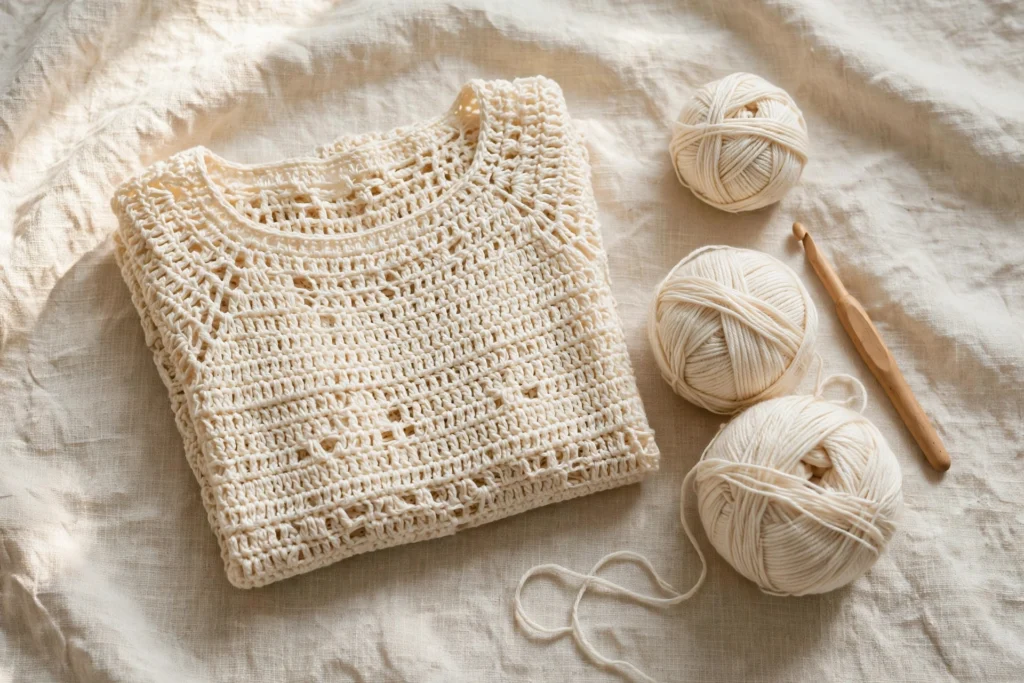
Every crocheter I know has a moment, usually in May, of looking at a wardrobe of jumpers they made and thinking: but what do I wear of mine in summer? The two-rectangle tee is the answer that starts your warm-weather handmade wardrobe — no shaping, no sleeves to set in, no maths beyond one measurement, and a top you will actually reach for.
Jump to section
The tutorial below builds the tee from two identical rectangles seamed at the shoulders and sides, and Yay For Yarn’s summer tee is the clearest first-garment walkthrough I know. What follows is her construction with my notes on cotton yarns, the all-important swatch, and adjusting length and ease so the fit is deliberate rather than hopeful.

Why two rectangles make a real garment
A rectangle is a lie crocheters tell beginners that turns out to be true. Drape does the shaping: a soft rectangle hung from the shoulders falls into a tee silhouette on its own, because bodies are not rectangles but fabric behaves as though they nearly are. The shoulder seam placement decides the neckline, the side seams decide the armholes, and both are sewn after the crocheting is done — which means every fit decision happens at the end, when you can try the pieces on. It is the same forgiving logic as the granny square garments in how to crochet a granny square, scaled up to a whole top.
What you need
- DK or sport-weight cotton or cotton-linen yarn — 400–700g by size
- A 4mm or 4.5mm hook
- A tape measure and your favourite well-fitting tee to measure against
- Stitch markers or safety pins for the try-on seaming stage
- A yarn needle for seaming and ends
Step one: the swatch you may not skip
Garments are where swatching stops being advice and becomes arithmetic. Work a 15cm square in your chosen stitch, wash it, dry it flat, then measure. Cotton relaxes — a rectangle measured straight off the hook can grow two centimetres in the wash, and on a top that is the difference between fitted and sloppy. Your target width is half your chosen finished chest measurement: lay your favourite tee flat, measure underarm to underarm, and that number is the width of each rectangle. Crochet to that width, then keep going in rows until the length — shoulder to hem — matches your tee plus a centimetre of seam allowance in your head.
Stitch choice: drape versus coverage
The stitch decides the top’s personality. Treble crochet works up fast and drapes softly but leaves a fabric you will want a camisole under. Half trebles are the sweet spot: quicker than double crochet, denser than trebles, respectable over a nude bra. A simple mesh or V-stitch panel at the yoke over a plain body gives a designed look for almost no extra skill — the same openwork logic as a summer cover-up. Whatever you choose, keep it identical on both rectangles; a gauge drift between front and back shows at the side seams.
Seaming and the try-on method
Pin before you sew — this is the entire secret. Pin the shoulders leaving a neck opening wide enough to slip over your head with room to spare, pin the sides leaving armholes of about 18–20cm, then try it on inside out, pins and all, and adjust in the mirror. Necklines can be lowered by moving the shoulder seams outward; armholes deepen by moving side seams down. Only when it fits do you sew, with a whipstitch or mattress stitch in the same yarn. A single round of double crochet around neck and armholes finishes the edges and stops the stretch-out that plagues first garments. The seaming confidence transfers directly to bigger projects — how to crochet a cardigan is the natural next garment once this tee is in the wardrobe.
Wearing and washing your handmade tee
Cotton tees soften with every wash and hold their shape if they are dried flat rather than hung — hang a wet crochet top and gravity will lengthen it a size by Friday. Fold it in the drawer rather than hanging it in the wardrobe, for the same reason. Expect compliments, and expect the specific question — you made that? — which never gets old. When you want a second, quicker summer make to rotate with it, easy crochet scarf for beginners worked in cotton becomes a summer wrap for evening shoulders.
Common first-garment worries, answered plainly
The rectangle that comes out a centimetre narrower than planned is not a failure — seams can be placed a centimetre in from each edge, and the garment simply gains a little negative ease. A rectangle that curls at the edges will flatten under the weight of its own seaming and one wash; blocking the two pieces before you pin them is the five-minute version of that fix. And if the finished tee feels plain, that is what the second summer is for: a row of shell edging at the hem, a contrasting yoke, a pocket. First garments are supposed to be simple. The wardrobe of handmade tops you actually wear starts with the one that fits, not the one that impresses.
Frequently asked questions
How much yarn does a summer top take?
In DK cotton, roughly 400g for a smaller, shorter tee up to 700g for a larger, longer one. Buy an extra ball from the same dye lot — running out one row from the hem is the oldest story in crochet.
I’m between sizes — which rectangle width do I choose?
Choose the smaller one. Cotton relaxes with wear and washing, and a tee with slight negative ease looks deliberate, while an oversized rectangle tee reads as a mistake rather than a style.
Can I add sleeves?
Yes — two short rectangles seamed into the armholes, or simple cuffs worked directly onto the armhole edge for three or four rounds. Try the sleeveless version first; most people find it is the one they wear all summer.




