
Crochet Cable Throw: A Cosy Afghan for Deep Autumn
A crochet cable throw without the fear: post stitches worked out of order, reading the rows, honest yarn maths, and a border that frames it.

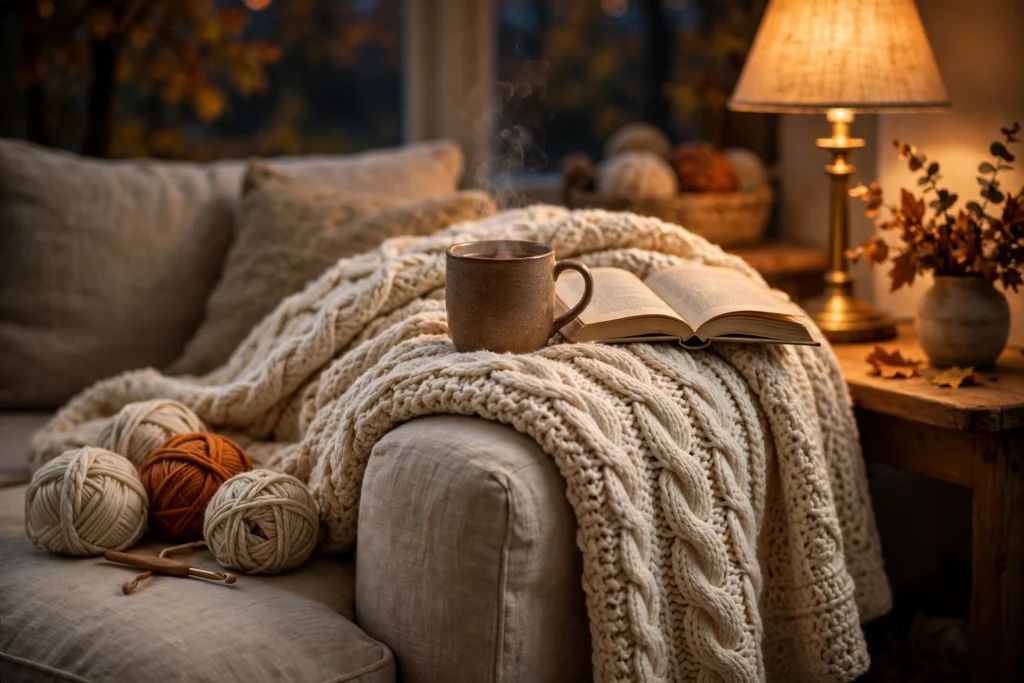
Every crocheter eventually meets the blanket that looks knitted in a shop window and feels slightly impossible — rows of plump, braided cables, rising off the surface like rope. Here is the secret the shop will not tell you: crochet cables are not hard. They are ordinary post stitches worked out of order, and once your hands understand the one idea behind them, a whole afghan is just patience and a good series to watch.
Jump to section
The tutorial below is The Crochet Crowd’s cable afghan, worked step by step by Mikey, whose cable teaching is the calmest on the internet. What follows is his method with my notes on reading the cable rows, the honest yarn maths for a full throw, and the edge and blocking decisions that turn a bumpy work-in-progress into the blanket in the photograph.

Post stitches: the whole secret, in one paragraph
A front post double crochet is a double crochet that goes around the stem of the stitch below instead of into its top — it pulls that stitch forward, toward you, and a row of them stands up off the fabric like a rib. A cable is what happens when you work those raised stitches out of order: skip three, work the next three, then reach back and work the skipped ones. The strands cross. That is genuinely all of it. The rest of the pattern is background — plain doubles or half doubles in the valleys between cables so the braids have somewhere quiet to sit. Practice the cross on a fifteen-stitch swatch before you cast on the afghan; twenty minutes of swatching saves a weekend of frogging, and the swatch becomes your gauge measure and your coaster.
Reading your rows instead of counting your life away
Cable patterns repeat on a cycle — typically a crossing row followed by several plain post rows while the strands travel. Learn to read the fabric: if the strands are leaning apart, you are on a travel row; when they touch, the next row crosses. Counting rows still matters at the start, so use a stitch marker clipped to every crossing row and move it up as you go — the marker becomes the pattern’s memory so yours does not have to. This is a longer meditation than our easy chunky crochet blanket, and the two make a good pair in a maker’s year: the chunky one for speed, this one for pride.
Sizing and the honest yarn maths
Cables eat yarn. A cabled throw takes roughly a third more than a plain blanket of the same finished size, because every crossing row is fabric folded over itself. For a sofa throw of about 110 × 140 cm in aran weight, budget 1,400–1,700 metres and buy it all in one dye lot, plus one extra ball — running out eleven rows from the end is a special kind of heartbreak. Width is set by the repeat: cast on in multiples of the cable panel plus its borders, and decide the finished width from your swatch, not the pattern’s promise, because cable fabric pulls in as it rises. Cream shows cables best; every deeper colour hides a multitude of learning in its shadows, which is its own kindness. The finished throw earns a permanent place beside our crochet mug cozy — tea, book, cables, November.
Edges, borders and blocking
Cable fabric ripples at the sides while you work; a border is not decoration, it is the frame that flattens the painting. Work two or three rounds of single crochet around the whole throw once the body is done, easing extra stitches into the rippled edges, then one round of half doubles if you want the frame firmer. Block by washing and pinning to size on mats, and let it dry completely — cables relax about ten percent wider than they look on the hook, and the valleys open up so the braids stand proud. Do not add fringe unless your household has agreed about fringe; it is the one irreversible decision in an otherwise forgiving project.
Colour, care and living with cables
Colour decides what a cable blanket says. Cream and natural wool show every crossing in shadow and are the classic for a reason. Charcoal and forest hide the texture until the light rakes across them, which makes them the evening blankets — subtle across the room, magnificent up close. Variegated yarn is the one honest mistake available here: it fights the cables for attention and both lose, so save the beautiful skeins for a plain-stitch project and let the cables have their solid stage. Care is simpler than the blanket’s looks suggest: most wool-blend arans machine-wash cool and gentle, and the throw should be dried flat or folded over a rail rather than hung, since wet cables are heavy enough to stretch their own valleys. Fold it over the sofa arm rather than rolling it into a basket — cables remember being crushed, and a weekly shake-out in fresh air keeps the loft that makes the braids cast their shadows. This is a blanket that improves with use for about a decade before it needs so much as a re-block.
Frequently asked questions
Are crochet cables much slower than plain stitches?
About a third slower, mostly on crossing rows. A sofa throw is a three-to-four-week evening project for most makers — which is precisely the right pace for deep autumn, and why this is the season to start one.
Can I work the cables in chunky yarn?
Yes, and the braids become magnificent. Keep the panel count low — two or three cables across — or the throw becomes a rug. Our granny square maths in how to crochet a granny square will help you recalculate repeats for the thicker yarn.
What if my cables lean the wrong way?
They are not wrong — you have worked a left cross where the pattern wanted a right one, or the reverse. As long as every cross in a panel leans the same way, the blanket is correct. Consistency is the pattern; direction is taste.




