
16 Crochet Home Refresh Projects for the New Year
Sixteen small crochet projects that re-dress a house for January: containing, softening, table-dressing and finishing makes in one calm palette.

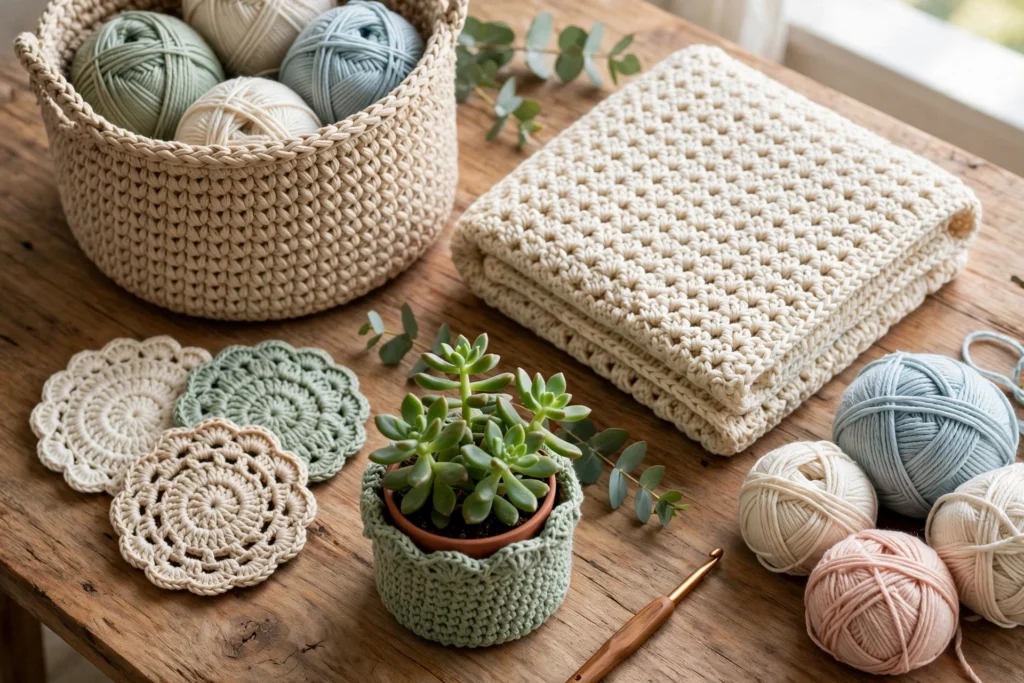
A home refresh does not need a skip and a paint chart. Sometimes it needs sixteen small crochet projects, each an evening or two, that between them re-dress a house: something for the clutter, something for the sofa, something for the table, something green. This is the January list — practical makes with a unifying palette, chosen so that one shelf of yarn refreshes every room.
Jump to section
The anchor make is Papari’s orange coaster set with its own crochet basket, a two-in-one project that shows the whole philosophy at once: a useful object, a handmade container for it, and a table that looks deliberately styled rather than accidentally tidy. The sixteen projects below are grouped by job — containing, softening, dressing the table and finishing touches — with yarn notes, honest evening counts, and no project that takes longer than a single weekend to finish and put to work.

Containing: projects 1–4
1. The storage basket — the batch’s own tutorial elsewhere in this set; the refresh’s hardest worker, in three sizes. 2. The hanging wall basket — a flat-backed pocket by the door for post, keys and gloves. 3. The remote-control caddy — a stiff, shallow tray that ends the sofa-arm archaeology. 4. The yarn bowl substitute — a small, heavy-based basket with a notch for the strand, for the chair where you actually crochet. Cotton or t-shirt yarn throughout this family; structure is the point. For more storage-adjacent inspiration, our crochet pillow ideas collection hides half its storage inside the cushions.
Softening: projects 5–8
5. The bobble cushion cover — texture you can feel from across the room; our full crochet bobble cushion cover tutorial makes it a weekend. 6. The sofa-arm protector — a flat rectangle in your palette, draped where hands and cups land. 7. The draught excluder — this batch’s door sausage, counted as softening because a room without a draught feels softer. 8. The bed runner — one long strip across the foot of the bed; our crochet bed runner tutorial sizes it for any bed in a one-row repeat. Choose two neutrals and one accent colour and hold the palette across all four; the refresh effect is mostly coordination.
Dressing the table: projects 9–12
9. The coaster set in a basket — the anchor project above; citrus colours optional, the basket non-negotiable. 10. The table runner — our crochet table runner in the refresh palette, the fastest whole-room change on this list. 11. Placemats, set of four — simple rounds or rectangles in cotton, washed weekly, replaced never. 12. The plant-pot cover — a ribbed sleeve that turns a plastic nursery pot into a considered object; the succulent in the photograph is wearing the sage version. Cotton wins again at the table — it washes, it irons flat, and it survives gravy, which is more than can be said for acrylic. The textures across this family echo our textured crochet patterns guide if you want to mix stitches deliberately.
Finishing touches: projects 13–16
13. The doily coaster revival — our crochet doily coaster from scrap yarn, proof that the smallest leftovers make the prettiest refresh. 14. The garland refresh — a simple leaf or circle garland for the mantel now the Christmas one is packed away. 15. The tissue-box cover — January’s most underrated make; a cold-season essential, dressed. 16. The hot pad pair — thick, double-layered cotton squares that live by the oven and coordinate with the runner. Each of these takes an evening at most, and each one moves a room from decorated-for-Christmas to deliberately January — calmer, paler and yours.
The palette, decided once
Sixteen projects in sixteen colours is not a refresh; it is a jumble sale. Decide the palette before the first stitch: two neutrals that match your rooms — cream and stone, say, or white and warm grey — and one accent that makes you happy in January, which for most of us is sage, dusty blue or a deep rust. Buy the neutrals in quantity, the accent in less, and let every project draw from the same three yarns in different proportions. The basket may be all cream, the cushion cream with an accent stripe, the coasters accent-edged — the family resemblance does the styling for you. It is the same trick interior shops use, and it is why the flat lay in the photograph looks calm: nothing in it owns a colour the others have not met.
What this refresh deliberately skips
No blankets: a throw is a month of evenings and January has other plans — the big textile change comes from the runner, cushions and bed runner working together. No wall hangings in this round either; walls are the last thing tired January eyes need to negotiate, and the hanging basket in the containing family does the vertical job practically. And nothing seasonal- themed: no hearts for February, no eggs for spring, because the whole point of this list is a house that looks right all year, refreshed once and then simply lived in. When the next season genuinely calls, the table family takes a new runner and the mantel takes a new garland — two makes, not sixteen.
A four-weekend plan
Two habits make the plan survivable. First, finish each project completely — ends woven, washed if it needs it, placed in its room — before starting the next; a refresh made of nine nearly-done objects is just a new category of clutter. Second, keep a small basket (yes, another basket) for the project’s travelling kit: current yarn, hook, scissors, needle. Four weekends produce sixteen objects, but they also produce a house where, room by room, things handmade have quietly taken over the jobs that plastic used to do — and that, more than any palette, is what makes visitors ask what has changed.
Weekend one: the containing family — baskets first, because everything else you make needs somewhere to live. Weekend two: softening, with the cushion cover as the big satisfying centre. Weekend three: the table — coasters, runner, placemats in one palette push. Weekend four: the finishing touches, made almost entirely from the first three weekends’ leftovers. By February the house reads as refreshed rather than redecorated, the yarn shelf is visibly emptier, and every project on this list is in daily use — which is the entire difference between a refresh and a resolution.
Frequently asked questions
How much yarn does the whole refresh take?
Planned as one palette, about 800 grams to a kilo of cotton or cotton-blend across all sixteen projects — and several of the finishing touches are designed to consume the earlier projects’ leftovers, so buy for the big five and improvise the rest.
I am a beginner. Where do I start?
With the coasters and the hot pads: flat, fast and forgiving. Then the storage basket, which teaches working in the round, then the cushion cover. Leave the runner until your tension settles — long rows show every wobble.
How do I keep sixteen projects looking like one refresh?
Palette discipline. Two neutrals and one accent, the same three yarns appearing in every room, do more for the effect than any single project. When in doubt, repeat the accent in one small item per room and stop there.




