
Crochet Beach Bag: The Bag That Gives the Sand Back
A crochet beach bag is built to give the sand back: a firm base, openwork sides that shake clean, and handles engineered to never fail you once.

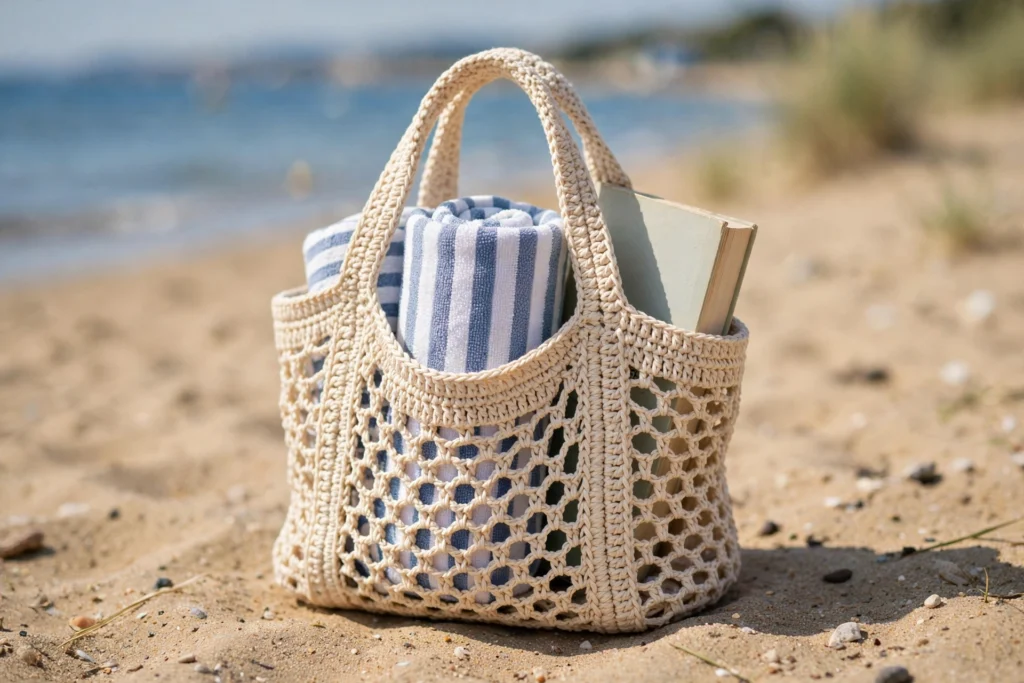
A beach bag has one non-negotiable talent: it must give the sand back. Everything else — the towel, the book, the bottle, the speaker — is cargo. The crochet beach bag is built around that talent, an open, airy structure that shakes clean at the car park and carries a whole day’s worth of shore in the meantime. It is the biggest make in this batch and the one that will be used most.
Jump to section
The tutorial I follow is ABoC Studio’s beach bag — titled plainly, built generously — and the design is the classic: a firm oval or rectangular base, openwork sides that give the bag its sand-shedding honesty, and handles long enough for a shoulder loaded with a chair. What follows is that build with my own notes on yarn choice (the beach is yarn’s harshest workplace), base firmness, and the lining question, which I will answer differently from most: mostly, don’t.

What you need
Yarn first, because the beach chooses it for you: cotton, cotton-blend, or the raffia-style paper yarns made for summer bags — something that shrugs off damp, dries fast, and does not stretch into a fishing net under a wet towel’s weight. Pure acrylic sags; pure wool is a crime scene. You will need more than instinct says — a generous beach bag eats 300 to 400 grams happily — plus a hook for a firm fabric, and optionally a second colour for the base and handles, the two zones that take the wear. It is the grown-up sibling of our crochet market bag: same carrying bloodline, different workplace — the market bag is lined and tidy, the beach bag is open and unrepentant.
The base: build the floor before the walls
Everything a beach bag survives is decided in its base. The tutorial works a solid, dense base — oval or rectangle — in the tightest stitch of the pattern, because the base takes the abrasion of pebbles, promenade and car boot, and carries the whole load’s weight into the sides. Work it firmer than feels natural and check its size against your actual beach towel, folded: the bag should swallow the towel lengthways without a wrestle. A base that wants to curl is telling you its increases are uneven — fix it now, on the flat, because no amount of side-work will argue a curling base into manners. If the bag is destined for heavy bottles, this is also the moment a rectangle of plastic canvas can be sandwiched into the base — invisible, washable, and the difference between a bag and a hammock.
The sides: openwork with a job to do
The sides rise in an open stitch pattern — mesh, shells with air between them, or a lattice — and the openness is engineering, not decoration. Sand falls through. Damp air moves, so the towel inside dries rather than marinates. The discipline is the sides’ top edge: finish with two or three firm rounds that gather the openwork into a tidy rim, or the bag’s mouth will stretch into a yawn within a season. Our easy crochet tote bag makes the same point for everyday carrying — structure lives at the edges, freedom in the middle.
Handles: the part that cannot fail
Handles are where beach bags go to die, usually mid-car-park, fully loaded. The tutorial’s handles are worked as part of the bag’s top rounds — chained spans reinforced with rows worked back over them — and the method matters: a handle crocheted as a continuation of the rim distributes its load into the whole top edge, while a handle sewn on afterwards concentrates it into four stitch clusters waiting to tear. Work handles slightly shorter than you think; every yarn gives a little under load, and a handle that starts at shoulder height ends at elbow height by August. Reinforce the handle bases with extra rounds if your beach days run heavy; sunscreen, water and a hardback can total four kilos before the shells collection starts.
Colour and the sand question
Choose colours the way beaches choose them: sand, stone, sea, sky. A natural or ecru body hides a season of dust between washes — the pragmatic champion — while navy and deep teal hide it nearly as well and photograph like the Mediterranean. White is glorious for exactly one afternoon. Stripes at the base and rim, worked in the second colour, give the bag its holiday face and put the fastest-wearing zones in the darkest yarn, which is design and laundry strategy in one. Team it with our crochet sun hat in the same cotton and the beach set is unmistakable — the two pieces share a yarn economy, too, since the bag’s leftovers are the hat’s whole appetite.
The lining question, answered honestly
Mostly, don’t. A lining defeats the sand-shedding, quick-drying logic that is the bag’s entire argument. The exception is the small-things problem: keys, coins and lip balm migrate through openwork like eels. Solve it with a zip pouch that clips or ties inside, not with a sewn lining — the pouch comes out, the bag shakes clean, the system survives.
Care and keeping
Shake it like you mean it at the end of every beach day — the design’s first commandment. Wash cool when the sunscreen film builds up, dry flat or hanging by the handles in moving air, never in a hot dryer: cotton bags shrink where they were loosest, and the rim decides the bag’s posture for life. Store stuffed loosely with tissue or a towel in winter so the base keeps its floor. A well-made one lasts a decade of summers, softening into the exact shape of its owner’s beach habits, which is the highest state a bag can reach.
Frequently asked questions
How long does a crochet beach bag take?
A weekend’s honest work — roughly eight to ten hours across a few evenings. The base is an evening, the openwork sides grow faster than they look, and the handles and rim are a final session.
What is the best yarn for a beach bag?
Cotton or a cotton blend for strength and quick drying, or raffia-style yarn for the lightest, crispest finish. Avoid pure acrylic (it stretches under load) and anything that cannot be washed.
How big should a beach bag be?
Big enough for your folded towel lengthways — typically a base around 40 by 15 centimetres and sides near 35 centimetres tall. Measure your own towel and book pile rather than trusting any pattern’s promise, including this one’s.




