
Crochet Water Bottle Holder: Hands Free, All Summer
A crochet water bottle holder turns any bottle into a cross-body companion in one sitting: a solid base cup, gripping mesh, a serious strap too.

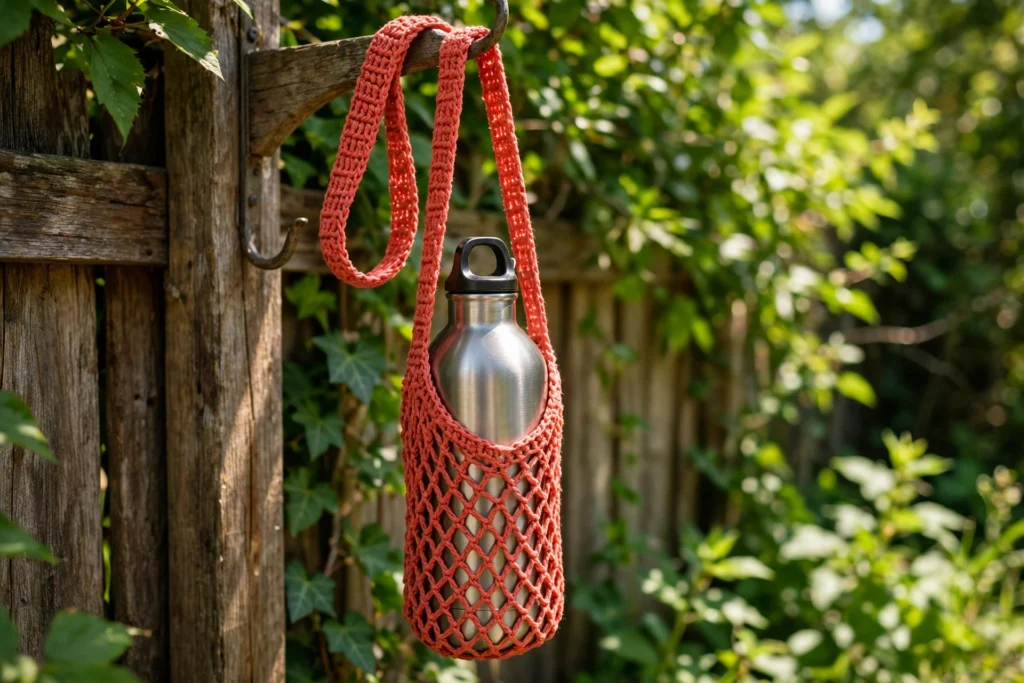
The water bottle is the one thing you carry all summer and the one thing with no handle. The crochet bottle holder fixes that in a single sitting: a mesh sling that turns any bottle into a cross-body companion, frees both hands, and quietly ends the era of the bottle left on café tables, park benches and the roofs of cars.
Jump to section
The reference is ElyseCrochets’ bottle holder tutorial — easy and beginner-billed in its title, a mesh bag by its own description — and the design is the classic sling: a solid little base cup, open mesh sides that stretch over the bottle, and a long strap. What follows is that build with my own notes on the stretch maths (the holder must grip, not bag), strap engineering, and fitting the same pattern to everything from a child’s school bottle to a two-litre festival flask.

What you need
Less than a ball of anything sturdy. Cotton is the professional choice — it grips the bottle, absorbs the condensation instead of dripping it down your hip, and barely stretches once settled. A cotton-poly blend is the athlete’s choice for the same reasons with lighter weight. The hook follows the yarn; the bottle you actually own must be present at the making, because this is a fitted garment, not a free-size one. A stitch marker earns its keep in the base rounds. Total yarn: fifty grams makes the standard size with strap, which puts this firmly in scrap territory — the leftovers from our crochet market bag will build two.
The base cup: small, solid, exact
The holder starts as a flat circle the diameter of your bottle’s base, then turns the corner into a short solid wall — three or four rounds worked straight up. This cup is the engineering: it stops the bottle sliding through, takes the knocks when the bottle is set down hard, and anchors the mesh. Measure the circle against the bottle itself, not its stated capacity; bottles lie about their dimensions with total confidence. The cup should hug — a base circle a half-centimetre wider than the bottle is a holder that rattles, and one too small is a holder the bottle must be posted into like a letter. Worked firmly, the cup also gives condensation a first drink before it reaches your clothes.
The mesh: stretch is a feature, sized like one
Sides rise in chain mesh — loops of chain anchored in rounds — and the mesh is what lets one pattern serve a shelf of different bottles: it rests narrow and stretches wide. The trap is generosity: mesh worked to the bottle’s exact circumference at rest will stretch past it under a full bottle’s weight and keep going all summer. Work the mesh to roughly eighty per cent of the bottle’s girth and let the stretch do the rest — the grip stays, the bottle stays. Height stops a couple of centimetres below the bottle’s shoulder, so the neck and cap stand clear for drinking without unslinging. The rhythm is meditative — the same round repeated — which makes this the rare useful make that can be finished during a single film without looking down.
The strap: length, width and the knot question
A strap has three decisions. Length: cross-body is the summer default — measure on the body, bottle at hip, and remember yarn straps grow about ten per cent under a full bottle in the first week, so cut your ambition accordingly. Width: a strap of four or five firm rows spreads the load; a chain-only strap becomes a cheese-wire by the second hour of a festival. Construction: work the strap as a continuation where the pattern allows, or sew it with a doubled tail and a paranoid number of passes — the strap’s joins take every gram of the load, every step, all day. Some makers add a sliding knot so the strap adjusts between adult and child; it is ten extra minutes and doubles the holder’s useful household. Pair the finished sling with our crochet sun hat and the summer walk kit is complete: shade on top, water at the hip.
Fitting the whole bottle shelf
The pattern’s real party trick is repeatability across sizes. A child’s 350 ml school bottle wants fewer base rounds and a shorter mesh run; the standard 750 ml gym bottle is the pattern as written; the one-litre bottle needs one more base round and mesh at the same eighty-per-cent rule; the two-litre festival flask graduates to a wider strap and a deeper cup. Make the family’s set in one colour family with different strap colours and the school-bag chaos reduces by half. The full tribe of summer carriers sits in our summer crochet projects roundup, but the bottle holder is the one that gets used daily.
Colours and character
A holder is a small canvas: it can be the loudest thing you own without consequence. Neon mesh with a natural strap; a rainbow worked from scrap ends, one colour per mesh round; the football team’s colours for the school run; a sober black that makes a steel bottle look like equipment. Gift logic is instant: a holder plus the bottle it fits is a present that looks thought-through because it was, and teachers, coaches and dog-walkers are its natural citizens.
Care and keeping
Rinse after sports drinks, wash cool with the week’s cottons, dry hanging by the strap. Check the strap joins each spring — they are the wear point — and re-sew at the first whisper of a gap; a bottle dropped on a trail is a lesson nobody needs twice. If the mesh relaxes after years, a cool wash and a dry over the bottle itself re-teaches the fit.
Frequently asked questions
How long does a bottle holder take?
One to two hours, strap included — the fastest functional make in this batch. The base cup is fifteen minutes; the mesh is rhythm; the strap is the only part that asks for attention.
Will it fit my bottle?
Yes, because you fit it as you go: the base circle is matched to your bottle’s base, and the mesh is worked to eighty per cent of its girth. Any straight-sided bottle from 350 ml to two litres follows the same rules with adjusted round counts.
What yarn holds up best?
Cotton or a cotton-rich blend. It grips, absorbs condensation, and holds its length once the first week’s stretch has settled. Pure acrylic works but slides on smooth steel bottles and grows longer over the season.




