Back to School Nails: Short, Tidy and Built to Last
Back to school nails that survive the term: short shapes, five tidy designs that pass the dress code, and the routine that stops the chips.


The September manicure has a job description no other manicure faces: it must survive a pencil case, a keyboard, gym kit, and — in many schools — an actual dress code. Back to school nails are not about doing less art. They are about choosing the designs whose art is in the finish and the tidiness, on lengths that can type, write and open a locker without negotiation.
Jump to section
The tutorial below is ImGirlYouDontKnow’s Nail Art Ideas For Short Nails — easy designs on genuinely short nails — and it is the perfect anchor because everything in it is school-proof by construction. What follows is that short-nail canvas with my notes on length, durability, and the rules check to do before you paint.

First, the rules check
School policies vary from “natural only” to “anything neat”, and there is no design clever enough to survive being sent to remove it. The safe universal read: short length, no charms or 3D anything, colours at the nude-pink-white end, or clear with the barest design. University and sixth form are looser; younger years, assume the strict version and treat any freedom your school actually allows as a bonus. When in doubt, the sheer pink manicure with immaculate cuticles has never once been confiscated.
Length and shape: the practical geometry
Short, and shaped to the fingertip: squoval or a soft oval with no free edge to catch on a bag zip. This is not a limitation to design around but the design’s foundation — everything in the tutorial above is built on exactly this canvas. File in one direction, keep all ten the same length, and remember that on short nails tidy beats long nails’ drama every time. The complete at-home ritual, shaping included, is in how to do a manicure at home.
The five designs, ranked by school-safety
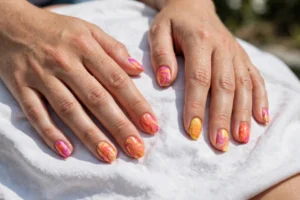
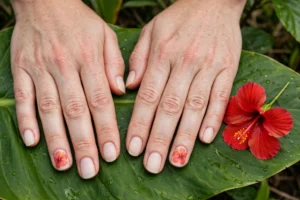
From the tutorial: the coloured-dot design on a bare nail is the most discreet — polish-free except for dots at the centre, it reads as nothing at arm’s length and as a delight up close. The cuticle-decoration design is next: a stripe and stud effect at the nail bed that keeps the tips business-clean. The twisted classic manicure and the polka dots sit in the middle — recognisably nail art, but neat and quiet. The glittery stripes are the Friday version: save them for schools that allow sparkle, or for the first weekend of term. All five share the same virtue — every one is a ten-minute design with no tools beyond a dotting tool or bobby pin.
Durability: the term-proof routine
A school manicure dies by chips, and chips are a routine problem, not a luck problem. Base coat always (it is the glue), two thin colour coats, top coat wrapped over the free edge, and gloves for washing up — hot water is polish’s oldest enemy. Keep a mini file and the colour in the school bag for the ninety-second chip rescue: file the edge smooth, one dab of colour, one of top coat. When a nail does go completely, you are better off with the repair in how to fix a broken nail than with a bare nail among nine painted ones. Gel converts the whole problem — a gel set shrugs off two school weeks — if your school allows the shine.
The grown-up shelf: clean colour stories
For readers past the dress-code years who still want the September feeling — new term, clean start — the aesthetic is the same: short, glossy, immaculate, in the quiet colours. The fullest expression of it on this site is simple white nail designs: thirty-five variations on clean. Milky whites, sheer pinks and one perfect nude are the term-time palette, and they pair with the academic wardrobe — blazers, knits, loafers — the way coral never will.
The Sunday-night routine
Term-proof nails are made on Sunday, not repaired on Wednesday. Fifteen minutes: remove the old set properly (no peeling — peeling takes nail plate with it and the next set pays), file to the school shape, push cuticles, one base coat, two thin colour coats, top coat wrapped over the edges. Thin coats are the whole secret: three thin layers outlast two thick ones by days, and they dry in time for bed. Set the week’s rescue kit while the last coat dries — mini file, the colour, a travel top coat, one plaster for the inevitable netball incident — and keep it in the same bag pocket all term, so the ninety-second repair is a habit rather than a search.
A word for the parents reading over shoulders: the routine above is also the whole kit list. One base coat, one top coat, the colour, a file, a dotting tool or the end of a bobby pin — everything in this article runs on under a tenner’s worth of supplies, most of which a home already owns. The expensive version of school nails does not exist, and that is rather the point.
Frequently asked questions
What nail length is actually practical for school?
No free edge beyond the fingertip — if you can see nail past your finger when you look at your palm, it is long enough to catch, chip and annoy you while writing. Short squoval is the school shape.
Which design is safest for a strict dress code?
The bare nail with coloured centre dots, or a sheer pink with no design at all. Both read as groomed rather than decorated. If even dots are too much, a clear glossy top coat over perfectly shaped nails is the invisible manicure.
How do I stop chips during the school week?
Wrap the top coat over the free edge, wear gloves for washing up, and reseal the tips once midweek. Carry a mini file: smoothing a snag the moment it happens is what stops it becoming a chip by lunch.