
Crochet Advent Calendar: A Tree of Pockets
A tree-shaped crochet advent calendar of twenty-four pockets in red, cream and gold: paced across November evenings and refilled every year.

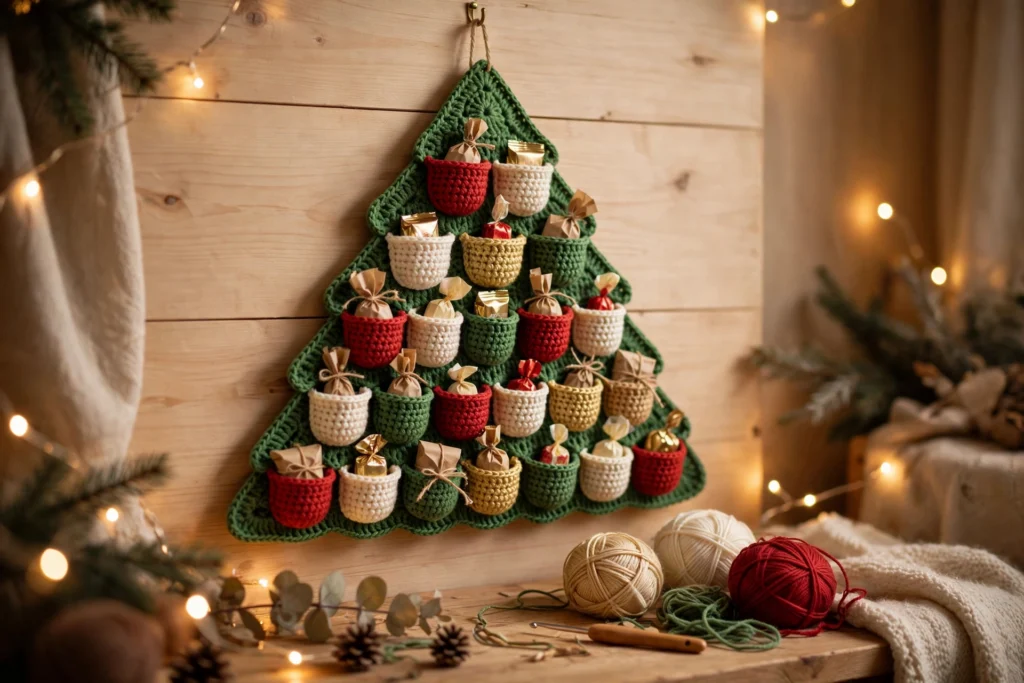
An advent calendar you made yourself changes the emotional arithmetic of December: instead of a cardboard door over a waxy chocolate, every morning somebody you love opens a pocket your hands stitched. The crochet tree version is the keeper — a green tree-shaped wall hanging studded with little pockets in red, cream and gold, refilled every year, and flat enough to store inside a book come January.
Jump to section
The tutorial I follow is Winding Road Crochet’s advent calendar tree, which builds the hanging from crocheted hexagon pockets arranged on a tree shape — a clever construction that makes twenty-four pockets feel like a series of small, satisfying finishes rather than one enormous project. Below is that build with my notes on pacing it across November evenings, sizing pockets for real treats, and filling ideas beyond chocolate.

The construction: hexagons on a tree
The design’s intelligence is that the pockets ARE the tree. Each pocket is a small crocheted hexagon or cupped shape, and twenty-four of them, arranged in widening rows — one, three, five and so on up to the base — form the triangle of the tree itself, mounted on a backing or joined edge to edge. Worked in a deep green with pockets alternating red, cream and gold, the silhouette reads instantly, even before a single treat goes in. Joining as you go, row by row, means the calendar grows visibly on the wall hook through November, which is exactly the encouragement a twenty-four-part project needs.
Pacing it like an advent of making
Twenty-four pockets is a marathon disguised as a sprint, so schedule it honestly: two pockets an evening is a relaxed twenty minutes each and finishes the set in twelve days; four an evening is a determined weekend push. The pockets are identical or near-identical, so the first three are learning and the remaining twenty-one are pure flow — this is television crochet of the highest order. Keep a little basket with the three pocket colours, the green, hook and scissors beside the sofa and the project will advance almost by itself. Start in mid-November and it hangs, finished and smug, on the last day of the month. Small, completable components are the same trick behind our crochet mug cozy — one sitting, one finished thing.
Sizing pockets for real treats
Measure your intended fillings before you commit to a hook size. A foil-wrapped chocolate needs a pocket roughly 6 cm across; a small wrapped gift, a hair clip or a folded note wants 8–9 cm. Work one pocket, test it with the bulkiest treat on your list, and only then batch the rest — resizing pocket one costs five minutes, resizing twenty-four costs the project. Cotton or a cotton-rich blend holds pocket shapes best and stops the tree sagging by mid-December; acrylic works if the calendar hangs somewhere cool and the treats are light.
Fillings beyond chocolate
The handmade calendar invites handmade-scale fillings: a joke written on a folded card, a tea bag, a single beautiful bead, a clue leading to a bigger gift hidden elsewhere in the house, a tiny crochet star for the real tree, a compliment IOU. For adults, twenty-four miniature spirits, spice sachets or seed packets make the calendar the best gift of the season; for children, one piece of a small puzzle per day, revealed whole on Christmas Eve, is a tradition that gets requested by name in October. However you fill it, the calendar itself joins the permanent decorations — and if you catch the gift-making bug at scale, it belongs at the top of our easy crochet gift ideas, and alongside our crochet fingerless gloves in the December making queue.
The refill ritual and storing it well
The calendar’s second December is when it becomes a tradition rather than a project. Refilling happens in our house in the last week of November, treats bought in one trip and pockets loaded in number order over a single evening, with the previous year’s notes — which fillings vanished fastest, which jokes landed — improving the selection annually. Store the empty calendar rolled around a cardboard tube or flat between tissue in the decorations box; crochet pockets forgive storage that would destroy a cardboard calendar, and a cool five minutes with a steam iron refreshes any pocket that has relaxed. If small hands have stretched a favourite pocket, a round of slip stitches in matching yarn around its mouth, worked slightly tight, restores the fit invisibly. This is the deep advantage of the handmade version: it can be repaired, refilled and improved, so the calendar a child opens at four is recognisably the one they open at fourteen.
Start with the pockets you find hardest to resist filling. In practice the tree is usually begun backwards in our house — treats bought first, in the October sales, and the crochet sized around them in November — and there is no shame in that order of operations at all. The calendar exists to hold the treats; letting the treats set the dimensions is simply good engineering.
Frequently asked questions
How long does a crochet advent calendar take?
Expect eight to twelve hours in total, spread painlessly as twenty-four small pockets. Most makers do it over two November weeks of evening crochet rather than in sittings.
Do the pockets need numbers?
Not necessarily — many families hunt for the right pocket by its position each morning, and the tree shape makes counting natural. If you want numbers, cross-stitch them in cream thread or sew on tiny numbered buttons rather than writing on the crochet.
What yarn works best for the hanging?
A cotton or cotton-blend DK keeps pockets crisp and the whole tree flat against the wall. Avoid soft, drapey yarns for the structure — this is one project where stiffness is a feature.




