
Crochet Santa Hat in an Evening
A crochet Santa hat that actually fits: a simple cone, three brim options and a properly sized pom pom. Chunky yarn makes it in one evening.

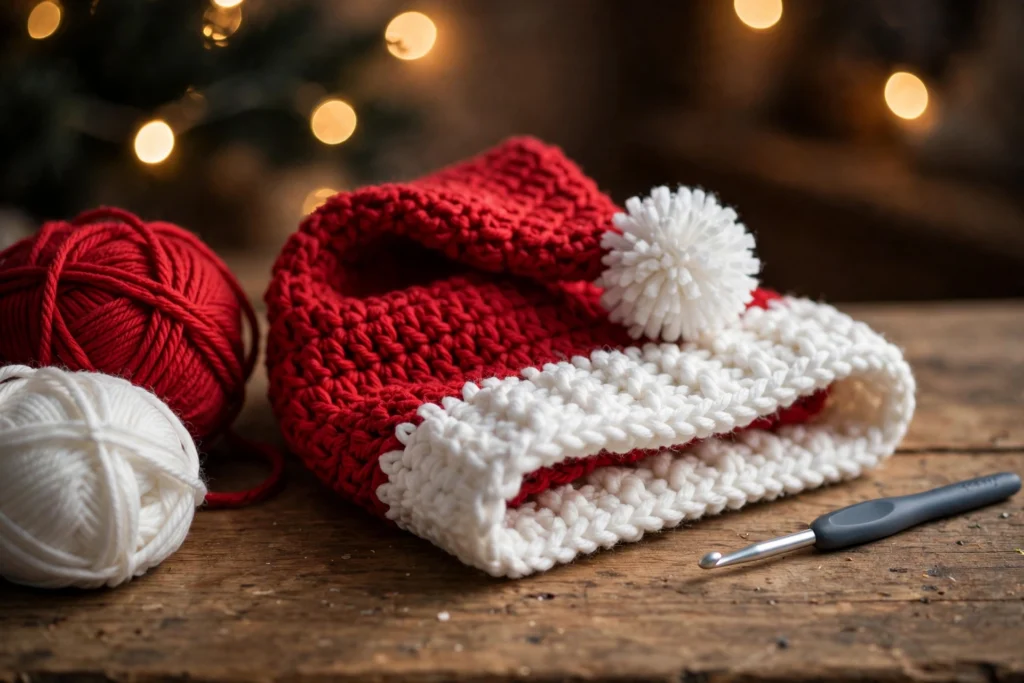
There is a special December joy in answering the door wearing a Santa hat you made yourself — especially to carol singers, delivery drivers, and any child under ten. A crocheted Santa hat beats the five-pound shop version on every axis: it fits actual heads, the brim is thick enough to be warm, the pom pom is the size a pom pom deserves to be, and it does not shed white fluff into the gravy.
Jump to section
The tutorial I work from is Secret Yarnery’s Santa hat, famous in my house for its title promise — a hat in minutes, or near enough — built as a simple cone in the round with a separate brim and pom pom. Below is that build with my sizing table notes, the brim options from neat ribbing to full faux-fur effect, and how to make matching hats for the whole family without losing your mind or your stitch count.

The cone: easier than a beanie
A Santa hat is a beanie that kept growing. Start at the tip with a small ring, increase slowly — typically two stitches every round or two — and the cone lengthens; then increase at a steadier rate until the circumference matches the head, and work straight for the final few centimetres. The slow start is what creates the floppy tip that folds over; increase too fast and you get a traffic cone, too slow and you get a wizard. Because the shape is so forgiving, gauge matters less than with fitted hats, but head measurement still does: measure around the forehead and work the straight section to that circumference minus a centimetre or two of negative ease. The beanie skills in our easy crochet beanie for beginners transfer directly — this is that hat, with theatre.
The brim: three ways
The brim is the hat’s handshake, so choose deliberately. A ribbed brim — rows of back-loop stitches worked sideways and joined into a band — is neat, stretchy and the warmest over ears. A folded cuff of plain stitches in white is the classic cartoon look and uses the hat’s own momentum. The faux-fur effect, working white eyelash or fluffy yarn for the last rounds, is maximum Santa and sheds the least if you knot the pom pom yarn through it securely. Whichever you choose, work the brim in white or cream against the red cone — the contrast is the entire costume in one line. For a subtler Christmas-week wearable, the same ribbed-band skill builds our crochet ear warmer headband in an evening.
The pom pom, sized properly
Shop hats fail at the pom pom: mean, small, apologetic. Yours should be the size of a satsuma. Wrap white yarn around a wide fork, a pom pom maker, or four fingers a good hundred times, tie off hard through the middle, cut the loops, and trim ruthlessly into a sphere — the trimming is where the dense, professional finish comes from. Attach it through the hat’s tip with the long tying tails and a tapestry needle, knot inside, and reinforce with a second pass; a pom pom lost mid-carol-singalong is a small December tragedy. Make two while the yarn is out — someone at the table will ask for a hat of their own before pudding.
Sizing for the whole family
The cone method scales gracefully. Baby hats (38–43 cm head) take an evening’s leftovers of red; children (46–52 cm) are the sweet spot, quick and worn with total commitment; adult sizes (54–60 cm) use roughly 120–150 g of aran or chunky red. Work family sets from the same dye lot of red — matching photographs forgive many things, but five slightly different reds is not one of them. And if the hat sparks a full handmade-Christmas mood, the same red yarn and an evening more makes the scarf from our easy crochet scarf for beginners to match.
Troubleshooting the cone
If the brim curls outward like a bucket hat, the last rounds before the brim were worked too loosely — go down a hook size for the white section only, which tightens the band against the head. If the hat stands up stiffly instead of flopping, the cone is too short or the yarn too structured; length cures it, and a night folded inside a drawer teaches even aran some manners. If it comes out too big, do not unpick: a line of elastic thread woven through the inside of the brim rescues a whole size. Too small is the one true failure, and it is prevented by the oldest rule in hats — measure the actual head, not the age on the birthday card, because children’s heads vary more than any sizing chart admits.
Washing is simple and worth doing before storage: cool water, a drop of mild soap, reshape and dry flat away from radiators. January storage inside a pillowcase keeps the brim from crushing and the red from dust; come December it emerges ready to wear while the shop hats are still shedding last year’s fluff.
Frequently asked questions
How long does a crochet Santa hat take?
In chunky yarn, an adult hat takes two to three hours — genuinely an evening’s work. In aran it is closer to four. Children’s sizes in chunky can be done inside a single film.
What yarn is best for a Santa hat?
Acrylic aran or chunky in a true pillar-box red: it holds the cone’s shape, survives being sat on at parties, and washes clean of mince-pie incidents. Save wool for hats that will be worn outdoors all winter.
How do I stop the tip from standing straight up?
Length and weight are the fix: work the cone a few rounds longer than feels necessary and let the pom pom’s weight pull it over. A stitched-down fold, secured with two invisible stitches, cheats it permanently into place.




