
Crochet Bee Amigurumi: A Palm-Sized Bumblebee for the Garden
A palm-sized crochet bumblebee in one evening: a spiral body, three stripes, raised wings and one face decision. Beginner-friendly amigurumi.

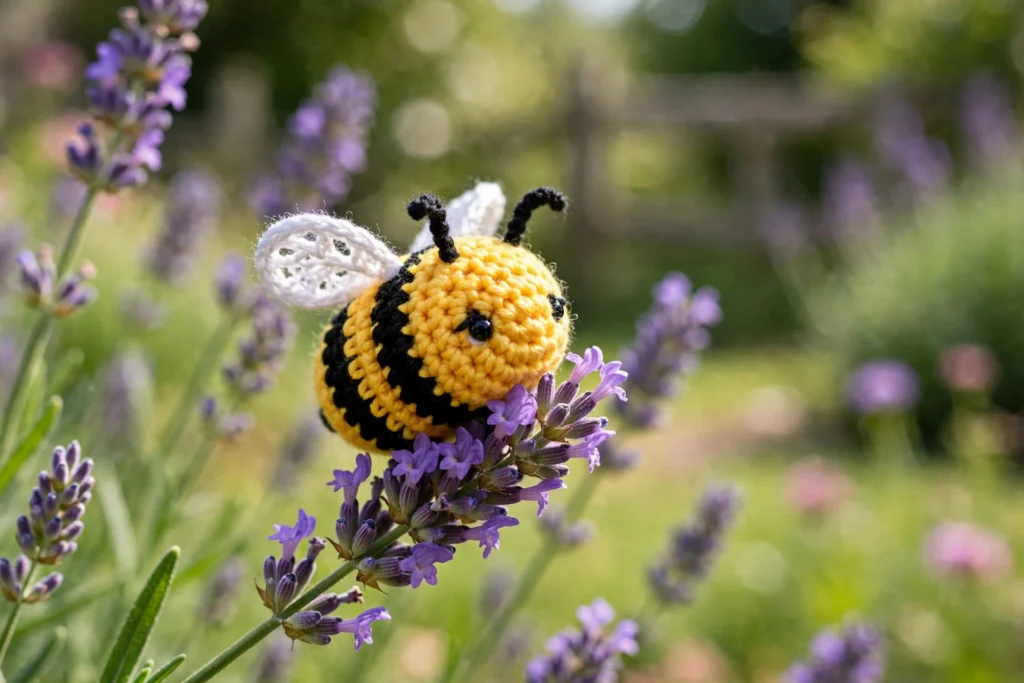
Every garden has workers, and in May they are on shift from dawn. This little bee — round, striped, no taller than your thumb — is the mascot of the garden-party season: an evening’s crochet, a ball of yellow and a scrap of black, and a personality entirely out of proportion to its size.
Jump to section
The reference I work from is Little Crochet Farm’s bumblebee tutorial, written and filmed for beginners, and it is the same steady hand that taught this site its lamb in spring. What follows is their construction with my own notes on stripes and faces, because a bee is two decisions — where the stripes fall and whether it gets a smile — disguised as a ball of yellow yarn.

What you need
Small amounts of yellow and black DK cotton, a scrap of white for wings, a 3 mm hook, stuffing, and safety eyes or black yarn for embroidered ones. Cotton is the bee yarn: it holds the round shape, the stripes stay crisp where acrylic fluffs them, and the finished bee survives being squeezed by small admirers. If amigurumi is new to you, this is the friendliest possible entry — one stitch, worked in a spiral — and our crochet lamb amigurumi from the same teacher’s flock is its natural stablemate.
The body: one spiral, three stripes
The body is a single crochet sphere, begun in yellow with the standard increasing rounds, and the entire character of the bee is decided by the colour changes. Work the face end in yellow first, then place the stripes across the middle and rear — two black bands are classic, three if your bee is small and needs the definition. Change colour at the last yarn-over of the stitch before, so the join steps diagonally rather than showing a seam, and carry the sleeping yarn inside the body where the stuffing will hide it. Stuff firmly before the decreases close: a bee should feel like a plum, not a cushion, because its roundness is the whole joke.
Wings and antennae
The wings are two small white ovals — a chain, a round of doubles, done — sewn at an upward angle behind the stripes, and the angle is everything: level wings read as ears, raised wings read as flight about to happen. The antennae in the reference are short black stalks; at home a French knot on a stub of yarn or two stitches of chain does the same work. Keep them short. Long antennae flop, and a bee with flopped antennae looks tired rather than busy — the one thing a bee must never look is tired.
The face: the one decision to take seriously
Eyes low and wide give a baby bee; eyes higher and closer give a worker. Embroidered French-knot eyes are the under-five-safe choice and lose nothing in charm; safety eyes must go in before the stuffing closes the body, which concentrates the mind wonderfully. A smile is optional and the argument is real: with one, the bee is a toy; without one, it is garden sculpture that also delights children. My house rule — smile for gifts to small people, no smile for bees destined for plant pots and bookshelves — has never once been regretted.
Where a bee earns its keep
A finished bee is infrastructure. On a keyring it makes keys findable in any bag. In a plant pot it marks the herb you keep forgetting is thyme. Strung with companions, bees become the mobile and the bunting-end weights of the garden-party list later this month. And as a gift topper — sewn to a ribbon on a jar of honey — it is possibly the highest charm-per-minute object in all of crochet. Garden company suits it: our crochet butterfly is its meadow-mate, and a bee and a butterfly on the same shelf is spring, filed permanently.
Yarn and care notes
One bee uses so little yarn that the true cost is the face decisions. A 50 g ball of yellow makes a swarm of six or more; black and white come from the scrap bag. Cotton bees wash by hand and dry in an hour on the line, holding their shape; acrylic bees grow gently fuzzy with love, which some households consider an improvement. Sit your finished bee among real flowers for its portrait — our how to crochet a flower guide will provide permanent ones for the shelf — and accept that the first bee is never the last. Bees are herd crochet. You have been warned fairly.
The swarm: stripes and variations
Once one bee exists, the variations arrive uninvited. A bee with three stripes and smaller wings is a worker; with two stripes and a crown of one crochet flower, a queen. Worked in pastel yellow with cream stripes, the bee becomes a spring ornament that no longer claims to be an insect at all. Sleepy bees — eyes embroidered as two small curves — belong on nursery shelves. Make them all if the yarn allows; a swarm on a shelf, each slightly different, is the kind of collection that explains itself to visitors while you put the kettle on.
Frequently asked questions
Is the crochet bee suitable for a total beginner?
Yes — it is one stitch, single crochet, worked in a spiral, with colour changes as the only technique, and the tutorial is paced for first-timers. If you can make a magic ring, you can make a bee by the weekend.
How big is the finished bee?
In DK cotton on a 3 mm hook, about 6–7 cm long — palm-sized, keyring-ready. A finer yarn and smaller hook shrinks it towards charm-bracelet scale; chunkier yarn makes a cushion bee.
Are safety eyes safe for babies?
Properly installed safety eyes are secure for older toddlers, but for under-threes the embroidered French-knot eye is the responsible choice. It takes two minutes, cannot be pulled out, and loses nothing in expression.




