
Crochet Bunting: Triangle Flags for Garden Parties
Crochet bunting in cotton triangles: top-down flags hanging flat, colours that photograph, sizing for every span, and care for years of parties.

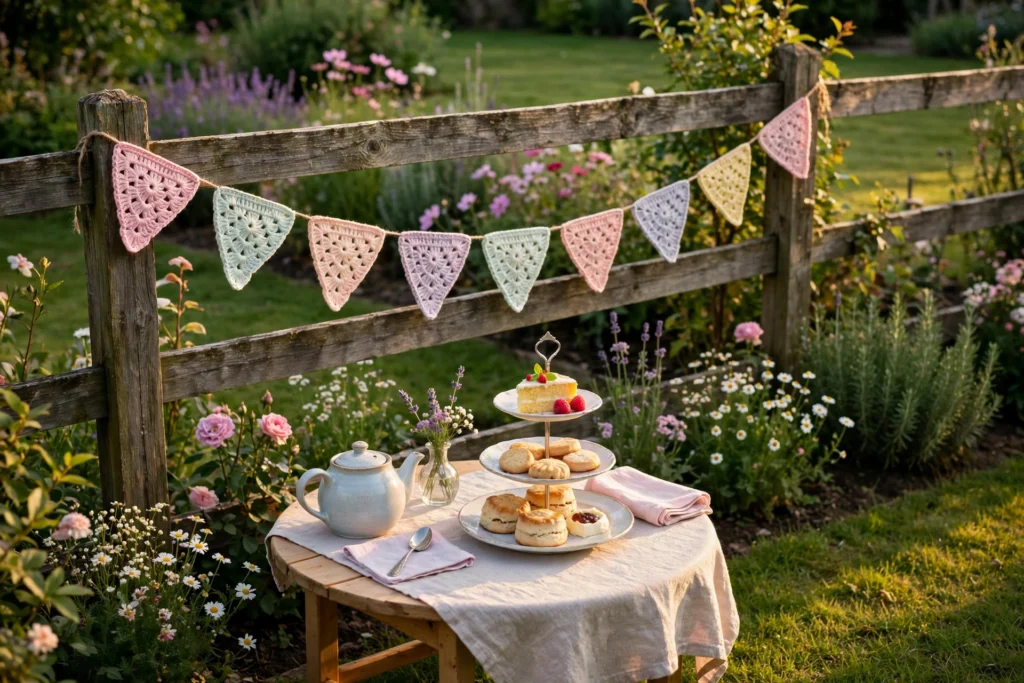
Nothing announces a party like bunting, and nothing survives a British garden party like the crochet kind: rain shrugs off it, wind plays it like an instrument, and it goes back in the drawer afterwards to wait, cheerfully, for the next occasion. Paper bunting is a purchase; crochet bunting is an heirloom that takes four evenings.
Jump to section
The reference I work from is Moara Crochet’s bunting tutorial — classic granny-style triangles on a crocheted chain — because her construction is the sturdy one: flags worked from the top edge down, so the chain that hangs them is structural rather than sewn on afterwards. What follows is that build with my own notes on scale and colour, the two places where bunting projects are won or lost.

What you need
DK cotton in your party’s colours — cotton, again, for weight and weather — a 4 mm hook, and a tape measure longer than your ambitions. Nine to twelve flags dress a fence panel or a table’s length of pergola. The yarn maths is kind: each flag takes roughly 15 g, so this is a stash project wearing a party dress, and the scrap bag is a legitimate colour strategy. If garlands are your love language generally, our crochet heart garland is this project’s February cousin — same chain logic, softer cargo.
The flag: a triangle that behaves
Each flag is worked from its wide top edge downwards, decreasing at both sides, which is what gives crochet bunting its professional secret: the top edge is a straight, stable row that sits flat against the hanging chain instead of curling or cupping. Granny-style clusters keep the flag light and lacy; a solid double-crochet flag is heavier, warmer-looking, and the better choice in a single colour. Whichever you choose, block every flag — pin the three corners, steam, leave overnight. Unblocked triangles curl into elf shoes within a week outdoors; blocked ones stay flags for a decade.
Colour: the decision that photographs
Three systems work and a fourth is chaos. Alternating two colours is the classic and the safest. A gradient — cream through blush to sage, say — is the garden-party version and the one this season is wearing. All one colour in natural cotton is the grown-up’s bunting, texture doing all the talking against green. The chaos option, every flag different from the scrap bag, succeeds only if the flags share a stitch pattern and the chain is one calm colour — the chain is the sentence, the flags are the words, and a noisy chain garbles everything. Decide before flag three; bunting is long enough that a mid-project colour regret compounds.
Stringing and hanging
Crochet the chain longer than the span — sag is not a flaw in bunting, it is the entire aesthetic — and join each flag by working through its top edge as you chain past, or sew flags on afterwards with the chain colour for an invisible finish. Space flags a hand’s width apart. Hang the finished string a day early if you can: cotton relaxes overnight into its natural drape, and you will adjust the sag once, calmly, instead of on a ladder with guests arriving. Outdoors, tie to fences and pergolas with the chain itself; indoors, it dresses a mantel or a bookshelf with exactly the same manners.
Bunting beyond the party
The mistake is putting it away. Crochet bunting earns year-round keep: across a child’s bedroom window, along the greenhouse, over the stall at the summer fête, and — in miniature, six small flags — as the porch decoration that tells the postman this house celebrates things. It is also the natural canopy for everything else this season builds: a table set under bunting, with our crochet picnic blanket doing ground duty, is the garden-party formula complete. And for the full outdoor room, the bunting is project one of our spring garden crochet projects thinking — hang it first, and the garden arranges itself beneath.
Care and storage
Cotton bunting washes in the machine on a gentle cycle inside a pillowcase — the pillowcase is non-negotiable, unless untangling a flag-chain knot is your idea of an evening — and dries flat or on the line it will next decorate. Store it rolled around a cardboard tube rather than folded; creases block out eventually, but rolled bunting comes out party-ready. Check the chain each spring for the one frayed link that outdoor winters cause, because a string repaired in April is invisible and a string repaired mid-party is a story.
Sizing: mini, standard and statement
The flag size sets the bunting’s whole personality. Mini flags, 10 cm across, are for windows, stalls and the porch — quick enough to make a string in two evenings. The standard 18 cm flag dresses fences and pergolas and is the size the reference builds. Statement flags at 25 cm belong to halls, fête stalls and any span over five metres, where standard flags shrink to punctuation. Match the chain’s weight to the cargo: a fine chain under statement flags will stretch its stitches into a permanent wave by the second party. When in doubt, size the flag to be read from where the lemonade is poured.
Frequently asked questions
How many flags do I need?
For a 3-metre span with a gentle sag, nine to twelve flags of about 18 cm across, spaced a hand’s width apart. Measure the span first and work backwards — bunting maths is friendly, but only forwards from a measurement.
What yarn is best for outdoor bunting?
DK cotton, without competition. It holds its blocked shape, shrugs off a shower, and does not stretch under its own weight the way acrylic does by August. Save acrylic bunting for indoors.
My triangles keep curling. What fixes it?
Blocking — pinning each corner and steaming — fixes nine curls in ten. If a flag still cups, its decreases are too tight at the edges; loosen the edge stitches a fraction and block again. Curl is a tension message, not a failure.




