
Crochet Flower Crown: A Garland You Can Wear
A crochet flower crown sized to the real head: a measured chain, flat-sitting flowers in two sizes, and a second life as a wreath afterwards.

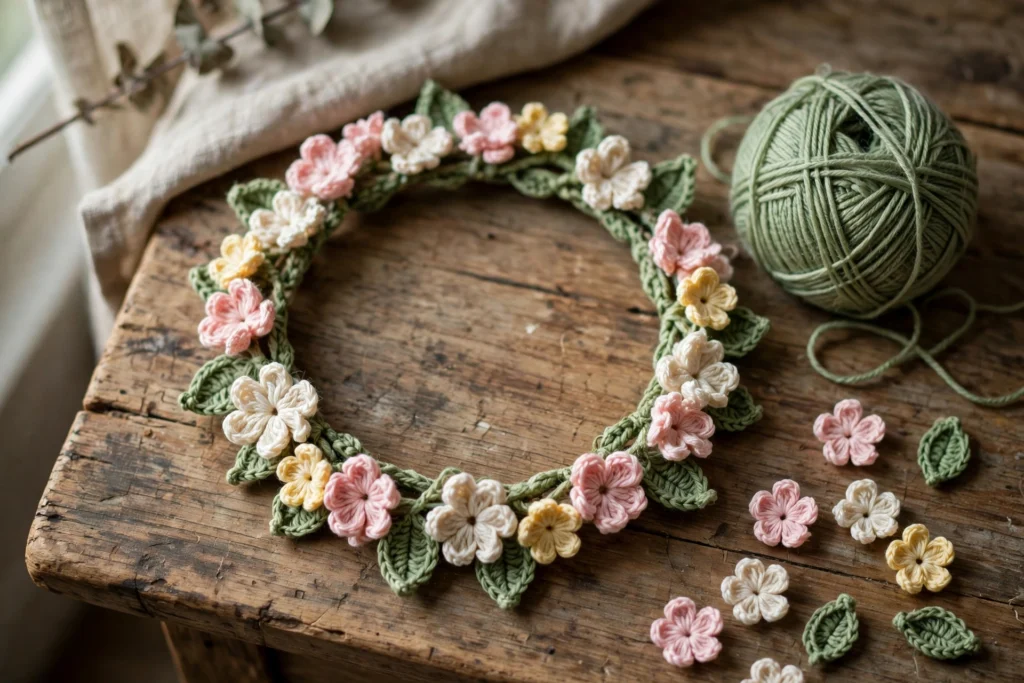
A flower crown asks to be worn for exactly one kind of day — the first warm one, a May Day, a garden wedding, a photograph that will be kept — and crochet makes the version that survives it: flowers that never wilt, in colours no florist stocks, sized to the head that will actually wear it.
Jump to section
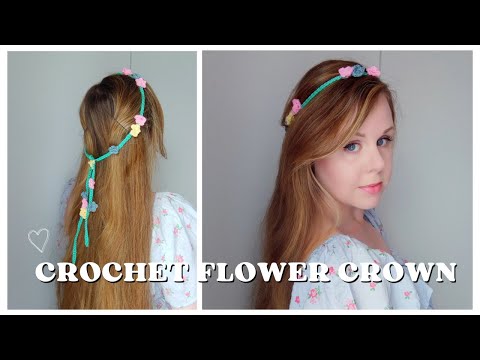
The reference I work from is Selina Veronique’s whimsical flower crown, built on a crocheted chain wreath with the flowers worked and attached along it — a construction that doubles as a headband and a wreath, which matters for sizing. What follows is that build with my notes on flowers, fit and honesty about occasions, because a crown is the one project where enthusiasm must be measured with a tape.
What you need
Fine cotton — a 4-ply or light DK — in green for the chain and leaves, plus your flower colours, a 3 mm hook, and a tape measure. Fine yarn is not fussiness here: a crown is worn against hair and skin, and a chunky crown is a hat with ambitions. The flower colours that read as spring rather than costume are the soft ones — blush, cream, butter, the palest violet — with the green doing the quiet work of making them believable. Our how to crochet a flower guide is the flower library this crown draws on; master the five-petal once and every crown is a variation.
The chain: measure the actual head
The base is a green chain long enough to circle the head with two ties to spare, reinforced with a row of doubles so it lies flat and does not roll. Measure the head that will wear it — crowns are not one-size, and a crown that slides is a necklace by lunchtime. The ties at the back are the design’s kindness: they forgive growth spurts, thick hair and borrowed heads. Work the leaves directly into the base row as you go if you are confident, or make them separately and sew; a leaf every two or three centimetres gives the flowers something to nestle into rather than a bare green wire to sit on.
The flowers: a small cast, well chosen
Seven to eleven flowers dress a crown; more becomes a hat, fewer becomes a headband with ideas. Mix two sizes — one hero flower at the front-centre or becomingly off to one side, the rest smaller — because real flower crowns are composed, not tiled. Our crochet tulip tutorial flowers are too dimensional for a crown, but the daisy family and the simple five-petal rose sit flat and sew flat, which is the whole requirement. Sew each flower through its centre back with the green yarn, twice, and tug-test before the next: a crown in motion — dancing, running for a train of small cousins — is a centrifuge for loose sewing.
Colour stories that work
Blush, cream and butter on sage green is the May crown and matches nearly everything a spring wardrobe contains. All-white flowers on deep green is the bridal version, and it photographs like a heirloom because it will become one. The bold version — poppy red, cornflower blue, marigold — belongs to festivals and May Day poles and should be worn with total commitment or not at all. What never works is the sweetshop mixture, every pastel at equal volume: pick one flower colour to lead, one to support, and let green be the third. Crowns are read at conversational distance, and three voices are a conversation; seven are a crowd.
Wearing, occasions and after
Fit the crown low on the forehead for the festival look, higher and flatter for the wedding-guest version, and pin through the chain into a braid or a bun if the day is windy — two pins, crossed, and it will survive a ceilidh. After the day, the crown’s second life is the wreath the tutorial’s title promises: the same circle, hung on a door or laid around a candle, which is why the chain was built flat. Our crochet daffodil tutorial belongs to this same spring-flower family; a crown made in March of daffodils and remade in May of roses is a household tradition waiting for its second year.
Making ahead and keeping it fresh
A crown rewards the organised: it can be made a fortnight ahead, since nothing in it wilts, but store it flat in a box with tissue between the flowers rather than hung up, where its own weight slowly stretches the chain longer than the head it was measured for. On the morning itself, a light steam — held above a kettle’s spout for seconds, never pressed — wakes the flowers from box-flatness. If a flower works loose mid-season, it sews back in five minutes with the same green yarn; keep a metre of it in the box with the crown and the repair kit travels with the patient. Crowns made this way come out year after year, which is how you can tell the photograph albums of crocheting families: the same crown, on a taller child, every May.
Frequently asked questions
How do I size a flower crown for a child?
Measure around the head where the crown will sit, then make the chain that length plus 15 cm for ties — the ties do the adjusting as the child grows, which is why this construction outlasts a fixed circle by years.
Which flowers sit flattest on a crown?
Simple five-petal flowers and daisies, worked in fine cotton. Anything cupped or dimensional — tulips, full roses — sits proud and makes the crown wobble; save those for stems and vases.
Will a crochet crown survive being worn all day?
Yes, if the flowers are sewn twice through the centre back and the crown is pinned into hair at two points. Cotton keeps its shape through a warm day; the wearer usually wilts before the crown does.




