
Crochet Plant Hanger: Lift Your Plants Towards the Light
A sturdy cotton net with four honest straps that lifts any pot into the light: the crochet plant hanger your windowsill has been waiting for.

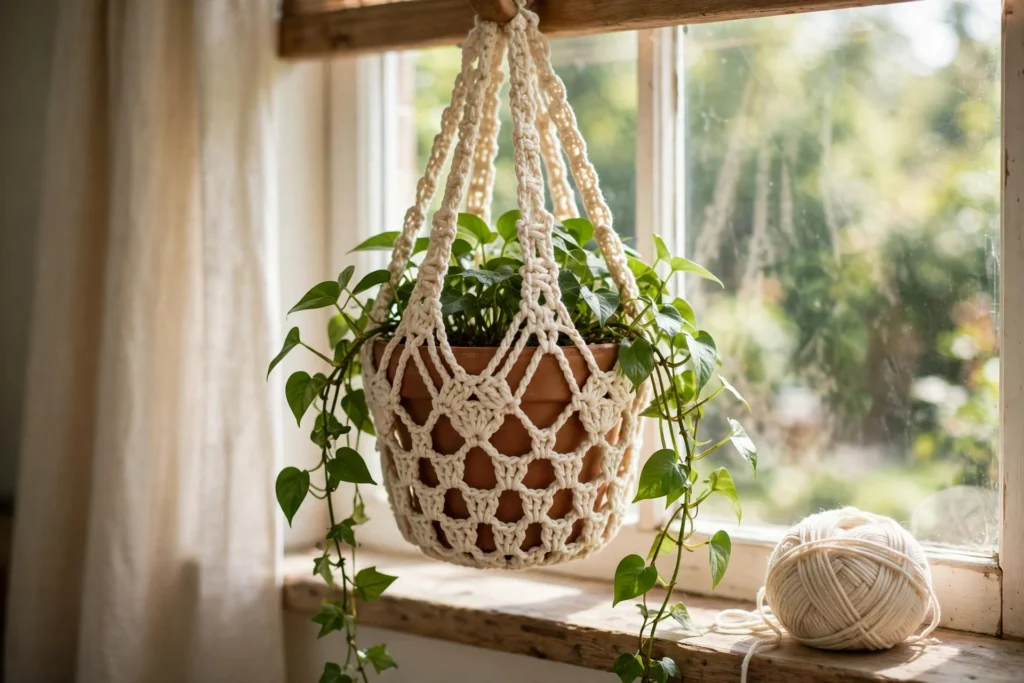
Sometime in February my houseplants start leaning. They have spent the dark months on a windowsill that no longer delivers, and the whole collection tilts towards the glass like an audience. The fix is a crochet plant hanger: ten minutes of height that lifts a pot into the light, off the crowded sill, and out of the cat’s jurisdiction. It is also, not coincidentally, the project that makes visitors ask which shop it came from.
Jump to section
The hanger I make follows You Should Craft’s big bohemian hanging planter, sized for an eight-inch pot and worked in double strands of cotton for strength. What follows is that sturdy construction with my notes on sizing for any pot, the knot-free strap join, and hanging hardware that will not betray you at 3 a.m.

What you need
Sturdy cotton yarn — kitchen cotton is ideal — worked double-stranded, or a single strand of t-shirt yarn; a large hook to suit, around 8 mm for doubled cotton; a wooden or metal ring for the top; and a ceiling or wall hook rated for more than your heaviest watered pot. The pot itself is a supply too: measure it before you start, across the widest point and from base to rim. The yarn logic is the same as our crochet storage basket — cotton, structure, no stretch — except this basket flies.
Sizing for any pot
The hanger is a net built from a base circle and rising straps, and it fits a pot when the base circle matches the pot’s bottom and the straps meet the rim at a slight inward angle. Start the base with a magic ring and increase evenly until the circle is the diameter of the pot’s base, then work one round into the back loops to turn the corner — that turned edge is what grips. Too small and the pot perches dangerously; too big and it sags into a shopping bag. Test with the actual pot after the turn round, not at the end: gravity is a strict editor and it charges by the rewrite.
Building the net and straps
From the turned base, the body rises in an open mesh — chains arcing between single crochet anchors — which stretches to cradle the pot’s belly while using a fraction of the yarn a solid wall would. Three or four mesh rounds suit most pots. Then divide the rim into four equal strap points and work each strap as a long chain or a narrow strip of single crochet, all four exactly the same length; unequal straps are the only way this project can truly fail, and a row counter or a piece of tape per strap keeps them honest. Gather all four through the ring, secure with a wrapping of yarn over the joins, and the hanger is structurally done. The mesh-and-strap engineering echoes our textured crochet patterns guide in one respect only: open stitchwork, chosen deliberately, does a job solid fabric cannot.
Hanging it safely
A watered eight-inch pot is heavier than your optimism — weigh it once and respect the number. Use a hook screwed into a joist or a proper wall anchor, never a suction cup, never a picture nail. Hang the planter, then stand back and check the pot sits level and the straps share the load evenly; a lopsided hanger is a strap-length error, fixed by adjusting the wrap at the ring, not by hope. Keep drip trays inside the pot or accept that watering day means taking the plant down — which, honestly, is also how the plant gets inspected, turned and admired, so I have stopped calling it a chore.
Styling: one hanger is a trio waiting
A single hanging plant tidies a windowsill; three at staggered heights turn a dull corner into the room’s photograph. Vary pot sizes down the trio, keep the yarn one colour, and let the plants differ — a trailing pothos longest, something upright in the middle, a small fern or string of pearls in the shortest. This is the vertical chapter of the same refresh our crochet home refresh projects listicle began in January: containers, softening, and now height. In late winter the light argument wins every time, but by spring it is simply the prettiest wall in the house.
Care, indoors and out
Cotton hangers wash like tea towels — forty degrees, air-dry, reshape the base circle while damp. Outdoors, expect one good season before sun and weather fade and tire the fibres, and bring hangers in for winter so the ring does not rust against wet yarn. Check straps each spring with a firm tug at each join; a hanger retired at the first fray is a plant saved. Make a spare strap set while the pattern is in your hands and future-you, mid-rehang, will be extremely grateful.
Small pots and trailing plants
The same net scales down gracefully: for a ten-centimetre pot, work the base to match, take two mesh rounds instead of four, and shorten the straps so the plant hangs high and proud. Trailing plants are the hanger’s best friends — pothos, string of pearls, small ivies — because the stems thread through the mesh and the whole object becomes one green sculpture. Keep one hanger empty by the sink if you can; it is the best air-plant and herb-drying rack I have ever accidentally invented.
Frequently asked questions
How strong is a crochet plant hanger?
Doubled cotton worked on a snug hook holds a watered eight-inch pot comfortably — the yarn is rarely the weak point. The hook in the ceiling is: always fix into a joist or use a rated anchor.
What yarn should I avoid?
Acrylic and wool both stretch under sustained load, so the pot slowly descends over a season. Cotton or t-shirt yarn barely creeps, which is why every serious hanger pattern specifies them.
Can I size it down for small pots?
Yes — the formula is the pot, not the pattern. Match the base circle to the pot’s base, turn, mesh until the belly is cradled, and keep all four straps scrupulously equal.




