
Crochet Rag Rug: A Round Rug from Old T-Shirts
Old t-shirts cut into yarn and crocheted into a flat round rug: the rag rug that turns the late-winter clear-out into something useful underfoot.

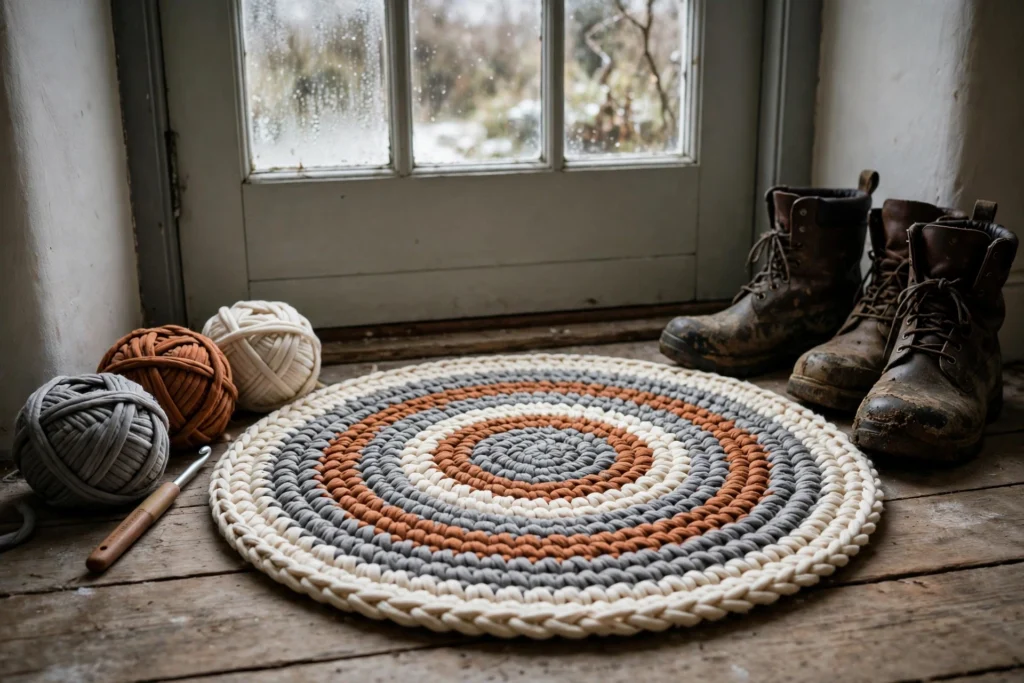
The late-winter clear-out has a sound: drawers opening, wardrobes exhaling, and the soft thud of t-shirts whose concerts nobody remembers landing in the charity pile. This year some of mine took a third route — cut into yarn and crocheted into a round rag rug that now lives by the back door, catching mud season one footprint at a time. It is the most useful thing I have ever made from laundry.
Jump to section
The method I follow is Meladora’s Creations’ t-shirt yarn rug tutorial, which is mostly a masterclass in keeping a growing circle flat. What follows is that increase discipline with my notes on cutting yarn from shirts, joining colours without knots the size of plums, and the lie-flat troubleshooting every rug maker eventually needs.

What you need
Six to ten worn-out t-shirts in colours that can stand to be neighbours, sharp fabric scissors or a rotary cutter, and a big hook — 10 to 12 mm — because t-shirt yarn is chunky and your hands will vote against anything smaller. A door-sized rug of about ninety centimetres takes roughly a kilo of shirt yarn. The fabric-yarn family also feeds our one-skein crochet projects philosophy in reverse: instead of one ball, one project, this is many shirts, one rug, nothing wasted.
Making yarn from shirts
Cut away the hem and the top of the shirt below the arms, leaving a tube of jersey. Fold the tube almost in half, leaving a finger’s width offset, and cut strips about three centimetres wide, stopping before the fold. Open it out and cut diagonally between the strips so the whole tube becomes one continuous spiral of yarn — the diagonal cut is the entire trick, and the first shirt is your rehearsal, so sacrifice the worst one. Pull each length firmly hand over hand and the edges curl inward into a smooth cord. Wind into balls and sort by colour; a rug planned in stripes behaves, a rug improvised from the pile tells on itself.
The flat circle: the only maths that matters
Start with a magic ring and six single crochet. The law of the flat circle is simple: increases must grow with the rounds — double every stitch in round two, then add one plain stitch between increases each new round: increase every second stitch, then every third, then every fourth. Work in a spiral with a marker in the first stitch of each round. T-shirt yarn is forgiving of a stitch count that is off by one or two, because the fabric is thick enough to absorb small sins — but it is not forgiving of whole rounds without increases, which is how rugs become sombreros, nor of increases everywhere, which is how they become lettuce. Lay the work flat on the floor every two rounds and let it confess early.
Colour planning and invisible joins
Stripes of widening width look richer than confetti: work each colour until its ball ends, in blocks, and let the circle’s growth make each band naturally broader than the last. Join new yarn by overlapping the last ten centimetres of old and new inside the stitches for several stitches — jersey grips jersey and the join disappears, no knots, no tails poking through to trip on. Keep one colour as your constant — mine is grey marl, from a decade of identical free conference shirts — and let it reappear between bolder bands to calm the whole rug down. The joining discipline is borrowed from our crochet granny square blanket, where the same rule applies: planned colour rhythm beats random abundance every time.
Troubleshooting: cups, waves and pride
If the edge cups upward, you are short of increases — add an extra increase round, evenly spaced. If the edge ripples like a pie crust, you have too many — work a plain round or two and let the circle catch up. If the whole rug domes gently in the middle, blocking will not save a structural dome, but weight and time will flatten a mild one; walk on it for a week before performing surgery. And if a band of colour displeases you once seen from standing height — the only honest viewing distance — frogging t-shirt yarn is quick and oddly satisfying, so fix it now rather than apologising to the rug daily, as I did for one memorable winter before relenting.
Living with a rag rug
Shake it outside weekly; machine-wash cold when mud season peaks, and dry it flat or over a rail so it keeps its circle. A rug pad or a few dots of hot glue on the underside stop it travelling on hard floors. Expect it to outlast the shirts’ second lives by years: jersey is stubborn stuff, and a rug that began as laundry has nothing left to prove. Mine has already outlived the boots it was made to serve, and it improves — softer, flatter, more itself — with every wash, which is more than I can say for most of the wardrobe it came from.
Beyond the back door
Once the flat circle is in your hands, the rug family expands quickly: an oval for the bath (start with a chain instead of a ring and increase at the ends), a runner for the hall in three long colour blocks, and bath mats in pure cotton jersey that drink water properly. The generous cousin of all of them is our easy chunky crochet blanket — the same thick-yarn, big-hook, watch-it-grow satisfaction, moved from floor to sofa. Start with the round door rug, though: it teaches the increase law with the fewest stitches and the fastest visible reward, and every other shape is a variation on its theme.
Frequently asked questions
How many t-shirts make one rug?
Six to ten adult shirts for a ninety-centimetre round rug, depending on shirt size and how wide you cut the strips. Weigh your yarn if you can — about a kilo is the comfortable target.
Why is my rug curling into a bowl?
Too few increases for the rounds worked. Add an evenly spaced increase round, lay it flat, and check again two rounds later; t-shirt yarn responds fast to corrected maths.
Can I machine-wash a t-shirt yarn rug?
Yes — cold, gentle, and dry flat. The yarn was t-shirts in its first life, after all. Avoid hot water, which can shrink the jersey unevenly and pucker the circle.




