
Crochet Ice Cream: The Scoop That Never Melts
The crochet ice cream cone survives heatwaves and toddlers: a textured waffle cone, a soft scoop and the drip edge that makes it read as dessert.

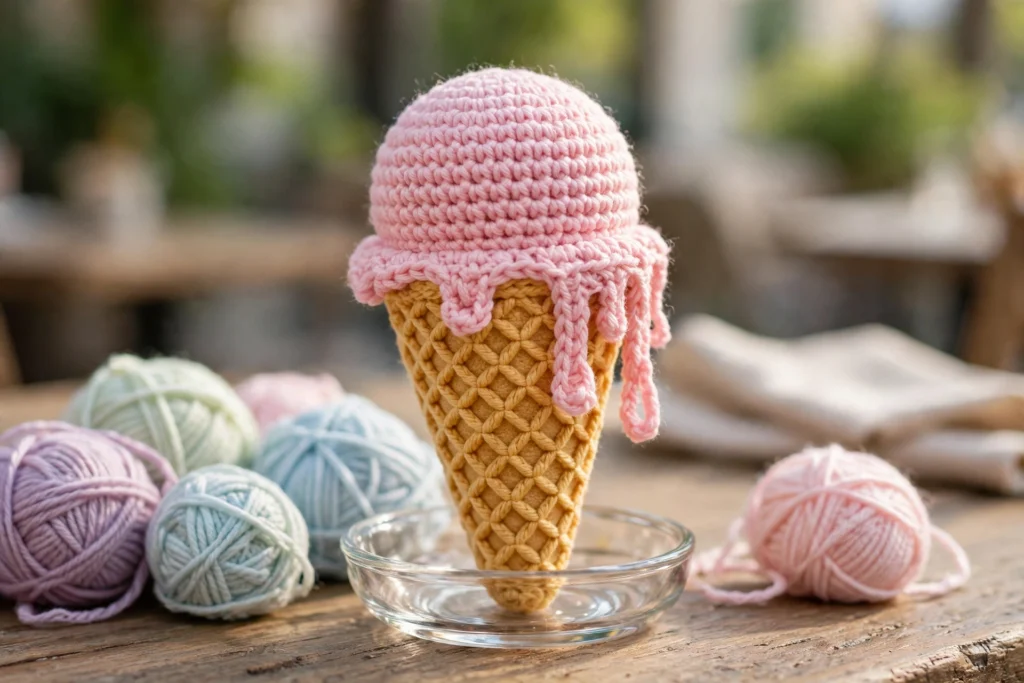
Here is the only ice cream that survives a heatwave, a car journey and a toddler: the crochet ice cream cone. It never melts, never drips down a wrist, and never costs four pounds a scoop — and as a make it is a small masterclass in amigurumi, because the scoop teaches shaping and the cone teaches texture, in about the time a real 99 takes to eat.
Jump to section
The reference is Crochet Crafts By Janna’s ice cream cone tutorial, billed in its title as quick and easy amigurumi, and the billing is fair: one scoop, one cone, no sewing marathon. What follows is that build with my own notes on the drip edge — the detail that makes the difference between a ball on a triangle and an ice cream you can recognise across a room — plus flavours, sprinkles and the keyring conversion that turns this into the summer’s most-gifted little make.

What you need
Scraps, mostly. A cone colour — light tan or golden brown — a scoop colour of your choosing, a hook a size smaller than the yarn’s band suggests so the stuffing never grins through, a handful of stuffing, and a yarn needle. Optional but transformative: a few grams of a second scoop colour for the two-scoop version, tiny beads or French-knot patience for sprinkles, and a split ring if yours is becoming a keyring. The whole cone uses so little yarn that our crochet strawberry and this one together still barely dent a ball — summer’s small makes are scrap’s finest hour.
The cone: texture is the flavour
A cone is not a brown triangle. The tutorial works the cone so its surface carries the waffle’s suggestion — worked in a stitch pattern with enough relief that the eye reads grid and crunch before it reads yarn. Start at the point and increase evenly; a cone that widens too fast becomes a party hat, too slowly becomes a carrot, and both errors are visible by the halfway round, so count. The rim matters: the top edge of a real cone is a clean rolled lip, and a final round worked firmly gives your scoop something to sit on. Keep the cone unstuffed or barely stuffed — it should feel crisp, not plump, and a hard cone under a soft scoop is exactly the contrast of the real thing.
The scoop and the drip edge
The scoop begins as amigurumi’s standard sphere, but the genius of the design is its bottom edge: instead of closing the sphere plainly, the last rounds wave — a drip edge, worked as uneven scallops so the scoop appears to be melting down over the cone in four or five drips of different lengths. This is the whole ballgame. A plain ball reads as a ball; a ball with drips reads as ice cream from across the room, in any colour, at any size. Keep the drips irregular — real drips never match — and resist stuffing the scoop to drum-tightness: a scoop is soft-serve’s firm cousin, full but with a little give. The shaping discipline is the same one our crochet bee amigurumi relies on: even increases, invisible decreases, stuffing added in wisps.
Flavours: the colour chart
Vanilla is cream with a whisper of yellow. Strawberry is the pink that batch thirteen’s strawberry season made famous. Mint choc chip is mint green with brown flecks worked — or embroidered — after. Chocolate is mid-brown, and it is the flavour where the drip edge matters most, because brown on tan is the lowest-contrast pairing and the silhouette must do the work alone. Blue raspberry exists in no orchard and every childhood: bright turquoise, unapologetic. Matcha is the grown-up: sage-adjacent, calm, photogenic. Two-scoop versions stack a smaller second scoop before the cone, and the rule is the parlour’s rule — one pale, one strong, never two neons fighting. A cherry on top, five millimetres of red sphere with a brown stem stitch, finishes the sundae register and costs three minutes.
Sprinkles, sauce and the finishing maths
Sprinkles are short straight stitches in contrast colours, scattered with a gambler’s hand — clustered sprinkles look like a rash; sparse ones look deliberate. Ten to fourteen per scoop is the sweet spot, angled randomly, never in rows. Sauce is a second drip edge in a darker or glossier yarn worked over the first: chocolate sauce on vanilla is the classic, and it doubles the melting illusion. If the cone is for a child under three, embroider everything and skip beads entirely; if it is for a bag charm, sew the scoop to the cone twice — keyrings live rough lives, and a scoop lost to a handbag’s depths is a small tragedy. Our crochet lamb amigurumi notes carry the same child-safety rules for eyes and attachments.
Sizes and second lives
The pattern as written makes a palm-sized cone. Halve the rounds’ counts with finer yarn and you have a keyring or a pram charm; double up with chunky yarn and two strands and the cone becomes a doorstop or a cushion with opinions. Teachers receive these well at term’s end, ice-cream sellers receive them better, and a cone in a child’s play kitchen will be sold to you, at imaginary prices, for years.
Care and keeping
Spot-clean first; these are small enough that a full wash is rarely needed. If a wash happens, cool water, a gentle squeeze, and drying on a mug so the cone keeps its point and the scoop its dome. Store flavours together in a basket rather than a drawer — they are display pieces that happen to be soft, and the drawer is where good amigurumi goes to be forgotten. Check keyring stitching each summer; thread tires before yarn does.
Frequently asked questions
How long does a crochet ice cream cone take?
Around an hour for the first one, including the drip edge. A production line of scoops in every flavour — the sensible approach — runs at about forty minutes a cone once the cone stitch pattern is memorised.
Is it suitable for beginners?
Yes, as a second or third amigurumi project. You need single crochet, increases and invisible decreases; the cone’s textured stitch is explained stitch by stitch in the tutorial and becomes rhythm within one cone.
What size is the finished cone?
In DK yarn, roughly twelve centimetres tall — true cone size. Finer yarn shrinks it to keyring scale; chunky yarn makes the cushion version. The proportions hold at every size because the shaping is counted, not measured.




