Daisy Nails: Five Dots, One Toothpick, a Whole Meadow
Daisy nails are five white dots dragged to a centre around one yellow heart: the beginner design that turns any base colour into a meadow too.

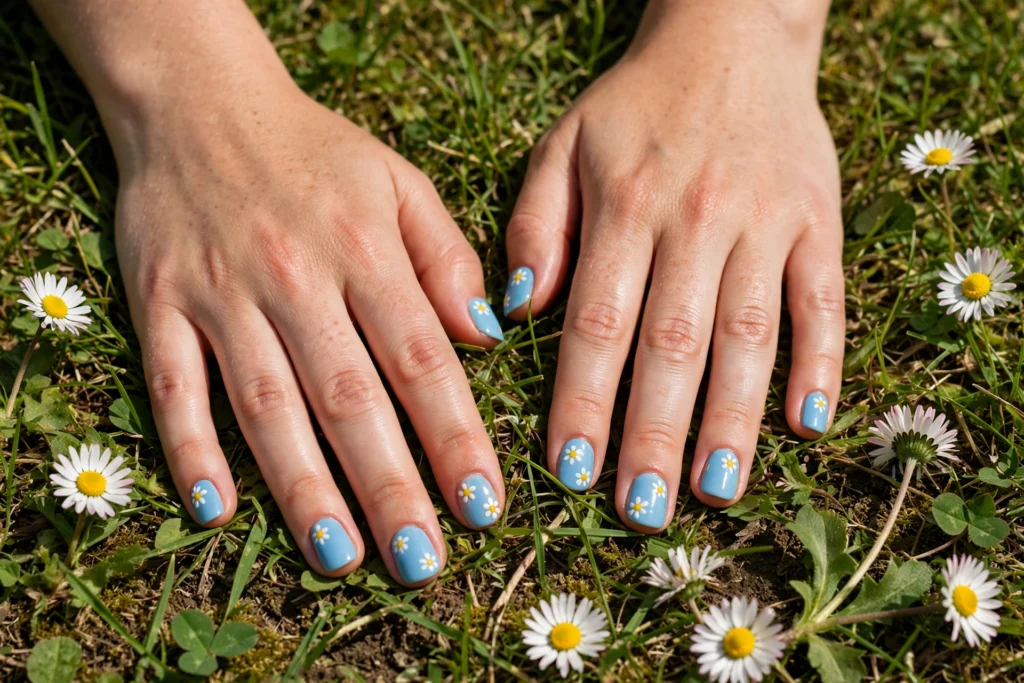
The daisy is the only flower you can paint with a toothpick and five dots, and it has been the gateway design of nail art for thirty years for exactly that reason: five white petals around one yellow heart, drawable by anyone, recognisable by everyone. Daisy nails are the design beginners succeed at first and experts never quite retire — the little white flowers that turn a plain colour into a meadow.
Jump to section
The tutorial I work from is Little Works of Art By Jamie Leigh’s easy daisy tutorial — easy by its title, and structured as a true beginner build — and the method is the dot-petal classic: petals placed as five dots pulled gently towards a centre, rather than painted as shapes. What follows is that method with my own notes on bases (the daisy only works on contrast), spacing, and the three arrangements — scattered, chained and French — that carry the design from cute to genuinely chic.

What you need
A base colour with courage — the daisy is white and yellow, so the base must not be either — plus white polish, a yellow or gold for the hearts, and a dotting tool or toothpick in two sizes. The base is the design’s first decision: sky blue makes a field, navy makes the daisies glow like a night garden, black turns them into a fashion print, and a soft sky blue makes the prettiest meadow of the season. Our earlier spring floral nail art painted roses and blossoms freehand; daisies are the same garden taught to beginners — dots, not brushstrokes.
The five-dot flower
The method in full: dip the larger dotting tool in white, place five dots in a circle — not touching, not strangers — then, while the dots are wet, drag each one slightly towards the centre with the toothpick’s point, which stretches the dot into a petal with a pointed inner end. The yellow heart goes in last, one small dot at the centre, once the petals have settled. Petal count is the forgiving part: four reads as a blossom, five is the true daisy, six crowds a small nail. Work one nail completely before moving on, and vary each flower’s rotation — daisies that all point the same way look printed, and printed is the one thing this design should never look. Keep the white polish at painting consistency: too thin and the petals go translucent against a dark base; too thick and the dragging tears.
Arrangements: scatter, chain, French
The scatter is the classic — flowers at random addresses across the nail, different sizes, one escaping over the edge, which is the design’s signature move: a daisy cut by the nail’s edge looks grown, not placed. The chain links small daisies along one side of the nail in a vine, formal enough for weddings when the base is sheer. The daisy French puts a single row of tiny flowers along the tip’s smile line over a clear or milky base — the quietest version, and the one that survives offices. Two accent nails scattered, eight nails plain base colour, is the arrangement most people land on by their second set: the meadow, rationed. Whatever the arrangement, leave negative space — a nail paved edge-to-edge with daisies reads as wallpaper, and wallpaper is a wall’s job.
Colour stories beyond the classic
White petals with yellow hearts is canon, but the construction accepts any palette. Pink petals with white hearts on a green base is the strawberry-blossom register. All-white daisies — white petals, white hearts a gloss different from the matte petals — on a nude base is the bridal whisper version. Black petals with gold hearts on cream is the fashion one, worn by people who say they do not do cute. And the daisy chain in rainbow petal colours on a white base is pure festival, a direct neighbour of our festival nail designs. The rule underneath all of them: petals, heart and base must be three distinguishable values — light, bright, deep in some order — or the flower dissolves at arm’s length.
Short nails and children
Short nails are daisy country: one flower per nail, scaled down, petals as four dots instead of five, hearts as pinpoints. The design forgives shortness because the flower itself is small change. For children — the design’s second great audience — use the peel-off or water-based polishes, make the flowers enormous by nail standards, and expect masterpieces of asymmetry; a seven-year-old’s daisy chain is the design in its natural state, and steadiness is not among its virtues or its requirements. Seal adult sets with gloss; the petals’ slight relief catches light like the real flower’s centre, and matte top coat flattens exactly that pleasure.
Wear and keeping
Dot designs wear well because there is little raised area to chip — the hearts go first, being smallest and most central to knocks, and a heart is a five-second repair with a toothpick. Re-gloss at day three to keep the petals bright against the base; whites dull by absorbing the week’s colours, and the top coat is their shield. Removal is unremarkable. If a set delights you, photograph it in daylight before day four: daisy nails are at their most meadow-like while the white is still white.
Frequently asked questions
Can a complete beginner paint daisy nails?
Yes — this is the beginner design. If you can place a dot, you can make the flower: five dots, a drag towards the centre, one yellow heart. The first flower takes a minute; the tenth takes seconds.
What base colour works best under daisies?
Anything with contrast against white and yellow: sky blue, navy, black, mint or coral. Avoid white, cream and pale yellow bases — the flower needs a field to grow in.
How do I stop the petals looking like blobs?
Drag each wet dot towards the centre with a toothpick point — the drag makes the petal shape. Undragged dots read as polka dots with ambition; the pull is the whole technique.