Emerald Green Nails: The Jewel-Tone Party Shade
Emerald is Christmas after dark: a jewel-deep green built in translucent layers for gemstone depth, plus the holly accent for Christmas week.

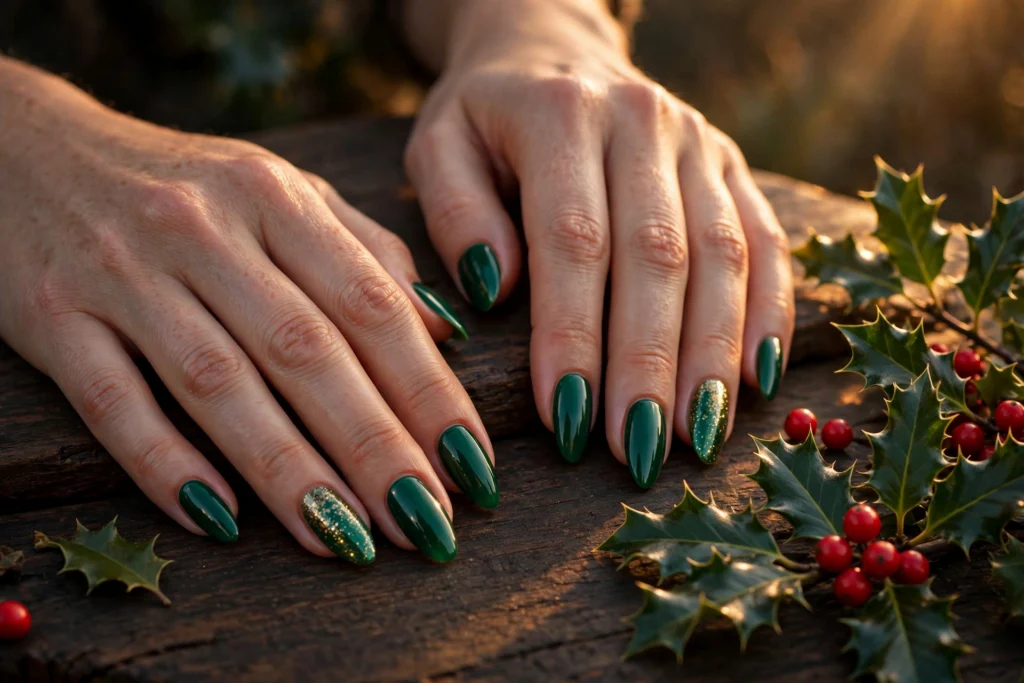
If red is Christmas being loud, emerald is Christmas after dark: jewel-deep, glossy, and expensive-looking in a way that survives into January without anyone calling it a costume. It is also the party shade I recommend to people who think they cannot wear colour, because a green this deep behaves like a neutral — it goes with black dresses, gold jewellery and every coat I own.
Jump to section
The reference for this post is RoseDIY13’s emerald video, which does something most of us never think of: mixing emerald green gel from a jelly nude base to get that lit-from-within depth, rather than painting a flat green and hoping. Below is that layered-depth approach, plus the straight-bottle route for regular polish users, and the holly accent that turns the shade into a design when you want one.

Why emerald reads expensive
Emerald sits at the exact point where green is richest: darker than grass, brighter than forest, with enough blue in it to look like a gemstone rather than a leaf. Under evening light a glossy emerald manicure does what actual emeralds do — it holds dark edges and flashes bright in the middle. That depth is also why it flatters such a range of skin tones; the blue undertone stops it clashing with either warm or cool complexions. It belongs to the same jewel family as the oxbloods and aubergines in our winter nail ideas collection, and it is the one I would pick if a whole season allowed only one bottle.
Getting the depth: layered jelly versus one flat coat
The video’s method — and the one that produces the photograph above — builds the colour in translucent layers. Start with a jelly nude or a very sheer green, cure, then add thin coats of green jelly, curing between each, until the depth arrives. Because each layer is translucent, light travels into the colour and back out, which is exactly the gemstone effect. With regular polish, approximate it: use a green that applies slightly sheer rather than chalky-opaque, and commit to three thin coats instead of two thick ones. Thick coats of dark polish are the number one cause of wrinkling, bubbling and that gummy, never-quite-dry feeling, so thin coats are doing double duty here.
The holly accent (optional, lovely)
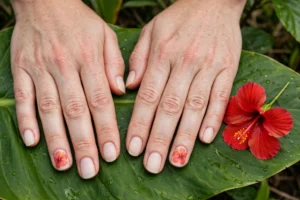
Plain emerald is a complete look, but for Christmas week itself a holly accent on one nail per hand earns its keep: two small green leaf shapes — darker than the base or picked out in gold — with two or three tiny red dots clustered as berries. Keep it small and set it near the cuticle corner of the ring finger, where it reads as jewellery rather than a picture. A dotting tool or the end of a hair grip makes the berries; a striping brush makes the leaves with two curved strokes each. If detailed accents are your thing generally, the magnetic shimmer in our velvet nails tutorial layers beautifully under an emerald jelly, too.
Shape, length and finish
Emerald is flexible about shape but opinionated about finish. Almond and oval shapes make it elegant; short squoval nails make it modern and are my pick for anyone typing through December. What it will not tolerate is a tired finish: matte emerald goes chalky and reads as craft paint, so keep it high-gloss and refresh the top coat every few days. Stiletto lengths push it toward fancy dress — fun if intended, startling if not. One practical note: deep greens can faintly stain the nail plate, so the base coat is not optional with this shade.
What to wear it with
Emerald has a gift for making other colours behave. Against black it is the colour itself that glows, the classic evening arrangement. Against cream and camel it turns preppy and daytime, especially on shorter nails. Gold jewellery doubles down on the jewel effect — the set in the photograph carries a fine gold shimmer on the accent nails for exactly this reason — while silver cools it into something more modern and architectural. The one pairing to handle carefully is red clothing: emerald and scarlet together are unmistakably Christmas, which is glorious on the 24th and a lot on the 12th. If you are wearing the shade all month, neutral outfits let it rotate through festive and ordinary weeks without ever looking like a costume that outstayed its welcome.
A note on green and skin tone
If a green has ever made your hands look washed out, the shade was too yellow. Emerald’s blue base is precisely what prevents that, and it is also why the colour photographs so faithfully — what you see in the bottle is what survives the camera flash at midnight. Very fair hands gain contrast from it, deep skin tones gain richness, and the narrow band of people who cannot wear green at all usually turn out to mean grass green. Try emerald once, in gloss, before ruling the whole colour family out.
Frequently asked questions
What is the difference between emerald and forest green nails?
Emerald is brighter and bluer, with a jewel-like clarity; forest green is darker, murkier and more yellow-brown. If the bottle looks like a gemstone in the light, it is emerald; if it looks like deep woodland, it is forest.
Does emerald green suit short nails?
Yes — it is one of the best dark shades for short nails because the colour is rich enough to look deliberate at any length. Keep the edges neatly rounded or squoval and the gloss high.
How do I stop dark green polish staining my nails?
Always use a base coat, and if staining has already happened, a gentle buff and a week of nude polish usually grows it out. The layered jelly method also helps, since the first layer touching the nail is nearly clear. For a pattern-based take on the same family of deep, glossy finishes, see our tortoiseshell nails tutorial.