
Crochet Sunflower: The Flower That Refuses to Wilt
A crochet sunflower stands in the vase in January with the face it had in June: two circles, two rounds of petals and a wired green stem too.

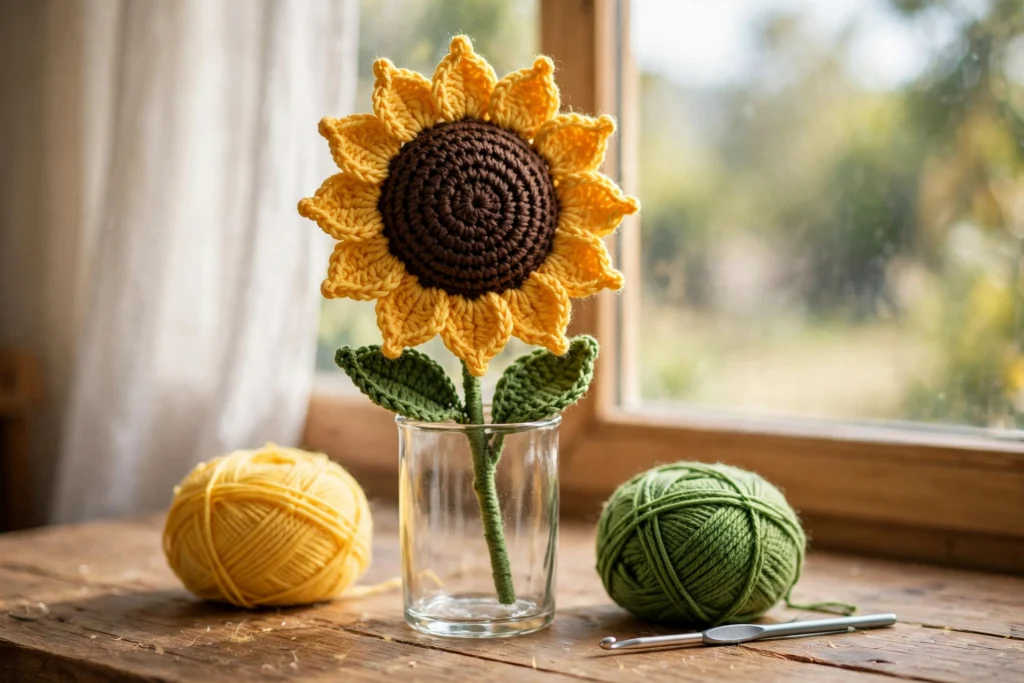
Every real sunflower in the garden is a countdown — glorious for a fortnight, then nodding, seeding and gone. The crochet sunflower refuses the countdown. It stands in the vase in January with exactly the face it had in June, and it is the single most saved flower in the summer crochet world for one simple reason: it looks impossible and is made from two circles and a row of petals.
Jump to section
The tutorial I work from is Lingzhi Handmade’s sunflower bouquet tutorial — beginner friendly by its own title, and honest about it: the flower is built flat, petal by petal, then given a stem so it can stand in a bouquet rather than live only as an appliqué. What follows is that construction with my own notes on scale, colour and the three ways to finish the back, because a sunflower’s back is where home-made ones give themselves away.

What you need
The list is short and mostly scrap-friendly: a dark brown for the centre, a golden yellow for the petals, green for the stem and leaf, a hook that makes the stitches dense enough to hold stuffing out of sight, a short length of florist wire or a wooden skewer for the stem, and a pinch of stuffing if you want the centre pillowy rather than flat. Cotton yarn earns its place here — acrylic sunflowers fuzz at the petal tips within a season of dust, while cotton keeps the silhouette crisp. If your flower is headed for a crochet flower crown, skip the wire and stem entirely and make the flat version from the start.
The centre: a seed head, not a brown disc
The centre is worked as a flat circle in dark brown, and the tutorial’s quiet trick is texture: the seed head reads as seeds because the stitches are worked to sit slightly raised, in two tones if you have them — a near-black brown at the very middle, a warmer chestnut at the rim. Real seed heads spiral, and while nobody sane crochets a true Fibonacci spiral into a coaster-sized flower, alternating the two browns in rings fakes the spiral well enough that the eye believes it. Keep the circle genuinely flat: a centre that domes before stuffing will dome twice as much after, and the flower tips from sunflower towards coneflower. Count your increases out loud. Every sunflower that has ever looked drunk had a miscounted centre ring.
Petals: two rounds, pointed, and more of them than you think
Petals are worked directly into the centre’s edge, each one a small pointed leaf shape built in a single pass — out along one side, a point at the tip, back down the other. The number matters more than the size: a ring of twelve petals looks like a child’s drawing, while eighteen to twenty-two, slightly overlapping, reads as the real flower’s abundance. The tutorial builds the petals in two rounds — a shorter back layer and the full front layer — and that layering is the difference between a sunflower and a daisy that happens to be yellow. Stagger the front petals so each one sits over the join of two behind it, and the flower gains the depth that photographs so well. Our crochet lavender sprigs use the same wired-stem finish, so a mixed vase of the two is an easy next step.
The stem and the leaf
A bouquet sunflower needs a stem that behaves like a stem. The wire goes in first, wrapped or crocheted over in green until no metal shows, stiff enough to hold the head upright in a tall vase but bendable for arranging. The leaf is the petal shape scaled up and worked in green, attached a third of the way down — attach it at the top and the flower looks strangled; a third down is where real sunflowers put theirs. For a flat appliqué version — the one for bags, hats and cushion fronts — omit wire and stem, sew the flower flat, and add a second plain brown circle behind as a backing so no floats or knots show against fabric.
Colour, honestly
Golden yellow is the headline, but the sunflower family is wider than the emoji. A burnt-orange petal with the same brown centre reads as the late-summer varieties and looks superb in autumn arrangements; pale lemon petals belong to the Italian White sunflower and suit spring better than June. What does not work is a yellow centre: the flower’s whole drama is the dark seed head against the bright ray, and a light centre collapses it into a generic daisy. The same warning lives in our spring garden crochet projects — contrast first, colour second. If you gift one flower, gift the classic. Experiments are for the second stem.
Making a bunch that looks arranged, not accumulated
Three stems are a posy; five are a bunch; seven are a statement. Vary the head sizes by one hook size up and down rather than by changing the pattern — the family resemblance stays, the monotony goes. Cut the stems at three different lengths and bind them with twine or a ribbon scrap at two points, never one: a single binding lets the heads swivel like sunflowers on a roundabout.
Care and keeping
Cotton sunflowers ask for almost nothing: a shake outside now and then, a cool hand-wash if the petals grey, and drying flat with the petals finger-pressed back into place. Acrylic versions can be freshened with a garment steamer held well back — too close and the petal tips curl permanently, which is either a disaster or a new variety, depending on your temperament. Store wired stems upright or flat, never folded into a drawer: a creased petal keeps its crease like a grudge.
Frequently asked questions
How long does one crochet sunflower take?
About an hour for the first, forty minutes once the petal rhythm is in your hands. A bunch of five is a comfortable evening’s work with the stems wired the following night.
What yarn weight works best?
DK or light worsted cotton gives a flower head around ten centimetres across — vase scale. Chunky yarn makes a cushion-sized sunflower; fine 4-ply makes brooch scale. Match the hook to a dense stitch, not the ball band.
Can beginners really make this?
Yes — it is circles and one repeated petal. If you can increase evenly and count to twenty-two, you can make the flower. The stem is the only fiddly part, and the flat appliqué version skips it entirely.




